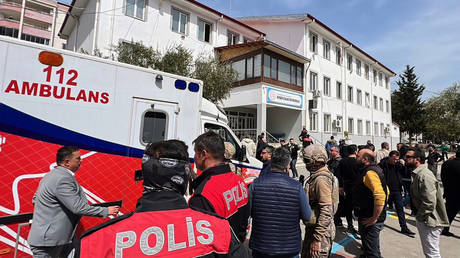
The headlines are bleeding, and the pundits are already reading from the same tired script. Two school shootings in two days in Türkiye. The knee-jerk reaction? Demand stricter gun control. Blame the black market. Point fingers at "failing security."
It is lazy. It is predictable. And it is completely wrong.
When you see a sudden surge in ultra-violent outbursts in a society that historically lacks a school shooting culture, you aren't looking at a supply-side problem. You are looking at a systemic software crash. We are witnessing the brutal friction of a society being dragged through a digital and cultural transition it isn't equipped to handle.
The Myth of the Gun Problem
Türkiye has always had guns. The "gecekondu" culture, the rural traditions, and the sheer volume of unlicensed firearms in circulation have been part of the social fabric for decades. Yet, for years, the schools remained safe. If "access to weapons" was the primary driver, Turkish schools would have been war zones since the nineties.
The variable hasn't been the availability of the tool; it has been the psychological state of the user.
The media focuses on the "how"—the pistol, the ease of purchase, the lack of metal detectors. They ignore the "why." These shooters are not products of a gun-loving culture; they are products of a digital nihilism that the Turkish education system refuses to acknowledge. We are trying to solve a 21st-century psychological crisis with 20th-century metal detectors. It won't work.
The Pressure Cooker of Turkish Meritocracy
Ask any teenager in Istanbul or Ankara about their mental state, and they won't talk about guns. They will talk about the LGS and YKS exams.
Türkiye has built a high-stakes, winner-take-all educational gauntlet that creates a massive underclass of "failures" by the age of fifteen. When you combine this academic Darwinism with the hyper-comparison of social media, you create an environment where the social cost of failure is total.
In this scenario, a school isn't a place of learning. It is a site of daily humiliation for those who don't fit the mold. When a student snaps, they aren't attacking "education"; they are attacking the institution they perceive as the architect of their lifetime misery.
The Identity Vacuum
We've seen this play out in the West, and we are arrogant enough to think we can avoid it. As traditional Turkish social structures—the family unit, the neighborhood "mahalle" support—dissolve under the weight of rapid urbanization, they leave a void.
That void is filled by:
- Aggressive Online Subcultures: Incels, doomerism, and ultra-nationalist aesthetics.
- Algorithmically Driven Rage: Platforms that reward the most extreme emotional outputs.
- The "Main Character" Syndrome: A desperate need to be seen in a world where they feel invisible.
The competitor articles talk about "two shootings in two days" as a coincidence or a "spillover." I call it a contagion. The second shooter didn't just happen to have a gun; they had a template. They saw the digital footprint of the first, saw the infamy, and decided to claim their share of the void.
The Security Theater Fallacy
The immediate demand from parents and politicians is always "more security." Hire more guards. Install more cameras. Turn schools into fortresses.
This is a catastrophic mistake.
Hardening a target does not remove the intent to kill; it merely changes the tactics. More importantly, when you treat students like potential combatants from the moment they enter the gate, you reinforce the very alienation that drives these attacks. You validate their view that the school is a hostile, carceral environment.
I have watched school districts spend millions on "smart surveillance" while their guidance counseling departments are staffed by one overworked individual for every thousand students. It’s like buying a $10,000 alarm system for a house with a gas leak. You’ll know exactly when the explosion happens, but you did nothing to prevent it.
The Data the Media Ignores
Look at the demographics. These aren't career criminals. These aren't "street kids." They are often students from the very middle-class backgrounds that are supposed to be the "success stories" of the new Türkiye.
The breakdown of the "Anatolian Dream"—the idea that if you study hard and follow the rules, you will have a better life than your parents—is the hidden engine of this violence. Inflation, a stagnant job market, and a devalued currency have turned the promise of education into a lie. When the "reward" at the end of the tunnel vanishes, the "rules" of the tunnel no longer matter.
Stop Asking "How" and Start Asking "Where"
People also ask: "How did they get the gun?"
Wrong question.
Ask: "Where did they lose their sense of belonging?"
If a teenager feels he has a stake in his future, he doesn't throw it away for thirty seconds of televised carnage. The "black market" for guns in Türkiye is a symptom of a weak state, but the "black market" for purpose is what's killing our children.
We need to stop talking about "safety" as a function of hardware. Real safety is a function of social cohesion.
The Actionable Reality
- Dismantle the Exam Fetish: Until the Turkish education system stops defining 90% of its students as "sub-par" based on a single weekend of testing, the resentment will continue to boil.
- Aggressive Digital Literacy: Not "how to use Word," but how to survive the psychological warfare of the internet. We are teaching kids math while they are being radicalized by algorithms we don't even track.
- End the Security Theater: Shift the budget from metal detectors to high-intervention mental health teams that actually know the students' names.
The media wants to treat these two days as a freak occurrence or a regulatory failure. It is neither. It is a structural warning shot. If you don't fix the soul of the institution, no amount of gun laws or guard dogs will save the people inside.
You cannot legislate away the desire to destroy. You can only build a society that makes destruction an unthinkable option. Right now, Türkiye is doing the opposite.
Fix the system, or get used to the sirens.