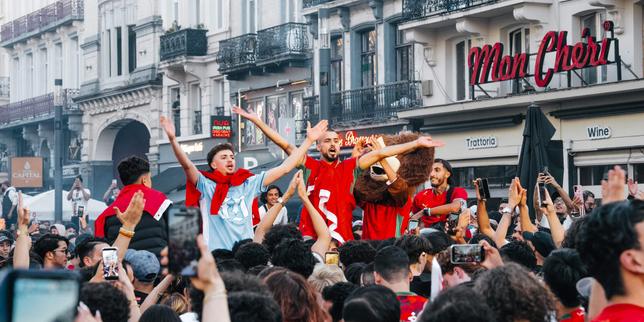
The coffee in Casablanca tastes different when the national team plays. It is thicker, heavier, brewed with an intensity that matches the collective breath held across a nation. In December 2022, that breath was held for nearly a month. Old men in jellabas sat side-by-side with teenagers in bleached denim, their eyes glued to flickering screens in smoke-filled cafes, watching a red-and-green shirt rewrite the geometry of global football.
When Youssef En-Nesyri rose into the desert air against Portugal, hanging there like an impossible mathematical equation before striking the ball into the net, he did not just score a goal. He broke a ceiling.
Morocco became the first African and Arab nation to reach a World Cup semifinal. It was beautiful, but it was also a curse. The beautiful trouble with miracles is that once you perform one, people expect you to walk on water every time it rains.
Now, the global stage shifts to North America. The tournament is larger, louder, and more bloated than ever before. For Morocco, the question is no longer about proving they belong at the table. The question is whether they can pull off the ultimate heist and take the trophy home. It sounds absurd to the traditional football elite in Madrid, Buenos Aires, and Paris. But if you look closely at the mechanics of this team, the dream is not built on sand. It is built on concrete tactical realities, a goldmine of dual-nationality talent, and a psychological shift that cannot be undone.
The Architecture of the Low Block
Football romanticism dictates that tournaments are won by glittering attackers who dance past defenders. Football reality says otherwise. Tournaments are won by teams that refuse to bleed.
During that magical run in Qatar, Morocco conceded just one goal before the semifinal, and even that was an unlucky own goal against Canada. They choked the life out of Spain. They frustrated Portugal to the point of tears. The architect of this defensive chokehold, Walid Regragui, understood a fundamental truth about international football: you do not need to play like Manchester City to win a World Cup. You need to be a wall.
Consider the mechanical setup required to repeat this feat in 2026. The backbone remains anchored by elite defensive minds. Achraf Hakimi, a player who covers the right flank with the engine of a long-distance runner and the precision of a surgeon, gives the team an outlet that few countries can match. But the real magic lies in the central compact block.
To win a tournament of this scale, Regragui’s system relies on suffocating the space between the midfield and the defensive line. Think of it as a moving cage. When the opposition moves the ball wide, the cage shifts. When they try to play through the middle, the cage closes. Sofyan Amrabat’s performances in 2022 showed the world how a single anchoring midfielder can disrupt the rhythm of elite European playmakers. For 2026, the defensive depth must evolve, ensuring that younger center-backs can step into the giant shoes left by aging veterans without losing that structural rigidity.
If they can maintain a clean-sheet mentality through the grueling knockout rounds, they reduce the game to moments. And in moments, anything can happen.
The Diaspora and the Pull of the Soil
There is a unique human element to this Moroccan squad that differentiates it from almost every other elite team in the world. It is a team built on the concept of return.
More than half of the squad that shocked the world in 2022 was born outside of Morocco. They grew up in the suburbs of Paris, the concrete blocks of Utrecht, the industrial towns of Belgium, and the coastal cities of Spain. They were scouted by European academies, trained in European methodologies, and offered the chance to wear the jerseys of some of the richest footballing nations on earth.
Yet, they chose the star on the red jersey.
This is not a matter of secondary options. Take Brahim Díaz, a virtuoso who wore the white of Real Madrid and had the Spanish football federation courting him for years. He chose Morocco. This injection of elite, elite-level creative talent alters the entire equation.
The integration of these players creates a fascinating tactical hybrid. You get the tactical discipline and technical education of the best European academies, fired by an intense, emotional patriotism that money cannot buy. When a player chooses to represent the land of their parents or grandparents, they are playing for something deeper than a winner's medal. They are playing for identity.
But this creates a management challenge. Regragui’s greatest triumph was not his tactics; it was his ability to make a kid from Madrid and a kid from Rotterdam feel exactly the same pride as a kid who grew up kicking a taped-up ball through the streets of Rabat. If Morocco is to lift the trophy in 2026, this chemistry must hold. The new arrivals cannot be viewed as mercenaries; they must be absorbed into the pack.
The Marathon of the Forty-Eight
The 2026 tournament is a different beast. The expansion to 48 teams means an extra knockout round. One more game of razor-thin margins. One more opportunity for a bad bounce or a refereeing error to send you home.
This is where depth becomes a matter of survival. In 2022, by the time Morocco faced France in the semifinal, their engines were running on fumes. The central defenders were playing through painkillers, their muscles tearing with every sprint. The squad simply did not have the bench to replace them without a massive drop in quality.
To counter this in North America, the scouting network has worked overtime. The squad is younger, fresher, and deeper. The presence of emerging talents in top-tier European leagues means that when Hakimi or Azzedine Ounahi needs a rest, the drop-off is no longer catastrophic.
The travel alone will be a psychological test. Playing a match in the humidity of Miami and then flying to the altitude of Mexico City or the summer heat of New York requires an elite sports science setup. The Moroccan federation has invested millions in facilities that rival any in Western Europe. They understand that a World Cup is not won just on the pitch; it is won in the cryotherapy chambers, the nutrition halls, and the charter flights.
Turning Fear Into a Weapon
Look at the history of the World Cup. The trophy is an exclusive club. Only eight nations have ever won it. There is an invisible psychological weight that crushes outsiders when they reach the final stages. They look across the tunnel, see the five stars on the Brazilian crest or the sky-blue stripes of Argentina, and they blink.
Morocco's greatest obstacle is not France or Brazil. It is the belief that a team from Africa is only meant to be a heartwarming story, a colorful sideshow before the traditional powers take over the tournament.
To win, they must lose the humility that characterized their previous campaigns. They cannot be happy just to be there. The mentality must shift from the hunter trying to upset the giant, to a team that believes it is the giant.
We saw flashes of this new arrogance—the good kind of arrogance—during their recent continental campaigns. They want the ball. They want to dictate the terms of engagement. With creative engines like Ounahi and the wizardry of Hakim Ziyech, Morocco can transition from a team that wins by defending to a team that wins by controlling the tempo of the match. They can starve opposition teams of possession, slowing the game down to a walking pace before striking with lethal velocity on the counter-attack.
The Final Whistle in the Mind
Picture the scene. July 2026. MetLife Stadium in New Jersey is a cauldron of sound. The stands are a blur of red shirts, thousands of members of the North American diaspora having converged on the stadium, turning an arena thousands of miles from North Africa into a home game.
The opposition is a traditional powerhouse, tiring under the relentless pressing of a Moroccan midfield that refuses to stop running. The clock ticks past the eighty-fifth minute.
For Morocco to win, they do not need a miracle this time. They just need execution. They need Bono to make the impossible save he has made a hundred times before. They need Hakimi to find the overlapping run. They need the substitute winger to track back and track the runner into the box.
It is a long road, filled with variables that no tactician can control. A red card, a VAR decision, a ball hitting the inside of the post and bouncing out instead of in. But the framework is there. The talent is there. The hunger is there.
The Atlas Lions have already shown the world how to roar. Now, they just have to hunt until there is nothing left to chase.