The headlines are celebrating a triumph that didn't actually happen.
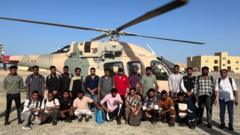
When a tanker bursts into flames off the coast of Oman following military strikes, and all 24 Indian crew members are safely pulled from the water, the international shipping community breathes a sigh of relief. The mainstream press runs the standard playbook: praise the rapid response, laud the heroic rescue efforts, and treat the incident as a localized crisis managed by geopolitical chess moves.
This reaction is completely detached from reality.
Celebrating these rescues as operational successes is like praising a car's airbags after driving it off a cliff. The crew survived, yes. But the fact that commercial sailors are being treated as acceptable collateral damage in modern choke-point warfare is a catastrophic failure of global maritime governance.
We are looking at the wrong metrics, asking the wrong questions, and hiding behind a facade of naval competence while the foundational economics of global trade disintegrate.
The Flawed Premise of Modern Maritime Security
The mainstream narrative relies on a comfortable assumption: international naval coalitions can patrol away asymmetric threats. We are told that convoy escorts, targeted counter-strikes, and rapid-response search and rescue operations are keeping the gears of global commerce turning.
They aren't. They are applying a temporary adhesive to a severed artery.
The reality of modern maritime warfare is defined by an extreme cost asymmetry. A non-state actor or regional militia can deploy a drone or a anti-ship missile costing a few thousand dollars. To counter this, a billion-dollar destroyer fires a multi-million-dollar interceptor. When that dynamic inevitably fails—as it did off the coast of Oman—the burden shifts entirely to the civilian crew and the shipowners.
I have spent years analyzing shipping corridors and supply chain vulnerabilities. I have sat in boardrooms where executives weigh the cost of crew bonuses against the skyrocketing premiums of war risk insurance. The industry is currently operating under a delusion that the oceans remain a neutral, shared global commons. That era is over.
The Logistics of Hope is Not a Strategy
Let's dissect what actually happens when a commercial vessel is set ablaze. The media focuses on the rescue vessel. What they ignore is the structural vulnerability built into the modern flag-of-convenience system.
- The Fragmented Command Structure: A vessel owned by a European entity, flagged in Panama, managed by a company in Singapore, and crewed by Indian nationals is attacked in international waters. Who is legally responsible for their defense?
- The Insurance Shell Game: War risk premiums in volatile corridors do not protect human lives; they protect the hull and the cargo. Shipowners are incentivized to push the boundaries of safety because the financial downside of a delayed transit often outweighs the abstract risk of a kinetic strike.
- The Limits of Naval Reach: No navy, no matter how well-funded, can provide a persistent shield over millions of square miles of ocean. Acknowledging a successful rescue is an admission that the deterrent failed completely.
When a strike occurs, the physical reality inside a burning tanker is a horror show of toxic fumes, compromised structural integrity, and remote geography. Relying on nearby vessels or passing military assets to fish crews out of the water is a strategy based entirely on luck.
Dismantling the Supply Chain Myth
The corporate world loves to talk about resilient supply chains. The moment a major transit corridor becomes a shooting gallery, that resilience is revealed to be non-existent.
When routes through the Red Sea or the Gulf of Oman become untenable, the alternative is not a smooth transition to another path. The alternative is bypassing the region entirely and routing around the Cape of Good Hope.
Standard Route (Via Choke Points)   --> [High Risk] [High Insurance] [Short Transit]
Alternative Route (Cape of Good Hope) --> [Low Risk]  [High Fuel Cost] [Extra 10-14 Days]
This detour adds roughly 10 to 14 days to a voyage. It burns thousands of tons of additional fuel, injects massive amounts of unexpected carbon into the atmosphere, and disrupts just-in-time inventory systems globally.
Yet, the industry treats these incidents as isolated traffic accidents. They are not anomalies. They are the new baseline for international shipping.
The Human Cost of Abstract Geopolitics
The maritime industry relies on an invisible workforce. Roughly 80% of global trade by volume is carried by sea, powered by over a million seafarers, predominantly from developing nations like India, the Philippines, and Ukraine.
When a tanker is targeted, the political analysts discuss regional deterrence, oil price volatility, and strategic choke points. Nobody discusses the psychological toll on the crew members who are forced to navigate these waters because their contracts leave them no choice.
Treating a successful evacuation as a victory glosses over the brutal truth: these seafarers are being used as human shields for global consumerism. They are placed in high-risk zones to maintain the illusion that goods can flow cheaply and uninterrupted across an increasingly fractured world.
The Flaw in Asking "How Do We Protect the Ships?"
The shipping industry and international navies are asking the wrong question. They are obsessed with tactical protection—better radar, more interceptors, specialized firefighting training for crews.
The real question is structural: Why are we still routing critical global commodities through narrow, easily targeted waterways when the geopolitical landscape has fundamentally shifted?
The contrarian reality is that certain maritime corridors are no longer viable for commercial shipping without state-backed, heavy military escorts for every single vessel—an option that is logistically and financially impossible. The insistence on maintaining standard commercial operations in these zones is an act of corporate negligence.
Stop Rewarding Failure
We must stop applauding the cleanup crew while ignoring the arsonist. A successful rescue is a testament to the survival instincts of the crew and the basic decency of nearby mariners. It is not proof that the system works.
The global shipping model is broken. It relies on cheap labor, tax-haven registries, and the assumption that the United States navy will indefinitely underwrite the security of global trade for free. None of these pillars are sustainable in a multipolar world.
Expect more fires. Expect more dramatic rescues. And expect the global supply chain to contract violently when the shipping industry finally runs out of luck.
Stop looking at the smoke off the coast of Oman and calling it a solved problem. The ship is burning down, and the entire maritime industry is standing on the deck pretending it's just a temporary rise in temperature.