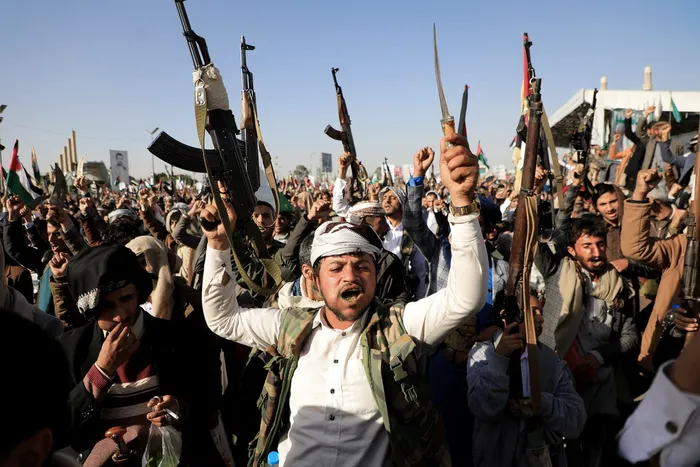
The recent escalation of Houthi missile strikes targeting Israeli territory marks the definitive end of the "proxy war" era and the beginning of a direct, trans-regional conflict. For years, Western intelligence agencies and regional analysts operated under the assumption that Ansar Allah—the Houthi movement—was a localized Yemeni phenomenon, albeit one with Iranian backing. That illusion has shattered. By launching medium-range ballistic missiles and advanced loitering munitions across the Arabian Peninsula, the Houthis have effectively integrated themselves into a unified northern and southern front against Israel, fundamentally altering the security calculus of the Middle East.
This is not a symbolic gesture of solidarity. It is a sophisticated military operation that requires high-level coordination, real-time intelligence sharing, and a logistics trail that stretches from the workshops of Sana’a to the research centers in Tehran. The primary objective is to overstretch the Israeli Multilayered Defense Array, forcing a choice between defending the northern border against Hezbollah or the southern gateway against an increasingly emboldened Yemeni force. If you enjoyed this piece, you might want to check out: this related article.
The Technical Reality of the Long Range Strike
The transition from "insurgency" to "regional missile power" does not happen in a vacuum. To reach targets in southern Israel, such as the port city of Eilat, Houthi forces are deploying variants of the Toufan ballistic missile. These systems are not indigenous Yemeni designs. They are derived from the Iranian Ghadr series, liquid-fueled missiles capable of traveling up to 2,000 kilometers.
Physics dictates the terms of this engagement. To cover the distance from Yemen to the Negev desert, a missile must reach altitudes that place it well within the sights of the Arrow 3 interceptor system. However, the Houthis are playing a volume game. By launching simultaneous volleys of cheap, slow-moving "Samad" drones alongside high-velocity ballistic missiles, they attempt to saturate radar arrays. They want to force the defender to expend a multimillion-dollar interceptor on a drone that costs less than a used sedan. For another perspective on this development, see the latest update from TIME.
The maritime dimension is even more volatile. The deployment of anti-ship ballistic missiles (ASBMs) in the Bab el-Mandeb strait represents a technological leap that few non-state actors have ever achieved. These weapons use electro-optical or radar seekers to find a moving target at sea. If the Houthis can credibly threaten global shipping while simultaneously striking the Israeli mainland, they have effectively created a strategic "choke point" that extends from the water to the atmosphere.
Why Containment Failed
For a decade, the international community treated the war in Yemen as a tragic but isolated humanitarian crisis. The strategy was containment. The Saudi-led coalition, backed by Western logistics, sought to pen the Houthis within the rugged highlands of North Yemen. This failed because it ignored the fundamental evolution of the "Axis of Resistance."
Tehran did not just send crates of rifles. They sent engineers. They established a decentralized manufacturing model where critical components—guidance systems, carbon-fiber engine parts, and encrypted transmitters—are smuggled in pieces and assembled locally. This "IKEA-style" proliferation makes traditional interdiction almost impossible. By the time a missile is on the launcher, the chain of custody has been obscured through dozens of front companies and dhow transfers across the Arabian Sea.
The failure was also intellectual. Analysts underestimated the ideological fervor and the tactical patience of the Houthi leadership. They are no longer a ragtag militia. They are a battle-hardened military force that has survived years of aerial bombardment by some of the most advanced air forces in the world. They have learned how to hide in plain sight, using mobile launchers and underground silos to negate the advantage of total air superiority.
The Intelligence Gap and the Southern Front
The emergence of this southern front has exposed a significant gap in regional maritime security. While the Mediterranean and the Lebanese border are under constant, high-fidelity surveillance, the vast expanse of the Red Sea offers more shadows. The Houthis are utilizing "mother ships"—converted commercial vessels or fishing trawlers—to provide mid-course telemetry updates for their drones and missiles.
This isn't just about Israel. The broader strategic implication is the vulnerability of the Suez Canal and the flow of global energy. If a group in Yemen can strike a target in Eilat with precision, they can certainly strike a commercial tanker or a naval task force with equal ease. The deterrent power of the United States and its allies is being tested by an adversary that views "escalation" not as a risk to be managed, but as a tool to be exploited.
The Mathematics of Attrition
Defense is always more expensive than offense in the modern missile age.
- Interceptor Cost: A single Arrow 3 or David’s Sling interceptor ranges from $2 million to $3.5 million.
- Threat Cost: A Houthi-produced "Quds" cruise missile or a long-range drone may cost between $20,000 and $150,000.
This disparity creates a "cost-exchange ratio" that favors the attacker over a long-term conflict. If the Houthis can sustain a launch rate of even three to five projectiles a week, they force the Israeli defense ministry into a perpetual cycle of high-expenditure defense. This is economic warfare by other means. It drains the treasury and keeps the civilian population in a state of constant, low-level mobilization, which has profound effects on the national economy and public psychology.
Beyond the Proxy Label
Labeling the Houthis as mere "puppets" of Iran is a mistake that leads to poor policy. While the technological debt to Iran is undeniable, the Houthis have their own internal domestic pressures and regional ambitions. They seek to position themselves as the primary vanguard of the anti-Zionist cause, potentially even eclipsing Hezbollah in the eyes of the "Arab street."
This internal competition for prestige within the Iranian-led alliance drives further aggression. The Houthis are willing to take risks that other players might find too costly. They have less to lose. Their infrastructure is already devastated, their economy is in shambles, and their leadership is accustomed to living under the threat of assassination. When an adversary has integrated "martyrdom" into their military doctrine, traditional concepts of deterrence—like the threat of retaliatory strikes—lose much of their weight.
The Drone Corridor and Electronic Warfare
The battle is currently shifting into the electromagnetic spectrum. To counter the Houthi threat, the focus is moving toward Directed Energy Weapons (DEW) and high-powered lasers. Systems like the Iron Beam are designed specifically to solve the cost-exchange problem. A laser shot costs about the same as a gallon of fuel.
However, the Houthis are already adapting. They are experimenting with "swarming" tactics, where dozens of cheap drones are launched from different vectors simultaneously to overwhelm the processing power of defense radars. They are also using "passive" guidance systems that do not emit signals, making them much harder to detect before they reach the terminal phase of their flight.
The sophistication of these maneuvers suggests a level of training that goes far beyond basic insurgent tactics. It points to a deep integration with the Iranian Revolutionary Guard Corps (IRGC) "Quds Force" and possibly even advisors from Hezbollah who have relocated to the Yemeni coast. This is a multinational military enterprise operating under a single, unified command structure.
The Geopolitical Fallout
The direct entry of the Houthis into the war effectively "regionalizes" the Gaza conflict. It draws in the United States, which has deployed carrier strike groups to the region to protect commercial interests. It puts Egypt in a precarious position, as any disruption to Suez Canal traffic directly threatens their national revenue. It forces Saudi Arabia to navigate a minefield, as they try to maintain a fragile truce with the Houthis while their own airspace becomes a highway for missiles headed toward Israel.
There is no simple return to the status quo. The capability has been demonstrated, the precedent has been set, and the hardware remains in the hands of a group that views the current global order as an enemy to be dismantled.
The immediate priority for regional stability is not just the physical interception of missiles, but the total disruption of the procurement networks that allow these weapons to exist. This requires a shift in focus from the "front line" in the Red Sea to the "back office" of the global shadow economy. Unless the flow of specialized electronics and dual-use technologies is severed, the southern front will continue to expand until it becomes the primary theater of a much larger, much more destructive conflagration.
The era of localized skirmishes is over. The Middle East is now facing a high-tech, long-range war of attrition that recognizes no borders and respects no treaties.