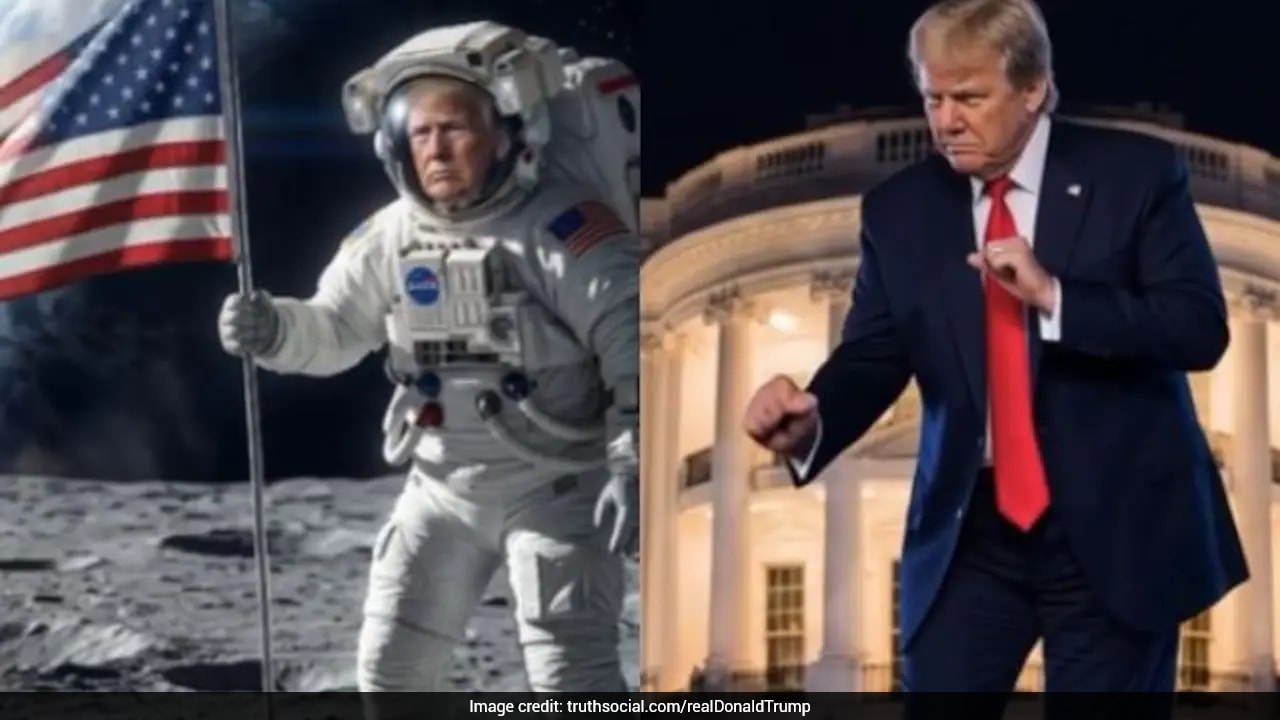
A bizarre digital artifact dropped onto Truth Social this weekend. It was a one-minute music video featuring an upbeat, synthetically generated track titled Donald, Donald Trump. The vocals repeatedly chanted that the world loves the current US president, while the visual component showcased a sequence of highly exaggerated, artificial intelligence-generated images. In the spans of mere seconds, the digital avatar of Donald Trump paraglides through the sky, stands on the moon in a spacesuit, rides a lion, and eats a pizza that features his own face baked into the crust.
Traditional political analysts viewed the post as a moment of strange vanity. They are missing the bigger picture. This is not just an isolated piece of self-praise; it is a calculated deployment of a massive shift in political communication. The video, credited to Anthony Constantino, a Trump-endorsed Republican congressional candidate from New York, represents the intentional normalization of synthetic media as a primary vehicle for political mythmaking.
By bypassing traditional production channels and relying on cheap, rapid generative tools, the current administration is redefining how public figures construct their images. This strategy moves beyond traditional media manipulation. It signals a future where political reality is entirely malleable, and authenticity is secondary to algorithmic engagement.
The Strategy Behind Synthetic Mythmaking
Political campaigns have historically spent millions of dollars on sleek, highly polished television advertisements designed to project authority and seriousness. Generative software dissolves that barrier to entry. The Truth Social video demonstrates how low-cost, high-speed media creation allows political actors to flood information ecosystems instantly.
The visual style of the video leans heavily into what internet culture categorizes as AI slop. The imagery is surreal, slightly distorted, and entirely detached from physical reality. Trump is shown riding a motorcycle through a street in India and posing next to the Leaning Tower of Pisa. There is no attempt to pass these images off as authentic photographs.
That lack of realism is precisely the point. By leaning into obvious fabrication, the messaging bypasses the standard scrutiny applied to political claims. It functions as a form of visual meme warfare. The absurd imagery grabs attention in a crowded media environment far more effectively than a standard campaign press release or a formal policy speech.
Weaponizing the Flooding the Zone Strategy
In communication theory, the practice of saturating media channels with continuous, low-quality content to distract, confuse, and overwhelm the public is a recognized tactic. This synthetic anthem serves that exact function. When a political figure shares a video of themselves riding a lion or standing on the moon, the conversation instantly pivots away from legislative battles, economic data, or policy failures.
Media outlets cover the bizarre nature of the video. Social media users debate the aesthetics. Critics mock the absurdity, while supporters celebrate the defiance of traditional political norms.
"The primary objective is not to convince the public of a specific truth, but to occupy the finite space of public attention."
While the public remains distracted by the spectacle of a pizza with a president's face on it, the underlying machinery of governance and political maneuvering continues unexamined. The content acts as a digital smoke screen, absorbing news cycles and exhausting the analytical capacity of observers.
The Fragmented Base and the AI Divide
This reliance on synthetic imagery reveals a growing friction within the broader political coalition. While the president has positioned himself as an advocate for rapid, unregulated domestic AI development to maintain a competitive edge against foreign adversaries, a significant portion of his core support base remains deeply skeptical of the technology.
Many working-class voters view generative tools as an immediate threat to human labor and cultural stability. Activists within conservative circles recently issued formal warnings regarding the unchecked proliferation of automation.
Yet, the digital strategy of the executive branch continues to double down on these exact tools. This disconnect highlights a pragmatic calculation. The immediate, tangible benefits of using generative software for cheap, highly viral political branding outweigh the ideological concerns of tech-skeptic factions within the base. The visual language of the internet is now dictated by code, and those who refuse to use it risk becoming invisible.
The Collapse of Institutional Trust
The long-term consequence of this shift is the systemic erosion of shared objective reality. When heads of state routinely distribute synthetically altered media, the line between authentic documentation and digital fabrication disappears entirely.
This creates a secondary, more dangerous effect known as the liar's dividend. In an environment where the public is fully aware that images, audio, and video can be generated instantly with a text prompt, bad actors can easily dismiss genuine, damaging evidence as fake news or a deepfake.
The defense against accountability becomes automated. If everything can be manufactured, then nothing can be definitively proven. The public, weary of trying to parse truth from fiction, retreats into tribal alignment. Citizens no longer believe what is real; they believe what satisfies their existing political preferences.
The New Baseline for Global Politics
The era of the polished, factual campaign ad is giving way to the era of the endless synthetic stream. This weekend's video is a preview of the upcoming media environment. Future political campaigns will not rely on teams of videographers and speechwriters. They will utilize automated pipelines designed to generate thousands of personalized, hyper-targeted synthetic videos per hour, calibrated to appeal to the precise anxieties and desires of individual voters.
This development cannot be reversed through fact-checking or platform moderation. The tools are democratized, open-source, and globally accessible. The real challenge moving forward is not detecting the fabrications, but surviving the sheer volume of the noise.