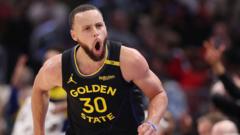
Stephen Curry has officially upended the multibillion-dollar athletic endorsement market by signing a landmark 10-year partnership with Chinese sportswear titan Li-Ning. The staggering move comes just seven months after Curry shocked the industry by walking away from a heavily publicized, supposedly lifetime extension with Under Armour. While standard sports commentary frames this as a simple late-career cash grab by a aging 38-year-old superstar, the underlying mechanics reveal a far more calculated corporate defection. Curry did not just change shoe sponsors. He exported an entire American intellectual property asset, Curry Brand, to Beijing because Western athletic infrastructure failed to deliver on its grandest promises.
The immediate ripple effects of this deal will fundamentally alter how elite athletes structure their corporate identities. By aligning with Li-Ning, Curry secures massive financial guarantees, global distribution capability, an independent golf line, and crucially, the autonomous power to recruit and sign active athletes under his personal banner.
To comprehend why the greatest shooter in basketball history chose a domestic Chinese brand over the comfort of American corporate giants, one must first examine the quiet disintegration of his relationship with Baltimore-based Under Armour.
The Phantom Billion Dollar Empire
In March 2023, the sports business press loudly trumpeted Under Armour’s "lifetime" contract extension with Stephen Curry, a deal widely reported to be worth upwards of $1 billion through equity and long-term incentives. It was meant to mimic Nike’s eternal bond with Michael Jordan. Yet by November 2025, that seemingly permanent marriage suffered a sudden, quiet divorce.
The structural flaws in the partnership were evident to industry insiders long before the official split. Under Armour initially captured lightning in a bottle when they signed Curry away from Nike in 2013 for a paltry $4 million annually, capitalizing on one of the most infamous corporate blunders in sneaker history. But over the ensuing decade, the company consistently struggled to build a premium lifestyle brand around Curry’s on-court brilliance.
Under Armour’s DNA remained stubbornly rooted in utilitarian, moisture-wicking compression gear. They were brilliant at selling high school football pads and training shirts, but completely out of their depth in the hyper-fickle world of global sneaker culture. The launch of the autonomous Curry Brand in 2020 was an explicit attempt to fix this, yet the sub-label remained choking inside Under Armour’s supply chain bottlenecks, identity crises, and shifting executive leadership.
When founder Kevin Plank returned to the CEO seat, a strategic pivot toward core profitability left the highly speculative, expensive global scaling of Curry Brand in bureaucratic limbo. The February 2026 release of the Curry 13 marked the definitive end of their product roadmap. Curry realized that while he owned his trademark logos, the machinery behind him lacked the international muscle and cultural agility required to compete with Nike's Jordan Brand or even Adidas.
Why Beijing Won the Free Agency Auction
When Curry entered sneaker free agency, Western observers assumed Nike would attempt to correct its historical mistake, or perhaps Adidas would make a play to bolster its post-Yeezy basketball roster. Instead, the most aggressive bidding came from the Far East.
Li-Ning, founded in 1990 by the legendary Chinese Olympic gymnast who captured six medals at the 1984 Los Angeles Games, brought an unmatchable proposition to the table. They offered true corporate autonomy.
The Autonomy Matrix
| Feature | Under Armour Partnership | The Li-Ning Paradigm Shift |
|---|---|---|
| Contract Length | "Lifetime" (Terminated early) | 10-Year Fixed Landmark Deal |
| Roster Control | Limited UA executive veto | Absolute authority to sign independent athletes |
| Global Infrastructure | Heavily reliant on North American retail | Direct, unfiltered access to Asia-Pacific supply and retail |
| Category Expansion | Basketball-centric | Dedicated basketball, athleisure, and comprehensive golf lines |
For a veteran star planning his post-retirement corporate empire, the ability to sign other active NBA and international players directly to his brand is unprecedented. Nike allows Michael Jordan this privilege because Jordan Brand generates billions in annual revenue. Under Armour was never able or willing to cede that level of capital and operational control to Curry. Li-Ning did it without blinking.
Furthermore, Curry’s locker room intelligence played a massive role. Over the past several seasons, teammates and peers like Jimmy Butler, Dwyane Wade, and CJ McCollum have praised the sheer performance capabilities and premium material builds coming out of Li-Ning’s development centers. In elite sports, performance matters just as much as marketing. When Curry began quietly testing rival footwear during his brief free agency window, the comfort and structural engineering of the Chinese designs validated the business proposal.
The Geopolitical Tightrope of Modern Endorsements
Securing absolute corporate freedom and a mountain of international capital comes with undeniable baggage. Curry’s defection to Li-Ning places him directly into a complex, often volatile geopolitical arena. The NBA has spent the last several years meticulously rebuilding its highly lucrative relationship with the Chinese consumer market following major diplomatic rifts.
By tying his personal brand to a company deeply intertwined with the domestic Chinese sporting establishment, Curry faces inevitable scrutiny back home. Human rights advocates and Western political analysts routinely criticize major Chinese sportswear entities regarding supply chain transparency and regional labor practices. Curry, who has carefully cultivated an image as a progressive, socially conscious philanthropist through his Eat. Learn. Play. Foundation, will now have to navigate a dual reality. He must balance his domestic American charitable endeavors with his role as the premier global ambassador for a flagship corporation based in Beijing.
It is a high-stakes gamble that underscores the shifting priorities of the modern superstar athlete. Global market penetration is no longer viewed through a purely Western lens. To truly scale an apparel brand to a multi-billion-dollar valuation, direct dominance in the massive Asian consumer landscape is mandatory, not optional. Li-Ning provides Curry with an immediate, frictionless gateway to millions of basketball-obsessed consumers who view him with near-religious reverence.
The Sunset of the Traditional Sneaker Deal
The era of the passive shoe endorsement deal is dead. Elite athletes are no longer content with receiving a check, filming two commercials a year, and wearing a designated colorway during nationally televised games. They demand equity, vertical integration, and genuine corporate governance.
Curry’s 10-year pact with Li-Ning serves as a warning shot to traditional American sportswear companies. If domestic brands cannot offer the infrastructure, global distribution, and executive freedom that modern icons demand, those icons will look overseas without hesitation. The market has globalized, and the leverage has shifted entirely into the hands of the talent.
The Golden State Warriors guard is enters the final phase of his legendary on-court career, but his corporate trajectory has just been completely re-engineered. The ultimate success of this international venture will not be measured by how many three-pointers he makes over the next few seasons, but by whether Curry Brand can successfully establish itself as an independent, permanent fixture in global fashion and sport long after he hangs up his jersey. The foundation has been laid in Beijing, leaving American executives to wonder how they let the most marketable face in sports slip through their fingers.