Bulgaria walked away with the grand prize at the 70th Eurovision Song Contest in Vienna, but the glitter on the Wiener Stadthalle stage could not mask a deeper shift in how modern pop spectacles are manufactured and won. Dara’s victory with her high-energy track Bangaranga secured 516 points, achieving a rare clean sweep of both the jury and public votes. While casual viewers credit her charismatic choreography, the true architecture of her win lies in a clinical combination of tactical staging by veteran producer Fokas Evangelinos and a calculated exploitation of voting blocks.
The traditional formula of sending a powerful vocalist to stand in a spotlight and belt out a ballad is dead. The 2026 contest proved that Eurovision is no longer a songwriting competition. It is a television production war where engineering a viral three-minute visual narrative matters more than the live vocal mix. Recently making waves lately: The Real Reason Bulgaria Swept Eurovision 2026 (And Why the EBU is Terrified).
The Illusion of the Double Sweep
To understand how Bulgaria dominated the leaderboard, one has to look past the flashing lights and examine the voting breakdown. Dara’s track was co-written by Dimitrios Kontopoulos, a Greek songwriter notorious for engineering high-scoring Eurovision entries. Kontopoulos understands the specific math required to appease jury panels composed of industry professionals while simultaneously triggering impulse votes from teenage TikTok users.
Historically, juries look for vocal precision and sophisticated arrangement, whereas the public favors chaos, heavy bass lines, and shock value. Bangaranga bridged this divide not through musical genius, but through structural familiarity. The track utilized a familiar chord progression, wrapped it in hyper-modern electronic production, and layered it with an easily repeatable hook. Further insights regarding the matter are detailed by Entertainment Weekly.
The strategy minimized financial risk and maximized regional appeal. By securing the creative direction of Fokas Evangelinos—the man behind several iconic Eurovision stagings over the past two decades—Bulgaria bought an elite playbook. Evangelinos staged the performance with rapid camera cuts that synchronized perfectly with the bass drops, ensuring that home viewers never looked away from the screen for more than two seconds. It was a masterclass in visual pacing, designed to manipulate short attention spans.
When Nostalgia and Consumerism Collide
The broader competitive field in Vienna attempted to replicate this success through various subversions of pop culture, with mixed results. The performances that resonated most were not those with the highest artistic merit, but those that tapped into specific psychological triggers.
The Retro Formula
Greece’s Akylas finished in tenth place with Ferto, a manic, up-tempo performance that functioned as an intentional homage to Helena Paparizou’s 2005 winning entry, My Number One. On paper, it was a joke entry disguised as vintage video game nostalgia, complete with neon pixel projections. Underneath the neon paint, however, the track served as a critique of modern consumerism. Akylas shouted demands for Cuban links, luxury cars, and submarines, contrasting the absurd demands against a backdrop of frantic dancing.
The irony was lost on the casual viewer, but the energetic delivery secured enough public points to salvage a top-ten finish. It proved that audiences will tolerate heavy-handed social commentary as long as it is packaged in a high-bpm dance rhythm.
Eurovision 2026 Top Four Leaderboard Breakdown
+------------+---------------------+-------------+
| Country    | Artist              | Total Points|
+------------+---------------------+-------------+
| Bulgaria   | Dara                | 516         |
| Israel     | Noam Bettan         | Undisclosed |
| Romania    | Undisclosed         | Undisclosed |
| Australia  | Delta Goodrem       | 165 (Jury)  |
+------------+---------------------+-------------+
The Heavy Metal Counter-Programming
Norway took a different approach by abandoning the pop machine altogether. Jonas Lovv’s Ya Ya Ya delivered a gritty, unpolished rock performance designed to capture the rock demographic that routinely feels alienated by the contest's pop-heavy bias. Lovv performed with an aggressive, classic-rock swagger reminiscent of mid-1970s stadium acts.
"In a year where ninety percent of the roster relies on pre-recorded backing tracks and synchronized dance troupes, standing on stage with a raw guitar riff is its own form of subversion."
While the betting odds dismissed Norway's chances of winning, the performance succeeded because it targeted an isolated pocket of the electorate. It did not need to win the juries; it just needed to dominate the phones of rock fans across Europe.
The Geopolitical Void and Australia's Near Miss
The most glaring flaw in the current Eurovision ecosystem is the structural disadvantage faced by non-European participants and nations lacking established voting alliances. Australia’s Delta Goodrem delivered what many critics considered the vocal performance of the night with Eclipse. Goodrem, an industry veteran with decades of live touring experience, stood in stark contrast to the heavily processed vocals of her competitors.
Prior to the public announcement, Australia sat comfortably in second place with 165 jury points, trailing only Bulgaria. The juries rewarded Goodrem’s technical perfection and emotional restraint. Yet, when the televote was announced, the entry cratered, ultimately sliding to fourth place behind Romania and Israel.
Australia has no natural geographic neighbors to guarantee a baseline of public points each year. While European nations frequently exchange high marks based on shared cultural spaces or diaspora populations, Australia must rely entirely on the merit of the performance. Goodrem’s descent down the leaderboard demonstrated that exceptional vocal capability is a secondary asset when a country lacks a built-in regional voting bloc.
Fire, Violins, and the Limits of Gimmicks
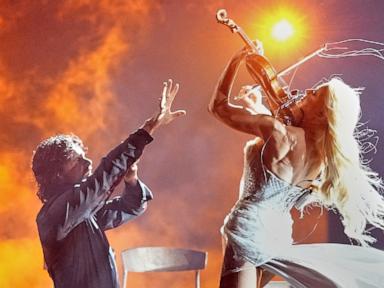
Finland tried to capture the public's imagination by leaning heavily into theatrical contrast. Linda Lampenius and Pete Parkkonen performed Liekinheitin (Flamethrower), a track that attempted to fuse classical violin with high-tempo electronic rock. The staging featured literal walls of fire and aggressive instrumental solos.
Finland has built a reputation over the last few years for sending eccentric, high-energy acts that challenge traditional pop structures. However, Liekinheitin exposed the limits of this strategy. When the visual shock of the pyrotechnics wore off after the first minute, the song lacked the melodic depth to sustain momentum. The performance felt derivative of past Finnish successes, proving that audiences can spot a calculated gimmick when it lacks a genuinely catchy core.
France, meanwhile, attempted to elevate the evening with Monroe's Regarde!, an operatic chanson piece that featured a line of dancers marching directly into the camera lens. The performance resembled a theatrical production more than a pop concert. While it garnered respectable points from Western European juries who appreciate theatrical tradition, it failed to register with the Eastern European and Nordic televoters who dictate the final outcome of the contest. The performance was too insular, too distinctly French, and lacked the universal sonic language required to win outside of traditional cultural allies.
The final standings in Vienna made one reality clear. The modern Eurovision Song Contest is no longer won by the artist who sings the best song. It is won by the creative director who best understands how to manipulate the television broadcast medium. Bulgaria did not win because Bangaranga was a musical masterpiece; they won because their production team left absolutely nothing to chance.