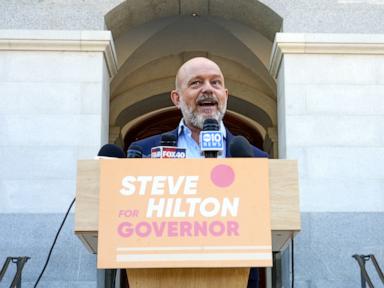
The political consensus holding California in place just shattered. Steve Hilton, a British-born former Fox News host and Downing Street strategist, has surged to the front of the pack in the race to succeed Gavin Newsom as governor. In a state where Democrats hold a legislative supermajority and outnumber registered Republicans nearly two to one, Hilton secured 28 percent of the vote in the June primary, edging past establishment Democrat Xavier Becerra.
This outcome is not a fluke or a simple protest vote. It is the direct result of a calculated, policy-driven strategy designed to exploit deep, bipartisan voter fatigue over an economy that has priced out the middle class. By running on a highly specific platform focused entirely on a single concept—making the state affordable—Hilton managed to consolidate the conservative base while pulling in independent and moderate voters who feel abandoned by sixteen years of single-party control.
The conventional narrative says a Republican cannot win statewide in California. The numbers from this primary show that the old rules no longer apply.
The Califordable Strategy
For over a decade, national Republicans have approached California as a fundraising ATM rather than a winnable territory. They relied on cultural grievances that alienated suburban voters in places like Orange County and the Inland Empire. Hilton threw out that playbook entirely. Instead of engaging in the standard national culture wars, he anchored his campaign to a single, pragmatic word.
"Califordable."
It sounds like a corporate marketing slogan, but the policy machinery underneath it targets the exact pain points of everyday life in the state. High taxes, soaring utility bills, and a housing market that locks out first-time buyers are not partisan issues. They are structural failures.
The core of Hilton’s economic pitch addresses these pain points with aggressive, concrete proposals. He has promised to eliminate state income tax on the first $100,000 of earnings for every worker. This is an idea so popular across the political spectrum that progressive rival Katie Porter openly admitted to borrowing it during the campaign debates. He also promised to force down gas prices to three dollars a gallon by rolling back state-specific environmental regulations and expanding local refining capacity.
This approach shifts the debate from abstract ideology to direct kitchen-table economics. A middle-class family struggling to balance a budget does not care about a candidate's pedigree if that candidate offers a clear plan to slash their monthly electricity bill in half. Hilton understood this dynamic early, and he rode it straight to the top of the ballot.
Shifting Coalitions and the Jungle Primary System
California's unique top-two primary system, often called the jungle primary, completely alters how campaigns must operate. Because all candidates appear on the same ballot regardless of party, a Republican candidate cannot win by merely playing to the fringes. They must build a coalition that can survive a head-to-head matchup in November.
2026 California Gubernatorial Primary Vote Share (Partial Count)
+-------------------+--------------------+---------+
| Candidate         | Party              | Vote %  |
+-------------------+--------------------+---------+
| Steve Hilton      | Republican         | 28.0%   |
| Xavier Becerra    | Democratic         | 25.0%   |
| Tom Steyer        | Democratic         | 19.6%   |
+-------------------+--------------------+---------+
The data reveals how split the Democratic electorate truly is. While Xavier Becerra held the establishment line, billionaire progressive activist Tom Steyer peeled away millions of left-wing voters who felt Becerra was too cautious or corporate. Meanwhile, the Democratic field suffered a massive disruption when early frontrunner Representative Eric Swalwell abruptly dropped out of the race following a series of damaging personal misconduct allegations.
This left a vacuum in the center-left. Hilton stepped into that space not with anger, but with a highly structured appeal to institutional reform. He has spent years writing books on decentralizing massive, unresponsive bureaucracies. When he talks about fixing the state's dysfunctional water boards or clearing out regulatory red tape to build suburban single-family homes, he sounds less like a partisan insurgent and more like an efficiency expert brought in to turn around a failing corporation.
The Trump Endorsement Paradox
The biggest hurdle for any California Republican is the shadow of national politics. Donald Trump lost the state by roughly twenty points in 2024, and his endorsement is typically viewed as a political death sentence for statewide hopefuls. Yet, Trump explicitly endorsed Hilton in April.
Instead of hiding from the endorsement or changing his tone, Hilton reframed it. He argues that having a governor who maintains a direct, functional relationship with the White House is a practical asset for the state, particularly when negotiating federal funds for infrastructure, water infrastructure, and disaster relief.
It is a risky gamble. In the central valley and rural northern counties, the Trump endorsement solidified Hilton’s support, allowing him to easily outpace fellow Republican Chad Bianco, the Riverside County Sheriff who ran a more traditional, law-and-order campaign. But to win the general election in November, Hilton must maintain a delicate balance. He needs the enthusiastic turnout of the conservative base without triggering a massive, defensive counter-mobilization by partisan Democrats in Los Angeles and the Bay Area.
Can a Maverick Governor Actually Govern Sacramento
If Hilton defies the historical odds and wins in November, he will immediately face an overwhelmingly hostile, Democratic-controlled legislature. A governor cannot unilaterally change tax brackets or permanently delete environmental laws without legislative approval.
Hilton insists his background makes him uniquely suited for this friction. Before moving to California in 2012, he served as the chief strategy director for British Prime Minister David Cameron, helping orchestrate a complex coalition government between conservatives and liberals. He views himself as an institutional pragmatist rather than a party loyalist.
But dealing with British parliamentarians is vastly different from dealing with Sacramento’s entrenched progressive caucuses. If Hilton attempts to dismantle key pieces of California’s landmark climate legislation by executive fiat, he will find his administration instantly bogged down in endless litigation by the state's powerful environmental lobbies.
The path forward for a reform-minded governor relies on finding hyper-focused areas of mutual survival. Democratic mayors in major cities like San Jose and Los Angeles are facing intense local pressure over street homelessness and housing scarcity. When San Jose Mayor Matt Mahan focuses heavily on building rapid, cost-effective tiny homes rather than waiting years for expensive permanent housing complexes, he is using a logic that aligns closely with Hilton's anti-bureaucracy philosophy.
If Hilton focuses his energy on these specific, shared crises—unshackling home builders from local zoning traps and restructuring utility oversight—he can bypass the ideological shouting matches. If he deviates into national partisan battles, his administration will lock up before his first budget is even printed.
The primary results prove that voters are actively looking for an exit ramp from the current economic status quo. The general election will not be a simple test of party loyalty. It will be a referendum on whether a voter is willing to take a chance on an unconventional outsider to fix a state that has simply become too expensive to live in.


