The rain along the coast of Blue Hill does not fall so much as it hangs. It clings to the wool of your collar, smells faintly of salt and rotting bladderwrack, and makes everything look gray. In the early morning light of the mudflats, when the tide drops low enough to reveal the muddy bellies of the inlets, you can see the oyster cages. They are heavy, wire-mesh boxes caked in silt, filled with sharp-shelled creatures that take years of backbreaking labor to bring to a restaurant plate.
For a long time, this was where Graham Platner anchored his identity.
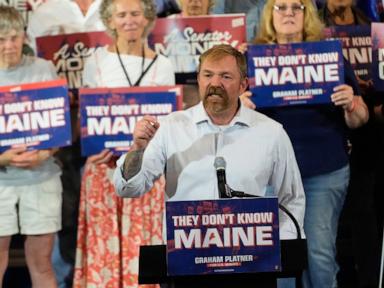
He was the rugged, combat-hardened Marine who came back from the sands of Ramadi and Fallujah to cultivate the cold waters of Maine. He wore flannel shirts that had seen actual work, spoke with the blunt cadence of a man who didn't care for polite society, and carried himself with the heavy gait of a 100% disabled veteran. When he announced he was running for the United States Senate to unseat Susan Collins, the long-serving Republican institution, he didn't just suggest a policy shift. He promised a class war.
"The enemy is the oligarchy," he barked into microphones during his rallies. He stood before crowds of loggers, fishermen, and teachers, positioning himself as the ultimate outsider. He was the antidote to a plastic political system.
Voters bought it. They were tired of polished lawyers and dynastic heirs. By March 2026, Platner had demolished the Democratic establishment's preferred candidate, Governor Janet Mills, forcing her out of the primary by sheer force of momentum. He walked away with 72% of the primary vote in June. He was a political rocket ship, fueled by raw working-class anger and a national progressive movement desperate for a fighter who looked like he could win a bar fight.
Then the ground gave way.
The Anatomy of an Idol
To understand how a movement collapses, you have to understand what it was built on. Platner's appeal was visceral. He wasn't a product of the McKinsey consulting conveyor belt. He was born in 1984, the son of a restaurant owner and a lawyer, but his trajectory was chaotic. Expelled from a prestigious boarding school, he eventually joined the infantry right out of high school, chasing a childhood fascination with the military. Four combat tours later, he was a man shaped by violence and survival.
When he returned to Maine and bought into an oyster farm in 2020, he wasn't making money. He supplemented his income with VA benefits. His mother’s restaurant was his biggest buyer. He was, by all accounts, living the precarious, frustrating economic reality that defines modern rural America.
When a coalition of labor groups approached him in 2025 to run for office, he initially balked. But the vision was seductive. A veteran with mud on his boots talking about universal healthcare, union strength, and ending foreign conflicts. It was a potent cocktail.
But beneath the populist armor, the cracks were already wide and deep.
First came the digital ghosts. Old social media posts surfaced, filled with language that made even his staunchest progressive allies wince. Then came the revelation of his chest tattoo: a Totenkopf, the infamous skull symbol used by Nazi SS divisions. Platner claimed ignorance, stating he and a fellow Marine just thought it was a cool skull-and-crossbones design. He got it covered up, but the image lingered. Then came reports of frantic, sexually explicit text messages sent to multiple women while he was married, an infidelity he dismissed as a personal struggle that he and his wife had survived.
Through each storm, his base held. His campaign manager blamed out-of-state establishment operatives. They claimed the corporate media was terrified of a real working-class savior. They called him a victim of a smear campaign.
Political movements can survive a lot of hypocrisy. They can rationalize bad behavior, cruel language, and personal betrayals if the followers believe the larger cause is righteous.
But some lines cannot be blurred.
The Breaking Point
On a Monday in early July 2026, the narrative shattered.
A report published by Politico carried an account from Jenny Racicot, a 41-year-old Maine woman who had dated Platner on and off for a couple of years. She recounted an evening from late 2021. Platner, she said, arrived at her home heavily intoxicated, climbed onto her couch, and forced her into the bedroom. She described a terrifying scene of non-consensual sex, explaining how she repeatedly told him to stop while he was almost blackout drunk.
The defense mechanism of the Platner campaign tried to fire up one more time. They released statements calling the allegations coached, coordinated, and categorically false.
The response from the rest of the political world was instantaneous. It was an eviction notice.
Consider the speed of the betrayal. Within hours, the institutional scaffolding that Platner had spent a year defying—but ultimately needed—evaporated. Senate Minority Leader Chuck Schumer and Kirsten Gillibrand issued a joint statement calling the allegations deeply disturbing and demanding his immediate withdrawal. Progressive champions like Bernie Sanders and Ro Khanna, who had stood on stages with Platner to validate his anti-corporate crusade, publicly severed ties. The money dried up instantly; the Democratic Senatorial Campaign Committee made it clear that not another dime would flow into Maine while his name remained on the ticket.
Platner released a video on X. His voice lacked the old thunder. He still denied the claims, but his language shifted to the somber calculation of a cornered politician. He talked about taking time to reflect on the best path forward, acknowledging the political reality of the damage done.
For Maine Democrats, reflection is a luxury they do not possess. The clock is ticking with terrifying precision.
The Six-Day Window
Politics is a game of ideals, but it is governed by the cold bureaucracy of election law.
Under Maine state statutes, if Platner wants to save his party from a catastrophic loss, he has until Monday, July 13, at 5:00 PM to formally withdraw his candidacy. If he signs the paperwork before that deadline, the Secretary of State can declare a official vacancy. That triggers a rapid, chaotic two-week sprint where the Maine Democratic Party has until July 27 to handpick a replacement nominee to face Susan Collins in November.
If he stays in past Monday? The ballot is locked. The Democratic line belongs to a man accused of sexual assault, abandoned by his own party, and bleeding support by the hour.
This is the invisible stake of the race. The U.S. Senate currently sits at a 53-47 Republican majority. Maine was supposed to be the crown jewel of the Democratic strategy to reclaim control. Now, the entire national balance of power hinges on the stubbornness of an oyster farmer sitting in a house in Blue Hill, deciding whether to self-immolate or step aside.
Behind the scenes, the scramble to find a successor has already turned ugly. The state party is trying to design an open, transparent selection process, but Platner's inner circle is reportedly trying to influence the transition. Executive Director Devon Murphy-Anderson went as far as releasing a public video warning Platner’s team that they have absolutely no role in choosing what comes next.
Names are being tossed into the wind like dry leaves. There is Troy Jackson, a former state senate president and a literal logger, who shared stages with Platner and commands respect among the same rural voters. Jackson has expressed intense interest, noting that the movement cannot be allowed to die because of one man’s actions. There is Nirav Shah, the highly respected former CDC official who became a household name in Maine during the pandemic. There is Shenna Bellows, the current Secretary of State.
Even Governor Janet Mills, the institutional powerhouse Platner humiliated months ago, is watching from the sidelines, her political ghost looming over the wreckage.
The Cold Water
Walk back to the mudflats.
The people who voted for Platner didn't do it because they loved his text messages or his tattoos. They voted for him because they wanted to believe that someone who understood the ache of a long day on the water, or the terror of an incoming mortar round, could go to Washington and fight for them. They wanted to believe that a regular person could break through the wall of billionaire money and entrenched power.
That is the true tragedy of the Platner campaign. When an outsider candidate fails so spectacularly on a moral level, they don't just ruin their own career. They poison the well for anyone else who tries to follow them. They validate every cynical elite who claims that regular people are too volatile, too messy, and too dangerous for the halls of power.
The oyster cages out in the bay will still need to be pulled up tomorrow, regardless of who wins the Senate seat. The people who tend them will still struggle to pay their rent, still worry about their healthcare, and still feel entirely forgotten by the capital.
Graham Platner wanted to be a hero of a working-class epic. Instead, he became a cautionary tale about the fragile nature of populist anger, leaving his party stranded on a rapidly shrinking shoreline, watching the tide come in.