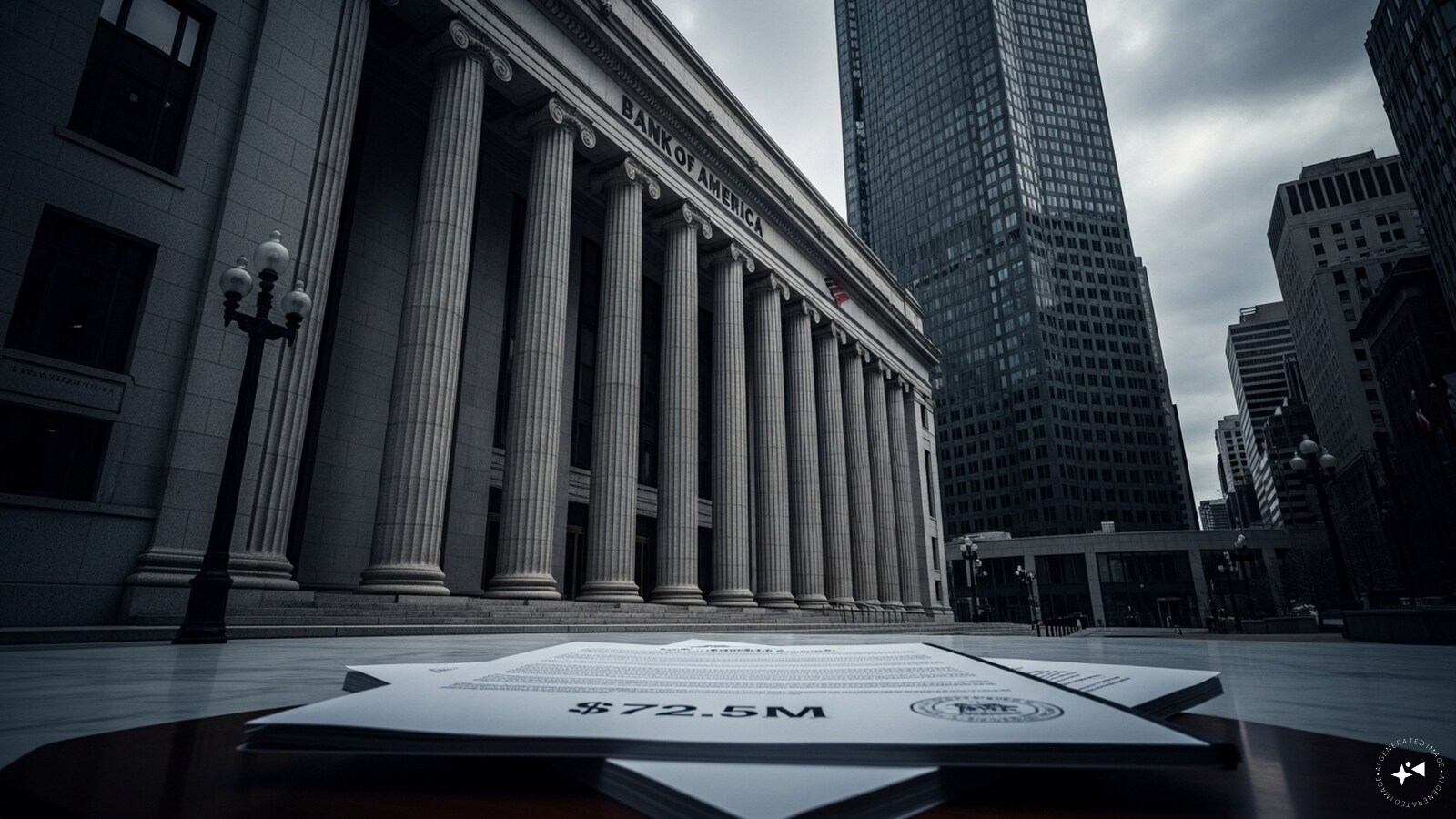
The marble floors of a global banking headquarters don’t just muffle the sound of footsteps. They muffle history. In the vaulted ceilings and the hushed tones of executive suites, there is a specific kind of silence that money buys—a silence that smells like expensive cologne and looks like a signed non-disclosure agreement. But eventually, even the thickest stone walls start to sweat.
Bank of America recently agreed to pay $72.5 million. On a balance sheet, it is a rounding error. To the women who lived through the nightmare of Jeffrey Epstein’s trafficking ring, it is a reckoning that arrived decades late. This settlement isn't just about a wire transfer. It is about the plumbing of the financial world and how, for years, the pipes stayed clear for a monster while the victims were treated as invisible.
The Ledger of Human Cost
Think of a bank account as a digital diary. It records where you go, what you value, and who you are. When Jeffrey Epstein moved through the world, he left a trail of transactions that should have set off every alarm in the building. Yet, for a long time, those alarms stayed dark.
The lawsuit brought against Bank of America by Epstein’s survivors wasn't about a simple clerical error. It was about the institutional "blind eye." The plaintiffs argued that the bank provided the essential oxygen—the liquidity—that allowed Epstein’s operation to breathe. You cannot run an international web of abuse with pocket change. You need a sophisticated, institutional apparatus to move millions, to pay off facilitators, and to keep the machine oiled.
Imagine a young woman, perhaps nineteen, lured by the promise of a modeling career or an educational scholarship. She enters a mansion that feels more like a prison. In the background, invisible to her, a banker is approving a transfer that pays for the very private jet that brought her there. This is the intersection of high finance and deep trauma. The $72.5 million settlement is a belated acknowledgement that the bank’s role was more than just passive. It was a failure of the most basic gatekeeping duty: the responsibility to ensure that your platform isn't being used to facilitate a crime against humanity.
The Illusion of Due Diligence
Banking regulations often talk about "Know Your Customer" (KYC). It sounds like a friendly handshake, but it is meant to be a defensive shield. It is the process where a bank looks at a billionaire and asks, "Where did this come from?" and "What is this for?"
In the case of Epstein, the "what" was increasingly obvious to anyone who dared to look. By the time he became a client of various major institutions, including Bank of America through its acquisition of US Trust, his reputation was not just a whisper; it was a roar. He was a convicted sex offender. He was a man whose wealth was as mysterious as his connections.
When a regular person tries to deposit $10,001 in cash, the bank triggers a Suspicious Activity Report. The system is designed to catch the small-time hustler or the local contractor evading taxes. But when the numbers grow large enough, the scrutiny often softens. The "private banking" experience is designed to remove friction. It is a world of "yes."
The survivors argued that Bank of America ignored the most glaring red flags because the relationship was profitable. They contended that the bank failed to monitor accounts that were being used to pay for the transport and housing of victims. In the cold language of a courtroom, this is called "complicity." In the language of the survivors, it is a betrayal of the social contract.
The Weight of $72.5 Million
Numbers are deceptive. To a person struggling to pay rent, $72 million is an unfathomable fortune. To a bank that manages trillions in assets, it is a Tuesday.
This is the central tension of the settlement. Does a payout actually change behavior? Or is it simply a "sin tax"—a fee paid to make a PR nightmare go away?
The survivors’ legal team, led by attorneys who have spent years chasing the ghosts of Epstein’s network, didn't just want the money. They wanted the discovery. They wanted the emails. They wanted the proof that people in suits knew what was happening and chose to look at their bonuses instead of the victims. By settling, Bank of America avoids a trial that would have dragged those internal communications into the harsh light of a public record.
However, there is a victory in the sum itself. It is one of the largest settlements of its kind involving a financial institution and human trafficking allegations. It sets a precedent that the "I just work here" defense is no longer sufficient. If your bank is the engine room for a criminal enterprise, you are responsible for the smoke.
The Invisible Stakes
We often talk about the "financial system" as if it is a weather pattern—something abstract and unavoidable. We forget that the system is made of people. People who sign off on wires. People who skip the extra background check because the client has a famous last name. People who decide that the risk of losing a wealthy client outweighs the risk of being a moral failure.
The stakes aren't just about Epstein. They are about the next predator who is currently using a legitimate business front to hide an illegitimate life. If banks aren't held to account for who they serve, the system remains a sanctuary for the worst among us.
Consider a hypothetical bank manager. Let’s call him Marcus. Marcus sees a series of large cash withdrawals and payments to "consultants" with no traceable business history. He sees travel expenses to private islands that correlate with news reports of a scandal. Marcus has a choice. He can flag it and risk the wrath of his superiors for offending a high-net-worth individual, or he can keep his head down and wait for his quarterly review.
For years, the culture of banking encouraged Marcus to keep his head down. This settlement is a message to every Marcus in every skyscraper from New York to London: the silence is getting too expensive to maintain.
Beyond the Checkbook
The money from this settlement will be distributed to the survivors, many of whom have spent the last decade fighting to be heard. It will pay for therapy. It will pay for the lives they had to rebuild from the scrap heap of Epstein’s "charity." But it cannot buy back the years lost or the innocence stolen.
The real shift isn't in the bank’s bank account. It is in the shift of the burden of proof. We are entering an era where "we didn't know" is no longer a legal or moral shield. The technology exists to track these patterns. The data is there. The only thing missing, historically, has been the will to act.
Bank of America’s decision to settle suggests they knew the risks of a trial were too great. They knew that a jury of twelve ordinary people might look at the evidence and see more than just a failure of compliance. They might see a choice.
The settlement is a closed door. It ends the litigation, but it doesn't end the conversation. It leaves us with a haunting question about the institutions we trust with our society’s wealth. If a bank can miss a monster in its lobby for years, what else is it missing?
The ink is dry on the check. The lawyers have moved on to the next case. But the survivors remain, and the precedent remains. The House of Money is no longer a fortress where the screams of the exploited can be drowned out by the sound of a ticking clock and the rustle of paper.
The silence has been broken. And in the world of high finance, that is the most expensive thing of all.
Would you like me to analyze the specific compliance failures mentioned in the court filings to see how they might impact future banking regulations?