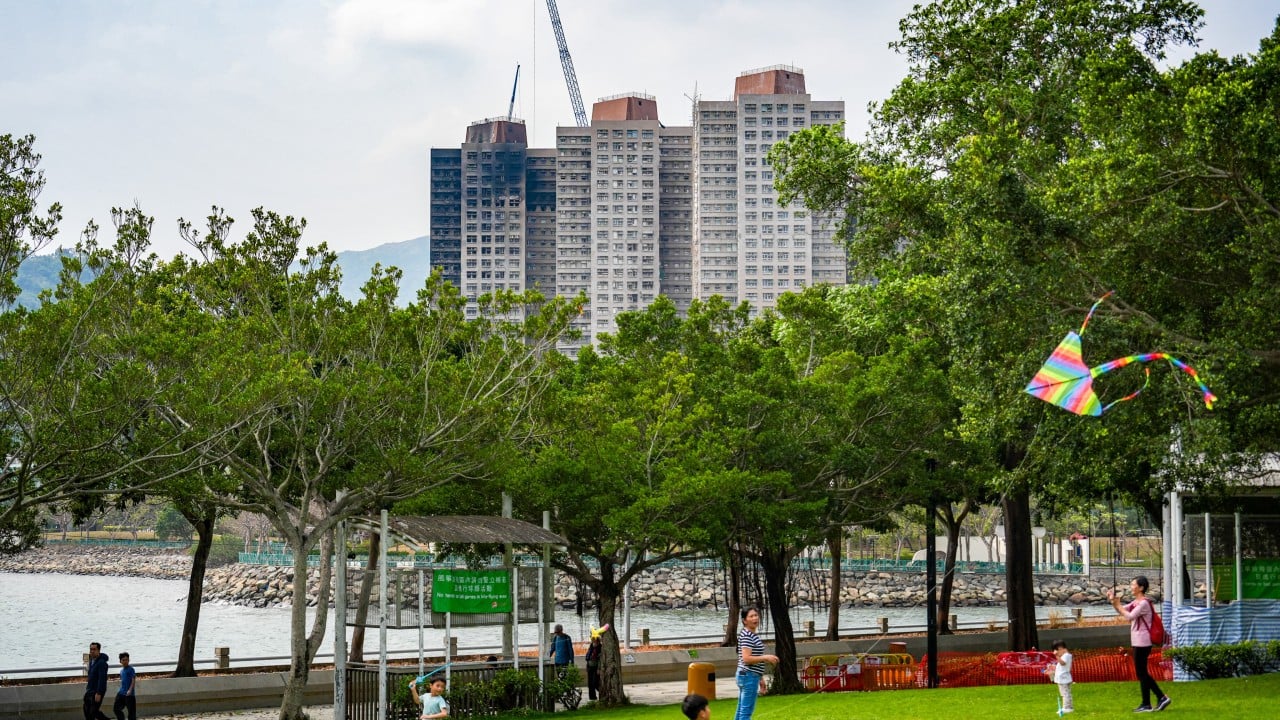
The smell of burning plastic has a way of lingering in the back of your throat long after the smoke clears. It is a chemical, biting scent that reminds you how fragile the walls of a home truly are. In Tai Po, at the sprawling Elegance Garden estate, that scent became the terrifying reality for hundreds of families on a Tuesday that should have been ordinary.
For months, the estate had been a hive of activity. Scaffolding climbed the walls like a wooden skeleton, and the air was thick with the dust of a HK$336 million renovation project. It was supposed to be a rebirth. A facelift for a middle-class sanctuary. Residents looked at the soaring costs—nearly a third of a billion dollars—and assumed that such a staggering price tag bought more than just aesthetics. They assumed it bought safety.
They were wrong.
The Day the Skeleton Caught Fire
Think of a high-rise renovation as a temporary, highly flammable second skin draped over a building. You have nylon safety nets, bamboo poles, wooden planks, and plastic debris wraps. When a fire breaks out in this "skin," it doesn't just burn; it climbs.
On that Tuesday afternoon, the scaffolding at Block 4 didn't just catch fire. It roared. Thick, oily black smoke choked the windows of apartments where elderly residents were taking naps and young parents were preparing afternoon snacks. The fire department scrambled, deploying two breathing apparatus teams and a coal-fire jet. They evacuated 300 people.
Imagine being one of them. You are 70 years old, living on the 15th floor, and the only way out is a stairwell rapidly filling with the ghost of burnt nylon. You look out your window and see orange tongues licking the very scaffolding that was supposed to be "improving" your life.
The fire was extinguished. The physical wounds were minor—one person sent to the hospital with smoke inhalation. But as the smoke dissipated, a much uglier truth began to crystallize.
A HK$336 Million Oversight
The numbers involved in the Elegance Garden renovation are dizzying. HK$336 million is not a budget; it is a fortune. It is the kind of money that should guarantee a gold-standard approach to every nail driven and every brushstroke applied.
Yet, records and post-fire investigations revealed a staggering void where common sense should have been. The Fire Services Department (FSD) confirmed a detail that should haunt every high-rise resident in Hong Kong: they had not conducted a single fire safety inspection on the renovation site before the blaze.
Why? Because the current regulations didn't strictly require it for this type of external work.
We often think of bureaucracy as a safety net. We tell ourselves that if a project is big enough, or expensive enough, someone in a uniform with a clipboard must have signed off on the risks. In reality, the net is full of holes. The renovation was treated as a cosmetic endeavor, a matter of paint and pipes, rather than a massive structural alteration that introduced tons of flammable material to a densely populated vertical neighborhood.
Consider the irony. A resident pays a massive levy—sometimes hundreds of thousands of dollars per household—to ensure their building lasts another thirty years. They sign the checks. They endure the noise. And all the while, the very equipment used to "save" the building is a tinderbox waiting for a stray spark or a discarded cigarette.
The Invisible Stakes of Vertical Living
Hong Kong is a city built on trust. We trust the MTR to run on time, we trust the banks to hold our savings, and we trust that the concrete boxes we inhabit are fortresses.
When a fire breaks out on a renovation site, that trust isn't just singed; it’s incinerated. The "human element" here isn't just the 300 people who ran for their lives. It’s the thousands more living in the other blocks, looking at the scaffolding outside their own windows and wondering if they are sleeping next to a fuse.
The technical failure at Tai Po was a lack of "hot work" supervision. Hot work is the industry term for anything involving sparks or flames—welding, cutting, grinding. On a HK$336 million job, you would expect a dedicated fire safety officer to be present for every minute of hot work. You would expect fire-retardant netting that actually retards fire, rather than acting as a vertical highway for it.
Instead, the investigation pointed toward a chaotic management of risk. The Fire Services Department noted that while they provide "guidelines," the enforcement of those guidelines on private residential renovations is often a grey area. It is a world of self-regulation where the lowest bidder often sets the pace.
The Cost of Silence
In the aftermath of the Tai Po blaze, the silence from the management and the contractors was louder than the sirens. For the residents, the financial burden of the renovation was already a source of stress. Many are retirees on fixed incomes who saw their life savings drained by the mandatory building inspection scheme and subsequent repair orders.
To pay a king's ransom for a renovation and then almost lose your home to it is a betrayal of the highest order.
The lesson of Elegance Garden isn't about one fire in one district. It is a warning about the complacency that grows when money starts moving in large quantities. We assume that high costs equate to high oversight. We assume that "professional" means "protected."
But safety is never a byproduct of a high price tag. It is a deliberate, daily choice. It is the choice to inspect the scaffolding at 6:00 AM. It is the choice to hire an independent safety auditor even when the law doesn't force you to. It is the choice to value the lives inside the building more than the deadline for the exterior finish.
Watching the Windows
The scaffolding at Elegance Garden will eventually come down. The walls will be painted, the pipes replaced, and the HK$336 million will be accounted for in ledgers and bank transfers.
But for the families who stood on the sidewalk that Tuesday, watching their homes disappear behind a curtain of black smoke, the building will never feel the same. Every time they hear a drill or smell something faint and acrid on the wind, their hearts will skip.
They know something now that the rest of us are still trying to ignore. They know that the only thing standing between a peaceful evening and a vertical inferno is a single inspection that nobody felt like doing.
Across the city, thousands of other buildings are currently draped in that same green nylon. Thousands of other residents are looking through the mesh, watching the sunset, unaware of whether their "skin" is a shield or a trap.
The fire in Tai Po didn't kill anyone this time. We got lucky. But luck is a terrible strategy for a city built in the clouds, and HK$336 million is a lot of money to pay for a roll of the dice.
Deep in the night, the building settles. The wind whistles through the bamboo poles. Somewhere, a loose piece of plastic debris flaps against the concrete. It sounds like a heartbeat. Or a warning.