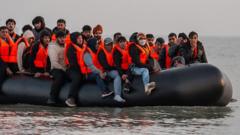
The mist on the English Channel doesn’t just obscure the white cliffs of Dover; it hides a multi-million-pound machinery of surveillance, diplomacy, and desperation.
On a morning where the salt air bites at the skin, the water looks like hammered lead. It is beautiful, in a haunting, lethal way. But for the officials sitting in wood-paneled rooms in London and Paris, this water isn’t a landscape. It is a balance sheet. It is a political frontier that has just been assigned a very specific price tag: £478 million over three years, or roughly €541 million at the current exchange.
Total the bill, and you arrive at a staggering £662 million investment to police a stretch of water barely twenty miles wide.
The New Watchtowers
Consider a hypothetical officer named Marc. He is stationed on a beach in northern France, his boots sinking into the grey sand of Pas-de-Calais. Ten years ago, Marc might have patrolled with a pair of binoculars and a radio. Today, the agreement signed between Rishi Sunak and Emmanuel Macron has transformed his patrol into a high-stakes tech operation.
The money buys eyes. Hundreds of them.
The deal funds a new detention center in France to hold those intercepted before they reach the surf. It pays for 500 additional French officers to roam these dunes. But the real shift is in the silence overhead. Drones now hum against the wind, their infrared sensors seeking out the heat signatures of bodies huddled in the tall grass. There are ground-based sensors, thermal imaging cameras, and a dedicated 24-hour command center where British and French officers sit side-by-side, staring at screens that turn human lives into pulsing green dots.
This isn’t just a border anymore. It is a laboratory for modern migration control.
The Invisible Stakes
To understand why two nations would commit over half a billion pounds to a few miles of coastline, you have to look past the headlines.
The political pressure is a physical weight. In Westminster, the "Stop the Boats" slogan has become a rhythmic chant, a promise that must be kept at almost any cost to maintain public trust. In Paris, the pressure is different but equally sharp. France does not want to be seen as the UK’s "border guard," yet they require the funding to manage the pressure on their own northern towns.
The £478 million is a handshake in the dark. It is an admission that neither side can solve the problem alone.
But the logic of the deal relies on a grim gamble. The theory is that if you make the crossing difficult enough—if you saturate the beaches with enough boots and the sky with enough cameras—the business model of the smuggling gangs will collapse. This assumes that a human being’s desire to cross is a rational economic choice that can be deterred by a higher price or a greater risk.
History suggests something more complicated.
The Cost of the Crossing
Imagine, for a moment, the person on the other side of Marc’s thermal camera.
Let’s call him Elias. He isn't a statistic. He is a man who has traveled three thousand miles to stand on a French beach in the rain. He has already survived deserts, shake-downs by militia, and the soul-crushing boredom of refugee camps. To Elias, the £662 million deal is invisible. He doesn't read the joint communiqués from the Elysée Palace.
What he sees are the dunes.
When the security gets tighter, Elias doesn't go home. He simply waits for a darker night. He looks for a more dangerous, less-monitored stretch of coast further west. He pays a smuggler more money because the risk has increased. The smuggler, in turn, buys a cheaper, flimsier boat to maximize profit against the risk of seizure.
This is the hidden physics of the Channel. As the investment in security goes up, the desperation doesn't vanish; it just shifts. It moves down the coast. It moves into deeper, rougher waters.
The Breakdown of the Bill
Where exactly does the money go?
- The Human Wall: The funding provides for a massive increase in personnel. This isn't just about more people on the sand; it's about the logistics of housing, feeding, and transporting a small army of gendarmes and border agents.
- The Tech Net: Expenditure on drones, helicopters, and fixed-wing aircraft has tripled. The goal is "total situational awareness"—the ability to see every movement on the French coast in real-time.
- The Infrastructure of Deterrence: A new administrative center in France will streamline the processing of those caught, attempting to break the cycle of "catch and release" that has frustrated authorities for years.
The British government views this as a necessary down payment on national security. They argue that the cost of housing asylum seekers in UK hotels—estimated at over £6 million a day—far outweighs the cost of this deal. If the deal prevents even a small percentage of crossings, the Treasury considers it a win.
The Friction of Success
There is a strange paradox at the heart of the UK-France relationship. The more successful the policing, the more friction it creates.
When the French police intercept a boat, they are performing a service for the British government. But they are also increasing the number of displaced people staying in French towns like Calais and Dunkirk. This creates local tension. It turns small seaside villages into geopolitical flashpoints.
The deal is a fragile bridge over a very turbulent sea. It requires constant maintenance. It requires the British to keep paying and the French to keep patrolling, even when the optics of "policing for a neighbor" become politically difficult in Paris.
The reality of the Channel is that it is no longer a natural barrier. It is a managed space. It is a theater where the props are patrol boats and the script is written in the language of international treaties.
The Silent Water
As the sun begins to set, the orange light catches the tops of the waves. It looks peaceful.
But beneath that peace is the constant, grinding reality of the £662 million operation. The drones are taking off for their night shifts. The officers are checking their thermal scopes. In the shadows of the dunes, groups of people are waiting for the wind to die down.
We speak about "small boats" as if they are the problem. They aren't. They are the symptoms of a world in motion, a world where the gap between where people are and where they want to be is wider than any channel.
The UK and France have bought themselves a very expensive set of tools to manage that gap. They have built a wall of glass and steel and human bodies across the water. They have gambled that money can buy control over the most primal of human instincts: the urge to find a different life.
The leaden water of the Channel remains indifferent to the deal. It doesn't care about the millions of pounds or the high-level handshakes. It only knows the weight of the boats and the coldness of the mist. And as the night falls, the green dots on the screens will begin to flicker again, moving slowly toward the horizon, proving that some things are far more expensive than gold.
The lights of Dover twinkle in the distance, a billion-pound view that remains just out of reach for those standing in the French mud.


