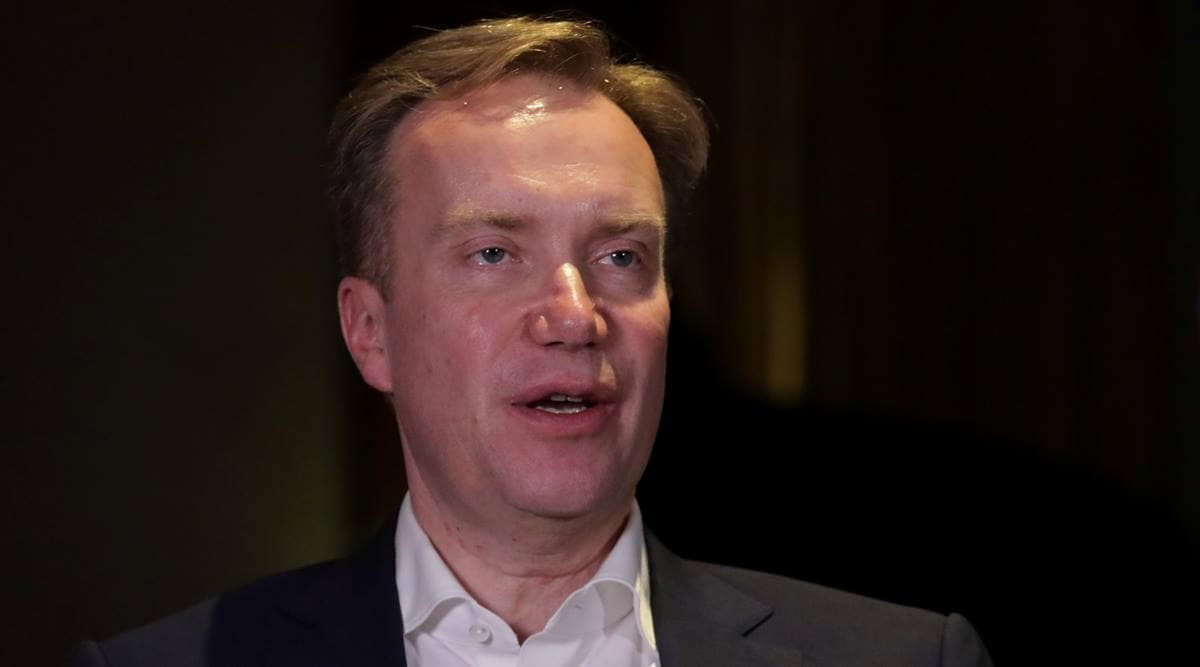
The sudden departure of Børge Brende from his post as President of the World Economic Forum (WEF) marks the end of an era for the Swiss-based organization. While the official narrative often leans on retirement or a planned transition, the timing suggests a much sharper reality. Brende, a former Norwegian Foreign Minister who has spent years as the public face of the Davos elite, found himself caught in a tightening web of institutional scrutiny. At the heart of this storm lies the resurfacing of the organization’s historical proximity to Jeffrey Epstein, a shadow that the WEF has desperately tried to outrun for years.
This isn't just about one man stepping down. It is about the collapse of a specific type of globalist insulation. For decades, the WEF operated as a sovereign entity of influence, untouched by the standard accountability measures of public office or corporate boards. However, as transparency demands intensified and the Epstein connection evolved from a whisper to a documented liability, the internal friction became unbearable. The "Davos Man" is no longer untouchable, and Brende’s exit is the first major crack in the facade. Meanwhile, you can read other developments here: The Caracas Divergence: Deconstructing the Micro-Equilibrium of Venezuelan Re-Dollarization.
The Epstein Connection That Wouldn’t Die
The association between the World Economic Forum and Jeffrey Epstein was never a secret, but it was long treated as a footnote. That changed as investigative efforts began to map the exact intersections of Epstein’s social circle and the WEF’s guest lists. Epstein was not just a casual observer; he was a fixture in the orbits where power and capital met under the guise of "improving the state of the world."
The problem for Brende was not necessarily personal involvement, but the institutional failure to address these ties with any level of sincerity. When the public started asking how a convicted sex offender maintained such high-level access to global leaders, the WEF’s response was a mix of silence and bureaucratic deflection. This strategy backfired. In the current climate, silence is often interpreted as complicity or, at the very least, a profound lack of judgment. To explore the complete picture, check out the detailed article by CNBC.
The pressure intensified as member companies—the massive global corporations that fund the WEF—began to worry about the optics. No CEO wants to be photographed at a summit that is being actively investigated for its historical links to a human trafficking ring. Brende, as the primary liaison between the Forum and these corporate titans, became the lightning rod for their anxiety.
Institutional Rot or Poor PR
One has to look at the mechanics of the WEF to understand why Brende’s position became untenable. The organization operates on prestige. It sells the idea of being "in the room" where the future is decided. If that room is perceived as tainted, the product loses its value.
Critics have long pointed out that the WEF’s selection process for its "Young Global Leaders" and its invitation-only summits lacked rigorous vetting. Epstein exploited these gaps. He understood that the WEF was a vanity project for the global elite, and he used it to bolster his own legitimacy. By the time Brende took the helm, the damage was already embedded in the foundation. He was tasked with professionalizing an organization that was built on a series of elite handshakes and closed-door agreements.
The friction grew when internal audits—stimulated by the threat of legal discovery and media pressure—began to look at historical funding and sponsorship. The WEF has always maintained it is a non-profit, but its revenue streams are as complex as any multinational bank. When the ledger meets the legacy of figures like Epstein, the math stops making sense to the public.
The Shift in Global Power Dynamics
Brende’s departure also reflects a broader shift in how the world views these types of international gatherings. The "Great Reset" era brought a level of scrutiny to the WEF that it was fundamentally unprepared for. Suddenly, every move Brende made was analyzed not just by business journalists, but by a global audience skeptical of centralized power.
The rise of populism across Europe and the United States turned Davos into a caricature of out-of-touch elitism. Against this backdrop, any scandal—especially one as visceral as the Epstein connection—becomes fuel for a fire that the WEF cannot extinguish. Brende found himself defending an institution that was simultaneously trying to lead the world while running from its own past.
It is a grueling task. Leading an organization that claims to solve the world’s most pressing issues while being unable to solve its own reputational crisis creates a cognitive dissonance that eventually breaks even the most seasoned diplomat.
The Corporate Exodus
Behind the scenes, the real story is the money. The World Economic Forum relies on "Partners"—companies like BlackRock, Goldman Sachs, and McKinsey—who pay hundreds of thousands of dollars annually for the privilege of membership. These entities are risk-averse. They are currently navigating an environment where "Environmental, Social, and Governance" (ESG) metrics are being weaponized by both the left and the right.
When the Epstein links were scrutinized under a fresh lens, these corporate partners began to ask difficult questions. They weren't just worried about the moral implications; they were worried about the legal ones. If an organization they fund is found to have ignored red flags regarding criminal activity, the liability could theoretically flow uphill.
Brende’s job was to keep these partners happy. Once he could no longer guarantee that the WEF was a "safe" brand, his utility to the board evaporated. The decision for him to quit was likely presented as a graceful exit, but the fingerprints of corporate boardroom pressure are all over the document.
A Failed Rebranding Effort
Throughout his tenure, Brende tried to move the WEF away from its "billionaire summer camp" image and toward a serious policy-making body. He introduced more technical tracks, focused on cybersecurity, and tried to integrate more voices from the Global South.
However, you cannot build a new house on a radioactive site. No matter how many panels on green energy or AI ethics Brende scheduled, the questions about the 2000s and 2010s remained. The internet has a long memory, and the digital trail linking Epstein to various WEF-adjacent figures is easily accessible.
Brende’s mistake was believing that "doing good work" in the present could overwrite the unresolved issues of the past. In modern crisis management, that rarely works. You have to excise the problem, not just cover it with new initiatives. Because the WEF refused to perform that surgery, Brende became the casualty of the resulting infection.
The Leadership Vacuum
Who steps into this role now? The WEF is at a crossroads. It can either double down on its current path and risk further irrelevance, or it can undergo a radical restructuring. The problem is that the founder, Klaus Schwab, still looms large over the entire operation. Brende was often seen as the pragmatic operator under Schwab’s ideological vision.
With Brende gone, the organization loses its most effective diplomat. Finding a successor who is willing to take on the Epstein baggage while also managing the egos of a thousand CEOs is a tall order. Most qualified candidates will look at the current state of the WEF and see a career-ender, not a career-maker.
The Legal Shadow
We must also consider the ongoing legal developments regarding the Epstein estate and his associates. As more documents are unsealed in various jurisdictions, the names appearing in flight logs and calendars continue to create headaches for high-society institutions. The WEF is uniquely vulnerable here because its entire model is based on networking.
If a new cache of documents shows that specific WEF events were used as scouting grounds or that the organization received direct or indirect financial benefits from Epstein-linked entities after his initial conviction, the situation moves from a PR nightmare to a legal catastrophe. Brende’s resignation allows him to distance himself from whatever might come out in the next round of disclosures. It is a classic "get out while the getting is good" maneuver.
Beyond the Official Statement
The official press release will talk about Brende’s "contributions to global cooperation" and his "steadfast leadership." It will ignore the protests, the uncomfortable questions from independent journalists, and the palpable tension that has defined the last few Davos summits.
To understand the truth, one has to look at what is not being said. There is no mention of an internal investigation. There is no mention of a change in vetting procedures. There is only a quiet exit and a hope that the news cycle moves on to something else.
But the world has changed. The gatekeepers of information no longer have the power to bury these stories. The scrutiny of Børge Brende and his ties to the Epstein era is not an isolated event; it is a symptom of a broader demand for transparency that the World Economic Forum is simply not built to survive in its current form.
The era of the untouchable global administrator is over. Brende’s departure is the definitive proof. If the WEF wants to continue its existence, it will have to do more than change its president; it will have to change its soul. That would require an admission of fault that the organization seems pathologically incapable of making.
Watch the sponsors. If the major banks and tech firms begin to quietly let their memberships lapse in the wake of this exit, you will know that the Epstein shadow has finally eclipsed the Davos sun. The collapse of an institution rarely happens with a bang; it happens with a series of quiet resignations and a slow, steady withdrawal of capital. Brende is just the first major domino.
If you are an executive at a partner firm, your next move is to demand a full, independent audit of the Forum’s historical associations before the next summit.