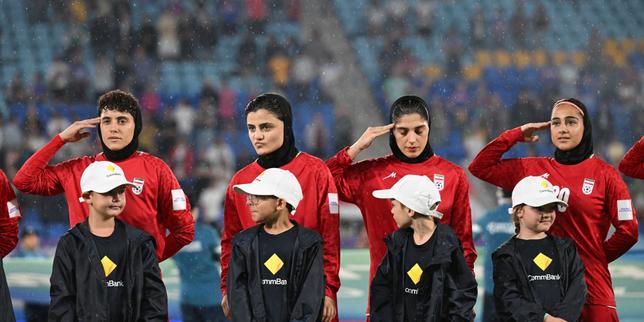
The grass in an Australian stadium has a specific scent when it is freshly cut. It smells like damp earth and possibility. For five women who spent their lives sprinting against the wind of a different sort, that scent is the most expensive perfume in the world. They didn’t buy it with money. They bought it with the terrifying currency of a one-way ticket and the clothes on their backs.
In the official record, this is a procedural update. The Australian government granted five Iranian female footballers humanitarian visas. It is a sentence composed of dry nouns and bureaucratic verbs. But if you look at the scuff marks on a pair of cleats or the way a player’s eyes dart toward the horizon, the story is not about paperwork. It is about the physics of escape.
The Sound of a Deflated Ball
Imagine—and this is no metaphor, but the lived reality of the pitch in Tehran—the sound of a game played in secret. In many parts of the world, football is a roar. It is the thunder of sixty thousand voices. For these women, for a long time, football was a whisper. It was the muffled thud of a ball against a concrete wall in a space where being an athlete was an act of subversion.
They grew up in a culture where the simple act of a girl kicking a ball was often viewed as a political statement. To lace up boots was to tighten a knot of tension with the state. When the "Woman, Life, Freedom" protests ignited across Iran following the death of Mahsa Amini, the stadium ceased to be a place of play. It became a crucible. For female athletes, the stakes shifted from winning a match to surviving the week.
Athletes are visible. That is the point of the profession. But in a crack-down, visibility is a liability. When you are a member of a national team or a prominent local club, your face is a target. Your travel is monitored. Your voice is a threat. These five women found themselves in a position where the game they loved had become the very thing that could destroy their futures.
The Geography of Fear
Australia is a long way from the streets of Shiraz or the mountains surrounding Tehran. It is roughly 12,000 kilometers of ocean and silence. To apply for a humanitarian visa is to admit that your homeland has become a house on fire.
The Australian Department of Home Affairs doesn’t hand these out like participation trophies. The process is a grueling interrogation of one’s own trauma. You have to prove, with evidence and testimony, that returning home is a death sentence or a fast track to a cage. These five players had to document the threats. They had to relive the moments when the morality police loomed larger than any opposing defender.
Consider the logistical nightmare of the departure. It isn't a team bus heading to an away game. It is a series of hushed phone calls. It is deleting messages from a WhatsApp thread every hour so that a random checkpoint search doesn't turn into an arrest. It is the agonizing weight of saying goodbye to a mother or a brother, knowing that the next time you see them might be through a pixelated screen, if at all.
A Legacy of Open Gates
Australia has a history of this. We saw it in 2021 when the Taliban reclaimed Kabul. The Afghan Women’s National Team fled, eventually finding a home in Melbourne. They became the "Hope" team, a living testament to the idea that a jersey can be a life jacket.
This latest move to bring the Iranian players into the fold is not an isolated act of charity. It is a continuation of a specific Australian philosophy regarding the intersection of sport and human rights. We believe the pitch is a sanctuary.
But the transition is brutal.
When a refugee athlete steps onto Australian soil, they aren't just thinking about their 40-yard dash time. They are thinking about the rent in a suburb they can’t pronounce. They are thinking about the teammate who didn't make it out. They are navigating a new language where even the word "football" means something different depending on which state you’re in.
The mental toll is a silent injury. You can’t put a hamstring strain in a cast, and you can’t easily heal the guilt of the survivor. They are safe, yes. But safety is a heavy thing to carry when you’ve left your soul’s geography behind.
The Invisible Scoreboard
What does Australia gain?
Critics of humanitarian programs often talk about "the burden" on the taxpayer. They look at the ledger and see costs. They see housing assistance, English classes, and administrative hours.
They are looking at the wrong scoreboard.
When these women join local clubs—and they will—they bring a brand of resilience that cannot be coached. You cannot teach a striker how to remain calm under pressure the way a woman who has navigated an autocracy remains calm. They bring a technical proficiency forged in the fires of necessity. More importantly, they provide a bridge.
The presence of these five players in the Australian sporting landscape forces us to reckon with our own freedoms. It reminds the girl playing in Sydney or Perth that her right to sweat, to shout, and to win is a precious, fragile thing. It turns every local match into a celebration of a global sisterhood.
The First Kick
The first time one of these women steps onto a pitch in Australia for an official practice, the world won't stop spinning. There will be no fireworks. There will just be the sound of a whistle.
She will look down at her boots. She will feel the familiar tension in her quads. For the first time in years, she won't have to look over her shoulder. She won't have to wonder if a member of the Basij is watching from the stands, waiting to reprimand her for a stray lock of hair or a defiant shout.
She will just be a footballer.
That is the ultimate victory of the humanitarian visa. it isn't the legal right to reside; it is the human right to be ordinary. To be judged only by the accuracy of a pass or the timing of a header.
The grass is green. The air is clear. The goalposts are exactly where they are supposed to be.
She takes a breath. She runs.
She is no longer running away. She is finally, after a lifetime of hurdles, running toward the ball.