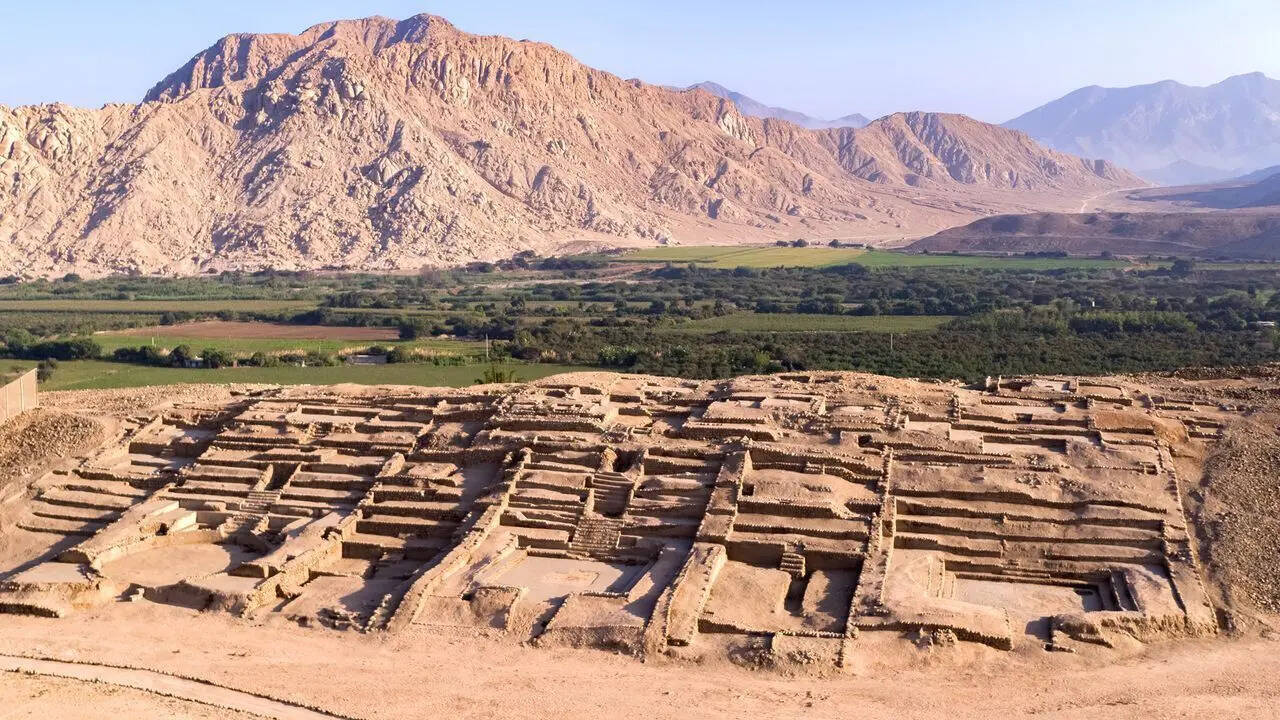
The wind in the Casma Valley doesn't just blow. It scours. It carries the weight of the Sechura Desert, a fine, relentless grit that finds its way into your lungs, your eyes, and the very marrow of your history. For nearly four millennia, this dust held a secret. It sat atop the ruins of Sechín Bajo, a sprawling urban complex that should not, by any conventional logic of geography, exist.
To understand why this place matters, you have to understand the hostility of the terrain. Most great civilizations were born in the cradles of abundance—the silt-rich banks of the Nile or the yellow earth of the Yangtze. But 3,800 years ago, a group of people looked at one of the driest strips of land on the planet and decided to build a masterpiece.
They didn't just survive. They thrived.
The Architects of the Impossible
Imagine a woman named Coya. This is a hypothetical exercise, but her reality is etched into the stone walls recently unearthed by archaeologists. Coya lives in a city of massive sunken plazas and towering platforms. To her left, the Pacific Ocean crashes against jagged cliffs; to her right, the Andes rise like frozen giants. In between is a wasteland.
Yet, Coya is not starving. She is not a nomad desperately chasing a seasonal raincloud. She is a citizen of a sophisticated socio-political machine.
The breakthrough at Sechín Bajo isn't just about the age of the stones, though at 3,500 to 3,800 years old, they predate almost everything else in the Americas. The real story is the engineering of the spirit. These people mastered the art of "lomas"—seasonal fog oases—and harnessed the meager runoff from the mountains with a precision that makes modern irrigation look like child’s play.
They built a circular sunken plaza, a space designed for the collective. When you stand in the center of that excavation today, the silence is heavy. You realize that these people weren't just stacking rocks; they were creating a theater for the soul. The walls are adorned with friezes of "sacrificers" and feline deities. It is visceral. It is violent. It is deeply, hauntingly human.
The Myth of the "Primitive"
We often fall into the trap of chronological snobbery. We assume that because they lacked the wheel or a written alphabet in the way we define it, they were somehow simpler. This is a mistake.
The inhabitants of this desert city were master strategists. They lived in a world where the El Niño Southern Oscillation could turn their home from a dust bowl into a flood zone overnight. Their response? They built for permanence. They used "shicras"—woven grass bags filled with stones—as the foundation for their pyramids.
This wasn't just construction. It was seismic engineering.
When an earthquake struck, the stones shifted within the flexible grass bags, absorbing the energy instead of resisting it. The building swayed. It breathed. While modern steel skyscrapers rely on complex dampeners, the Sechín architects used the weeds growing by the riverbank to keep their gods from falling.
The Invisible Stakes of the Casma Valley
Why did they stay? This is the question that keeps archaeologists awake. Why choose the desert when the lush highlands were only a few days’ trek away?
The answer lies in the ocean. The Humboldt Current, cold and nutrient-dense, acted as a prehistoric pantry. By bridging the gap between the hyper-arid coast and the sea, these people created a trade monopoly. They exchanged dried fish and salt for obsidian and colorful feathers from the interior.
They were the first great capitalists of the New World, but their currency wasn't gold. It was survival.
Consider the logistics of a single plaza. It required the coordinated labor of thousands. This implies a hierarchy. It implies taxes, or at least a shared religious fervor strong enough to convince a man to carry a forty-pound bag of rocks under a sun that wants to kill him. This wasn't a village. It was a statement of intent.
The Shadow of the Sechín Friezes
If you walk along the outer wall of the Cerro Sechín complex, the narrative takes a dark turn. The stone carvings here are not of harvests or marriages. They are of war.
You see dismembered bodies. You see warriors holding trophy heads. You see the agony of the defeated carved into granite with such skill that the terror feels fresh. Some scholars argue these represent actual battles; others suggest they are symbolic representations of the cosmic struggle between order and chaos.
But for the person living there, the distinction was likely irrelevant.
In a landscape where resources are so tightly contested, the "other" is always a threat. The city was a fortress as much as it was a temple. The beauty of their architecture was bought with the blood of their defense. It is a sobering reminder that civilization is not a natural state of being. It is a fragile, hard-won victory against the void.
Lessons from a Dying Sun
There is a specific kind of light that hits the Casma Valley at dusk. It turns the sand a bruised purple and makes the ancient walls glow with a deceptive warmth. Looking at these ruins, it is impossible not to feel a sense of kinship.
We live in an era of climate anxiety. We look at our changing world and wonder if we can adapt. The people of Sechín Bajo already answered that question. They lived through cycles of drought and deluge that would have leveled a less organized society. They didn't have satellite imagery or drought-resistant GMOs. They had communal will.
They understood something we have largely forgotten: wealth is not what you extract from the earth, but how you manage what the earth refuses to give.
The Silent Exit
Then, they vanished.
Around 1500 BCE, the great centers of the Casma Valley began to go quiet. The plazas were filled in. The friezes were covered. There is no evidence of a cataclysmic plague or a Great Fire. Instead, it seems the people simply moved on. Perhaps the bureaucracy became too heavy. Perhaps the gods stopped answering the prayers for rain.
The desert reclaimed its own.
The sand filled the sunken plazas, preserving the carvings in a vacuum of dry air. For thousands of years, the wind moved the dunes back and forth over the site like a restless blanket.
Today, as researchers brush away the dirt, they aren't just finding artifacts. They are finding a mirror. We see our own drive to build, our own capacity for cruelty, and our own desperate need to leave a mark on a world that is indifferent to our presence.
The city of Sechín Bajo is a ghost, but it is a loud one. It tells us that even in the harshest desert, among the jagged rocks and the blinding dust, humans will always find a way to build something that reaches for the sky.
We are a species that refuses to be quiet.
The wind continues to scour the valley, but the stones remain, defiant and unyielding, staring back at the sun.