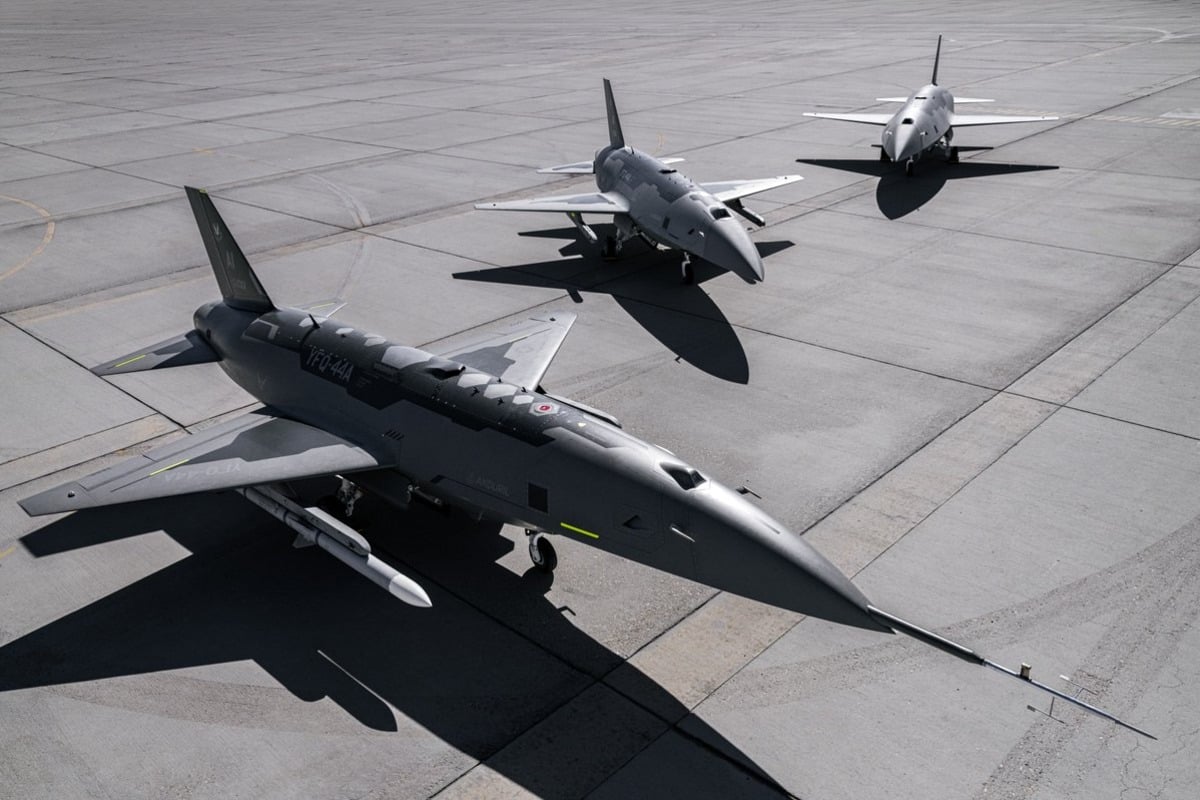
The mainstream defense press is swooning over the U.S. Air Force greenlighting two Collaborative Combat Aircraft (CCA) prototypes. They paint a picture of automated wingmen flying flawlessly alongside F-35s, overwhelming adversaries through sheer numbers and cheap production.
It is a fantasy.
The defense establishment is making a massive, predictable blunder. They are treating a deep, systemic software and architectural crisis as if it were a simple hardware manufacturing problem. By celebrating the approval of these unmanned systems, Washington is cheering for the illusion of mass while ignoring the reality of digital obsolescence.
I have watched defense contractors burn through billions of taxpayer dollars promising autonomous revolution, only to deliver platforms that cannot pass basic regression testing without a team of hundreds of engineers sitting in a control room. The current CCA roadmap is not a breakthrough. It is an expensive band-aid for an Air Force that has priced itself out of a conventional fleet.
The Myth of the Cheap Attritable Drone
The tech media loves the word "attritable"—the idea that these drone jets are cheap enough to be lost in combat without breaking the bank. They quote targets of $10 million to $20 million per unit.
Let's look at the math. A standard precision-guided munition like a Joint Direct Attack Munition costs thousands. An advanced air-to-air missile costs over a million. If you build a sleek, stealthy airframe, pack it with a high-performance turbine engine, and stuff it with an advanced sensor suite capable of tracking threats at Mach 1.5, you have not built a disposable drone. You have built a cut-rate fighter jet.
When you factor in the lifecycle costs, secure data links, specialized ground control stations, and the inevitable cost overruns that plague contractors like Anduril and General Atomics, that $15 million price tag will easily double.
Imagine a scenario where a fleet of these "cheap" autonomous wingmen faces heavy electronic warfare jamming over the South China Sea. If they lose line-of-sight data links with their manned quarterback, they become exceptionally expensive lawnmowers or, worse, free targets. The moment a platform costs $30 million, it is no longer disposable. Leaders will treat it with the same risk-averse hesitation they show with manned assets, completely destroying the operational premise of massed drone swarms.
The Software Bottleneck Nobody Admits
Airframe design is a solved problem. We know how to shape composite materials to scatter radar waves. We know how to build efficient jet engines.
The failure point is the code.
The Air Force wants these robots to execute complex tactical decisions: identifying targets, prioritizing threats, managing energy in a dogfight, and cooperating with a human pilot who is already cognitively redlined.
Currently, the military cannot even update the software on the F-35 without years of delays and billions in cost overruns. The current Technology Refresh 3 (TR-3) upgrade for the F-35 has been a rolling disaster of software instability, pausing jet deliveries for months. If the Pentagon cannot stabilize the code on a manned platform where a human handles the high-level decision-making, it is pure delusion to think they can deploy fully autonomous, cooperative combat algorithms on a secondary fleet by the end of the decade.
True autonomy requires deterministic reliability under chaotic conditions. Right now, autonomous flight algorithms are brittle. They work beautifully in pristine simulations inside a laboratory in Southern California. They fail when faced with emergent, real-world anomalies, sensor degradation, or deliberate spoofing by a sophisticated adversary.
The Quarterback Fallacy
The prevailing concept of operations dictates that a human pilot in an F-35 or a Next Generation Air Dominance (NGAD) fighter will act as a "quarterback," commanding a small fleet of these loyal wingmen.
This concept misunderstands the reality of modern aerial warfare.
A fighter pilot traveling at supersonic speeds in a high-threat environment does not have the cognitive bandwidth to be a real-time tactical commander for four autonomous aircraft. Air combat is a matter of split-second reactions. If the pilot must constantly check a secondary display to validate what their drone wingmen are doing, approve their weapon releases, or correct their positioning, the drone is no longer an asset. It is a deadly distraction.
Furthermore, communicating with these drones requires a massive amount of data transmission. In a peer-conflict scenario, emitting any RF energy is a beacon for enemy sensors. If your robot wingmen are constantly pinging data back and forth to their quarterback, they are giving away the position of the very manned stealth jet they are supposed to protect.
The Real Strategic Play
We are asking the wrong question. The problem isn't "How do we build cheaper robotic wingmen for our existing fighters?" The real question is "Why are we still obsessed with short-range tactical fighters in an era dominated by long-range anti-access and area-denial (A2/AD) missiles?"
If an adversary can target U.S. airbases and aircraft carriers from thousands of miles away with hypersonic anti-ship and land-attack missiles, a short-range drone with a 1,000-mile combat radius is useless. It won't even make it to the fight.
Instead of building pint-sized robot fighters to protect legacy manned jets, the resources should be shifted entirely toward long-range, high-endurance autonomous strike platforms. We need machines that can operate independently over vast distances for days at a time, not fragile wingmen tied to a human pilot's apron strings.
The Pentagon's rush to greenlight these two CCA prototypes is a public relations victory disguised as a strategic shift. It allows officials to tell Congress they are innovating, while maintaining the exact same industrial base and operational philosophies that have bloated defense budgets for fifty years.
Stop celebrating the arrival of the robot wingman. It is a costly distraction from the structural reforms needed to survive a modern conflict. Move the funding out of tactical fighter concepts entirely and put it into long-range distributed payload delivery, hardened non-kinetic electronic warfare, and decentralized command architecture. Everything else is just theatre.