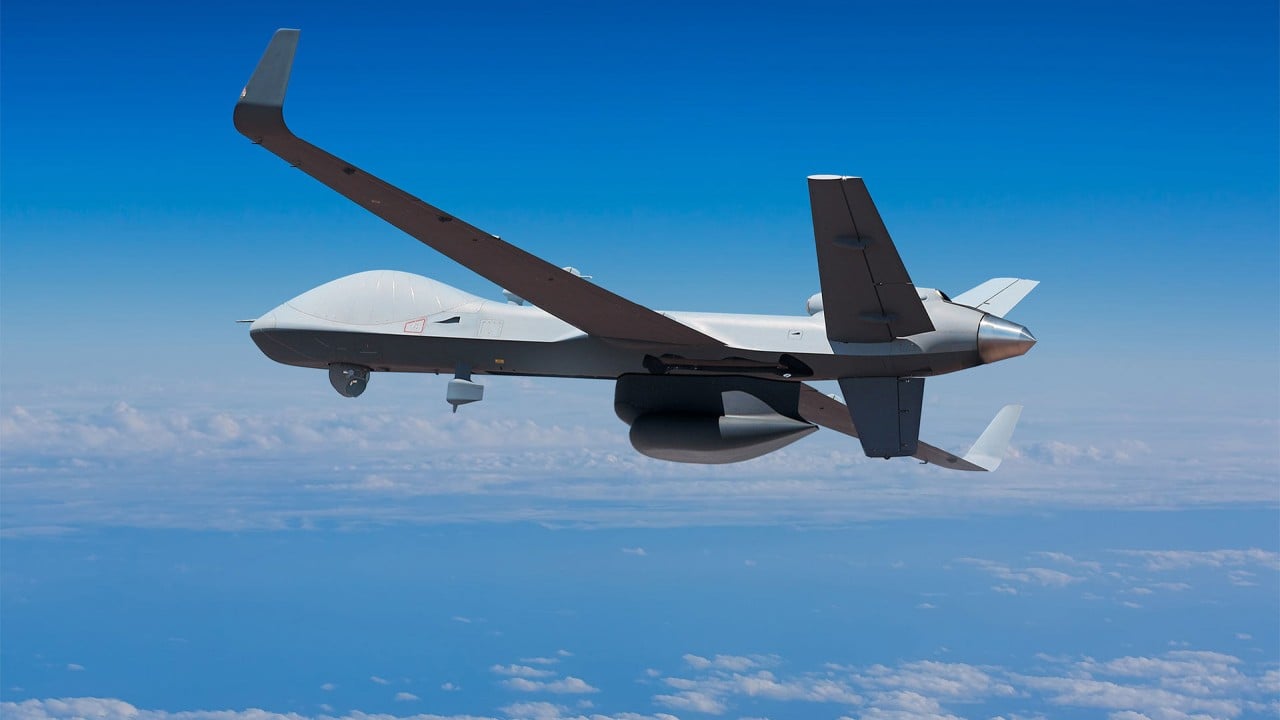
Tokyo is quietly scrambling to plug a massive security gap in the Western Pacific before it is too late. The Japanese government has initiated a sweeping defense overhaul to deploy long-range, early-warning radar drones and mobile tracking units across its remote islands. This high-stakes initiative targets what military planners openly call a critical surveillance "blind spot"—a massive expanse of open ocean where Chinese aircraft carriers and sea-skimming missiles can increasingly operate outside the view of traditional land-based radar networks. By pushing its electronic eyes thousands of feet into the air via unmanned platforms, Japan aims to rewrite the tactical math of the First and Second Island Chains.
For decades, the waters stretching east of Japan toward Guam were treated as a secure backyard. That era is dead.
The Peoples’ Liberation Army Navy (PLAN) is transforming the Philippine Sea into a routine launchpad for power projection. Last summer, two Chinese aircraft carriers conducted simultaneous operations in the Pacific for the first time, a massive logistical milestone. Months later, a Chinese carrier-based fighter locked its radar onto a Japan Self-Defense Force (SDF) aircraft in a dangerous, high-altitude provocation.
The Horizon Problem
Geography is a brutal master in electronic warfare. Ground-based radar systems, no matter how powerful, are bound by the curvature of the earth.
A radar antenna sitting on an isolated beach cannot see through water. Low-flying cruise missiles and sea-skimming naval vessels can easily exploit this physical limitation, slipping beneath the radar horizon until they are practically on top of their targets.
To see farther, you must look from higher up. While Japan possesses world-class crewed early warning platforms like the E-2D Hawkeye, these assets are intensely expensive to fly, bound by pilot fatigue, and far too vulnerable to risk in the opening hours of a high-intensity conflict.
Unmanned aerial vehicles offer the only logical solution to this mathematical bottleneck. Tokyo's front-runner for this mission is the MQ-9B SeaGuardian, an American-made endurance platform capable of staying airborne for over 24 hours. By mounting advanced airborne early warning radars to these high-altitude drones, Tokyo can effectively create "flying radar sites" that push the detection horizon out by hundreds of kilometers.
Dismantling the Second Island Chain Strategy
Beijing's military strategy relies heavily on Anti-Access/Area-Denial (A2/AD). The goal is simple: prevent the United States and its allies from entering the Western Pacific during a crisis, particularly one involving Taiwan.
[Mainland China] ---> [First Island Chain: Nansei/Okinawa] ---> [Second Island Chain: Ogasawara/Guam]
                                                                        ^
                                                             Japan's Drone Target Zone
By expanding its naval footprint past the First Island Chain (which runs from Japan’s Nansei Islands down to Taiwan and the Philippines) and into the Second Island Chain (stretching from the Izu and Ogasawara Islands through Guam), China intends to build a maritime wall.
Japan's new drone deployment strategy hits the axis of this wall directly. The defense ministry plans to utilize isolated outposts like Iwo Jima (Iwoto) and Minamitorishima for drone takeoff and landing operations. Simultaneously, Tokyo is transitioning fixed radar installations on Iwo Jima into highly survivable mobile units and conducting surveys to place vehicle-mounted air defense radars on Chichijima.
The logistical reality of this deployment is daunting:
- Minamitorishima sits over 1,800 kilometers southeast of Tokyo. Supplying it requires massive naval and aerial coordination.
- Persistent Maintenance of delicate sensor suites in highly corrosive, saltwater-heavy island environments degrades airframes faster than normal.
- The Pilot Shortage within the SDF means that even unmanned systems require significant ground control crews and data analysts, stretching a shrinking demographic thin.
The Workforce Mandate
Beyond the obvious geopolitical signaling, Tokyo's pivot toward an unmanned surveillance architecture is driven by a domestic crisis: demographic collapse. The Self-Defense Forces have missed recruitment targets for years. There are simply not enough bodies to staff every radar room, ship bridge, and flight deck required to monitor a theater this massive.
Automation is no longer a luxury; it is a survival mechanism. A single SeaGuardian drone can patrol vast swaths of the ocean with a fraction of the human footprint required by a traditional naval vessel or crewed aircraft.
Furthermore, this intelligence network is designed to feed directly into joint operations with regional allies. Right now, on islands like Yonaguni and Ishigaki near Taiwan, the Japan Ground Self-Defense Force is conducting aggressive joint exercises with US Marines, testing mobile anti-ship missile nodes and smaller reconnaissance drones like the ScanEagle 2. The long-range data gathered by the incoming SeaGuardian fleet will form the foundational intelligence layer for these distributed missile units.
A Network Under Watch
China has noticed. The sudden spike in PLAN carrier sorties and radar-illumination incidents suggests that Beijing is actively probing the edges of Japan’s current surveillance network before the drone blanket is fully deployed.
If a conflict breaks out tomorrow, the remote runways of Iwo Jima and Minamitorishima will instantly become high-priority targets for Chinese long-range ballistic missiles. Drones are incredibly capable, but they are fragile on the ground. For Tokyo's ambitious Pacific strategy to work, these isolated island airfields will require rapid-runway-repair capabilities and localized air defense systems that can withstand a concentrated opening salvo.
Tokyo is wagering its security on the assumption that early visibility equals deterrence. The revision of Japan's National Defense Strategy later this year will lock this drone-centric architecture into formal policy. The challenge now is moving the technology from the testing grounds to the Pacific outposts faster than Beijing can expand its naval reach.