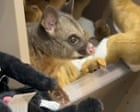
The discovery of a Tasmanian brushtail possum (Trichosurus vulpecula) within the retail perimeter of Hobart International Airport is not a whimsical human-interest story; it is a clinical demonstration of structural failure in exclusionary biosecurity. This incident exposes the gap between theoretical security—designed to intercept human and chemical threats—and the biological reality of opportunistic urban-adapted fauna. When an apex-adapted marsupial successfully navigates the sensory and physical barriers of a high-traffic aviation hub to occupy a "soft target" like a gift shop, the breach indicates a systemic breakdown in facility envelope integrity.
The Mechanism of the Permeable Envelope
Modern airport architecture prioritizes thermal efficiency and human flow, often at the expense of preventing small-animal ingress. The brushtail possum possesses physiological advantages that allow it to exploit these design oversights. Their musculoskeletal structure facilitates the navigation of vertical conduits, HVAC ducting, and cable trays—infrastructure that is frequently left unsealed during maintenance cycles.
The failure of the "sterile zone" can be categorized into three specific vectors:
- Loading Dock Fatigue: The most common entry point for terrestrial fauna. While primary passenger gates are monitored, secondary and tertiary logistics bays often remain open for extended durations to facilitate rapid turnaround of retail stock.
- Roof-to-Ceiling Cavity Continuity: In many regional airports, the ceiling plenum is a continuous space. Once a creature gains access to the roof or an external service ladder, it has unimpeded access to any internal retail unit.
- Thermal Cues: In the colder Tasmanian climate, the heat signature of an airport terminal acts as a biological lighthouse. Forced-air heating systems create plumes of warmth that animals track to their source, leading them directly into the building's mechanical guts.
Behavioral Crypticism and the Retail Niche
The specific choice of a plush toy display as a nesting site is a function of "behavioral mimicry by coincidence." The possum did not intend to hide; it sought a substrate that optimized two variables: insulation and concealment. Plush toys provide a high surface-area-to-volume ratio, trapping heat and offering a soft, deformable environment that mimics the leaf litter or hollowed logs of its natural habitat.
This represents a Signaling Failure for airport security. The animal remained undetected because its physical profile—when nestled among synthetic replicas of itself—did not trigger the "anomaly detection" patterns of human staff or automated surveillance. Motion sensors calibrated for human-sized silhouettes or heat signatures typically ignore small, stationary heat sources buried under insulating layers of fabric.
The Economic Cost Function of Biological Breaches
While the immediate damage in this instance was limited to minor inventory loss, the broader economic implications of wildlife infiltration in transit hubs are substantial. The presence of a wild animal in a retail space introduces several layers of unquantified risk:
- Sanitation and Compliance Liability: The potential for fecal contamination or the introduction of ectoparasites (ticks, mites) necessitates a professional-grade decontamination of the retail footprint.
- Asset Degradation: Brushtail possums are notorious for gnawing on electrical insulation. A single animal in a ceiling void can compromise data lines or fire suppression triggers, leading to cascading system failures.
- Brand Erosion: While some travelers find the encounter charming, the presence of wildlife in a "clean" environment suggests a lack of operational control, which can negatively impact the perceived safety and hygiene standards of the facility.
Quantification of Risk via the Ingress-Impact Matrix
To manage these events, facility managers must move away from reactive "capture and release" tactics toward a predictive risk matrix.
- Low Frequency/High Impact: Wildlife on the runway (Bird strikes/Ground strikes).
- High Frequency/Low Impact: Insects or rodents in food service areas.
- Moderate Frequency/Moderate Impact: Arboreal mammals in the terminal infrastructure (The Hobart Incident).
The Hobart breach falls into the moderate category, where the primary cost is operational downtime and the diversion of security personnel from their core mandates to wildlife management.
Structural Hardening and Mitigation Protocols
Preventing future occurrences requires a shift from superficial monitoring to structural exclusion. Relying on staff to "spot" an animal is a failing strategy. The solution lies in engineering the environment to be biologically hostile.
Acoustic Deterrents
Implementing ultrasonic frequencies in non-public service corridors creates a "wall of sound" that is undetectable to humans but distressing to sensitive marsupial hearing. This creates a psychological barrier that reinforces the physical one.
Envelope Sealing
Every penetration point for utilities—water, electricity, HVAC—must be treated as a potential breach point. Using stainless steel mesh (316 grade) instead of standard expanding foam is required, as marsupials can easily claw through polymer-based sealants.
Thermal Masking
Reducing the heat leakage from loading docks and service doors removes the primary attractant. High-speed "air curtains" at entry points not only maintain climate control for humans but also disrupt the scent and heat trails used by animals for navigation.
The Limits of Coexistence in Critical Infrastructure
The sentimentality often attached to these incidents masks a dangerous complacency. The brushtail possum is an adaptable generalist, capable of thriving in human-altered landscapes. As urban sprawl continues to encroach on natural habitats, the frequency of these "biological overlaps" will increase.
A facility's inability to exclude a 4-kilogram mammal raises uncomfortable questions about its ability to exclude more malicious, smaller-scale threats. If the physical security perimeter is porous enough for a possum to sleep undisturbed in a public-facing retail zone, the integrity of the entire sterile area is theoretically compromised.
Facility managers must adopt a "Zero-Trust" architecture regarding the building envelope. This involves treating the external perimeter as a constantly pressured boundary where any gap larger than 25mm is a confirmed vulnerability. Regular infrared sweeps of ceiling voids and the installation of localized moisture and motion sensors in non-trafficked areas are no longer optional "add-ons" but essential components of modern infrastructure management.
Immediate tactical priority must be given to a full-scale audit of the Hobart terminal’s secondary "soft" entry points. This begins with the installation of self-closing mechanisms on all service-corridor doors and the immediate replacement of all polymer-based gaskets with metal-reinforced alternatives. The goal is not the removal of the animal, but the permanent elimination of the niche it exploited.