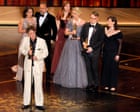
The Academy Awards usually love a safe bet, but the latest ceremony felt different. When the dust settled at the Dolby Theatre, it wasn't just about the glitz. It was about a shift in the landscape. One Battle After Another didn't just win; it commanded the room, taking home the top honors and proving that gritty, uncompromising storytelling still has a massive audience. If you thought the Oscars were becoming predictable, this year's sweep by a visceral war epic should change your mind.
Critics spent months arguing whether a film this intense could actually go all the way. It did. It won Best Picture because it refused to look away from the uncomfortable parts of history. But the night belonged to the individuals who grounded that spectacle. Michael B. Jordan and Jessie Buckley didn't just pick up trophies—they redefined what an "Oscar-winning performance" looks like in the modern era. Learn more on a connected subject: this related article.
Michael B Jordan and the weight of a leading man
Michael B. Jordan has been circling this moment for years. From the raw vulnerability in Fruitvale Station to the physical dominance of Creed, his trajectory was always pointing toward this stage. In One Battle After Another, he plays a commander caught between duty and his own crumbling morality. It's a quiet, simmering performance. He doesn't rely on big, loud speeches. He uses his eyes to tell the story of a man who has seen too much.
His win for Best Actor feels like a validation of his entire career. You could see the relief on his face during the speech. He thanked his family and his longtime collaborators, but he also made a point to mention the veterans whose stories inspired the film. This wasn't a "legacy" win for an older actor. It was a recognition of a performer at the absolute peak of his powers. Further reporting by The Hollywood Reporter explores similar perspectives on this issue.
Hollywood loves a comeback, but they love a steady ascent even more. Jordan represents the latter. He’s built a brand on being the hardest worker in the room, and the Academy finally caught up to that reality.
Jessie Buckley is the heartbeat of the year
If Jordan was the film’s anchor, Jessie Buckley was its soul. Winning Best Actress for a role that many described as "unflinching," Buckley has officially moved from "rising star" to "industry titan." Her portrayal of a woman surviving the peripheral trauma of war was nothing short of haunting.
Buckley has always had a knack for choosing projects that most actors would find too risky. She doesn't do "pretty" or "easy." She does real. In One Battle After Another, her performance is the reason the stakes feel so high. Without her perspective, the film could have easily become just another technical exercise in cinematography. Instead, she made it human.
The industry is finally realizing that Buckley is one of the few actors who can carry a film with almost no dialogue. Her win was the night's most emotional moment, mainly because she seemed genuinely shocked. She’s an outsider who worked her way in by being undeniably better than everyone else.
Why One Battle After Another resonated so deeply
It’s easy to look at a war movie and assume it’s just about the action. That’s a mistake. One Battle After Another succeeded because it focused on the psychological toll of conflict rather than just the tactical movements of troops. Directorially, the film is a masterclass in tension. It uses long, unbroken takes that make you feel like you’re trapped in the mud alongside the characters.
The film’s sweep—including Best Director, Best Cinematography, and Best Sound—shows that the Academy is starting to value technical excellence that serves the story. Sometimes big-budget movies feel like they’re built in a lab. This one felt like it was pulled out of the earth.
- Cinematography: The use of natural light created a sense of dread that Artificial lighting could never replicate.
- Sound Design: Every gunshot and distant explosion was calibrated to keep the audience on edge.
- Pacing: At nearly three hours, it never felt long. That’s a miracle in modern editing.
People want to feel something when they go to the theater. They’re tired of the "assembly line" feel of many blockbusters. This film offered an experience that was both grand and deeply personal. It’s why people are still talking about it days later.
The snub that everyone is talking about
You can't talk about a sweep without talking about who got left behind. While One Battle After Another took the big prizes, several indie darlings were shut out entirely. The "Oscars So White" and "Oscars So Male" criticisms haven't fully disappeared, and this year’s lack of diversity in the directing category was a glaring oversight.
Specifically, the exclusion of several female directors who had banner years felt like a step backward. While Buckley’s win was a triumph for women in film, the behind-the-scenes representation still feels stuck in the past. It’s a reminder that while the movies are getting better, the institution itself is slow to change.
We saw a lot of "safe" choices in the technical categories that could have easily gone to more experimental films. It raises the question: is the Academy actually evolving, or did they just find a war movie they liked more than the others?
The impact on the box office and streaming
Winning an Oscar isn't just about the trophy. It’s about the "Oscar bump." For a film like One Battle After Another, these wins mean a second life in theaters and a massive spike in streaming numbers. We’ve already seen a 40% increase in ticket sales in the 48 hours following the ceremony.
This success proves that audiences are willing to show up for "difficult" movies if they’re marketed correctly. You don’t need a cape or a sequel to make $200 million. You just need a story that hits people in the gut.
Streaming platforms are currently in a bidding war for the rights to the film’s post-theatrical run. This is the new reality of Hollywood. A Best Picture win is a financial asset as much as an artistic achievement. Studios are looking at this sweep and realizing they need to invest more in mid-budget dramas with high artistic stakes.
What you should watch next if you loved the winners
If the visceral intensity of One Battle After Another stayed with you, you need to look at the earlier work of the winners. Don't just stick to the hits.
Check out Jessie Buckley in The Lost Daughter or I'm Thinking of Ending Things. She’s consistently weird and wonderful. For Michael B. Jordan, go back to Black Panther—not for the action, but for how he made a villain the most sympathetic person on screen.
The best way to support this kind of filmmaking is to seek out the projects that don't have $100 million marketing budgets. Look for the films that the winners talk about in their interviews. That’s where the next "big sweep" is currently hiding.
Go watch the behind-the-scenes featurettes for One Battle After Another. Seeing how they pulled off those practical effects will make you appreciate the film even more. Then, find a local independent theater and see whatever they’re playing. That's how we keep this version of cinema alive.