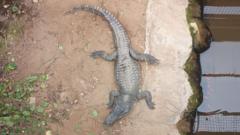
The media script for an apex predator attack is entirely predictable. A horrific incident occurs—in this specific case, a child fighting for their life in a hospital bed after a crocodile strike. Within hours, the standard machinery whirs to life. Journalists demand to know why the local wildlife authorities failed to predict it. Commentators scream for culls, tracking collars, and more exclusion zones.
They are asking all the wrong questions.
The lazy consensus dominating the news cycle insists that these tragedies are failures of management, or worse, evidence that we need to actively scrub wild spaces of dangerous reptiles. It is a comforting lie designed to give us an illusion of control over ecosystems that do not care about human borders.
The uncomfortable truth nobody admits is that the risk cannot be managed down to zero, and attempting to do so actually increases the likelihood of catastrophic human-wildlife conflict. By treating rare, horrific accidents as systemic failures of predator containment, we incentivize behaviors that put more people in harm's way.
The Myth of the Manageable Wilderness
The competitor press spent forty-eight hours obsessing over the logistics of the attack: the exact distance from the shoreline, the response time of the emergency services, the historical data of reptile monitoring in the region. This coverage builds a false narrative that the wilderness is just an outdoor theme park with a temporary safety glitch.
I spent twelve years working in wildlife management across areas where large predators overlap with human populations. If that environment teaches you anything, it is that a crocodile is not a rogue actor violating a social contract. It is an ambush predator acting on millions of years of optimization.
When we tell the public that authorities can map, tag, and neutralize every high-risk animal, we foster a deadly complacency. People walk into high-risk zones assuming that if it were truly dangerous, a sign or a ranger would stop them.
Consider how risk mitigation actually operates in the wild:
- Removal creates vacuums: When a large, dominant crocodile is culled or relocated from a territory, it does not leave the area safe. It creates a sudden resource vacancy. Younger, more aggressive, and less predictable males immediately move in to fight for the territory.
- False senses of security: Erecting physical barriers or posting warning signs often shifts human behavior from hyper-vigilance to total relaxation. A tourist sees a fence and assumes the water twenty feet away is a swimming pool.
- The saturation effect: Modern tracking data shows that for every large apex predator visible to a drone or a spotter, several others remain entirely submerged and undetected within a few hundred meters.
We are running a broken mental model. We treat wild spaces like urban infrastructure that requires a maintenance upgrade, rather than fluid ecosystems operating under brutal thermodynamic rules.
Dismantling the Panic Economy
Whenever a high-profile attack hits the front pages, the immediate policy response is driven by political panic rather than biological data. Politicians line up to fund "population control measures"—a polite term for mass culls.
Let us look at the raw math, which the standard news cycle routinely ignores. Data from wildlife research units globally demonstrates that broad-scale culling programs have a negligible impact on reducing actual attack rates. Why? Because crocodile density is not a linear predictor of human conflict. The primary variable is always human behavior and exposure time.
+-----------------------------------+-----------------------------------+
| The Panic Approach (Flawed)       | The Reality Approach (Verifiable) |
+-----------------------------------+-----------------------------------+
| Focuses on total animal count.   | Focuses on human proximity time.  |
| Assumes culling creates safety.   | Understands vacancy dynamics.     |
| Demands zero-risk wilderness.     | Accepts inherent natural hazard.  |
+-----------------------------------+-----------------------------------+
If you reduce a population by twenty percent via indiscriminate culling, you do not reduce the risk by twenty percent. You simply alter the demographic makeup of the remaining population, often leaving behind smaller, hungrier individuals that are more willing to take risks on non-traditional prey items.
The downside of my own contrarian view is harsh: it means accepting that if humans choose to live, work, or recreate in ancient apex predator habitats, a non-zero number of horrific incidents will occur. That is an agonizing reality to articulate to a grieving family or an anxious community. But lying to them by promising a sanitized, risk-free wilderness is a far greater betrayal.
The Flawed Questions Driving Public Outrage
Look at the questions currently trending across media platforms and community forums. They are structurally designed to avoid self-examination.
"Why wasn't this specific animal removed before the incident?"
This question assumes a level of predictive capability that does not exist in biological science. You cannot look at a three-meter reptile basking on a mudbank and determine its specific behavioral trajectory for the next forty-eight hours. Animals are opportunistic. An attack is almost always a crime of immediate opportunity—a sudden splash, a low light condition, an unexpected silhouette—not a premeditated pattern of escalation that an analyst could have flagged on a spreadsheet.
"Should we close all natural waterways to public access?"
This is the classic bureaucratic overcorrection. Total exclusion zones fail because they are unenforceable over thousands of miles of coastline and river systems. More importantly, they completely sever the human relationship with the natural world, turning conservation into a hostile game of trespassing and enforcement. When you lock people out of the wilderness entirely, they lose the generational knowledge required to navigate it safely.
Rethinking Accountability in Wild Spaces
If we want to honor the victims of these tragedies and actually prevent the next one, we have to stop treating nature as a defendant in a lifestyle lawsuit.
True safety does not look like a drone fleet tracking every reptile across a continent. It looks like a cultural shift back toward radical, personal accountability. It means acknowledging that step one of entering a wild ecosystem is accepting that you are no longer at the top of the food chain.
Stop expecting the state to sanitize the planet. Stop demanding a world where monsters don't exist, while simultaneously demanding the right to play in their backyards. The wilderness is beautiful precisely because it is indifferent to us. If you take away the danger, you take away the wild.
Pack up the outrage. Teach your children how to read a river shoreline, not how to read a liability waiver. Understand that the water belongs to the things that hunt inside it. If you step in anyway, you take your life into your own hands.
Get out of the water.