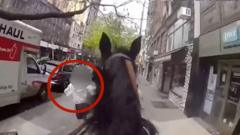
New York City's Times Square is a sensory overload of neon, tourists, and noise. Most people don't expect to see a 1,500-pound horse weaving through yellow cabs to chase down a shoplifter. But that's exactly what happened when an officer on horseback chased a suspect through New York streets after a robbery gone wrong. It wasn't just a PR stunt. It was a tactical masterclass.
While the world obsesses over high-tech surveillance and drone patrols, the NYPD Mounted Unit just proved that sometimes the most effective tool in law enforcement is four legs and a saddle. You can't outrun a horse in a crowd. It's that simple.
The Logistics of a High Speed Horse Pursuit
When a guy snatched a bunch of sunglasses from a vendor near 45th Street, he probably thought he could disappear into the gridlock. He was wrong. Officer Krystin Fenrich, riding her horse Samson, spotted the commotion. She didn't wait for a patrol car to get stuck in traffic. She just moved.
Think about the height advantage. An officer in a cruiser sees tailpipes and bumpers. An officer on a horse sees over the tops of SUVs. They see three blocks ahead. They see the guy in the red hoodie trying to duck into a subway entrance before he even gets there. This isn't just about speed. It's about a literal bird's eye view from the ground.
Samson didn't panic. These horses are trained to ignore sirens, screaming tourists, and the smell of roasting nuts from street carts. They're built for this. When the suspect saw a wall of muscle and fur closing in on him, the game changed. You've seen police foot chases before, but there's a psychological weight to a horse pursuit that most people don't consider.
Why You Can't Hide from the Mounted Unit
Crowd control is usually where we talk about horses. They’re great for keeping protestors back or managing New Year's Eve madness. But as a pursuit vehicle? They’re underrated.
The suspect in this specific New York chase tried to use the density of the city as cover. In a car, an officer is tethered to the asphalt. On foot, an officer has to navigate every shoulder-check and tourist stopping to take a selfie. A horse creates its own path. People move for a horse. It’s an instinctual reaction. You hear those hooves on the pavement and you clear out.
The NYPD has used the Mounted Unit since 1871. It’s one of the oldest specialized units in the department. People think it’s ceremonial. It isn’t. These officers are real cops doing real work. They just happen to have a partner that weighs as much as a small car and can jump a curb without popping a tire.
The Training Behind the Chase
The NYPD doesn't just grab any horse from a farm and throw a badge on it. These animals go through "Remount School." It’s basically boot camp for equines. They’re exposed to everything that would normally make a horse bolt—balloons popping, umbrellas opening suddenly, and the screech of air brakes.
- Desensitization to loud noises and chaotic movement.
- Maneuvering in tight urban spaces.
- Tactical positioning to block suspects without causing injury.
- Sustained gallops on hard city pavement.
When you see that video of the chase, notice how calm the horse remains. The officer is directing the animal with one hand while using the other for her radio. It’s a level of multitasking that most drivers can't manage with a smartphone, let alone a living creature with its own brain.
The Psychological Impact of a Thousand Pound Partner
Let’s be honest. If a cop is running after you on foot, you might think you have a chance. You might be faster. You might have better cardio. If a horse is coming at you, that logic disappears.
The intimidation factor is massive. Most suspects give up the moment they realize the "vehicle" chasing them can go anywhere they can. Stairs? The horse can do it. Narrow alleys? The horse fits. Into the middle of a crowded park? The horse is faster.
In this New York incident, the suspect eventually realized he wasn't going to win. The sheer presence of the horse forced him into a position where ground units could move in and make the arrest. It’s a symphony of old-school policing and modern radio coordination.
Why We Should Stop Calling These Units Outdated
Every few years, some budget-cutter in a suit asks why we’re still paying for hay and stables in Manhattan. They look at the cost and think a motorcycle or an electric scooter could do the same job. They’re wrong.
A motorcycle can’t look over a crowd. A scooter can’t push back a hundred people without someone getting hurt. And neither of them has the public relations power of a horse. People love these animals. They humanize the police force in a way that a piece of glass and steel never will. But don't let the "petting" fool you. These are tactical assets.
The Times Square chase was a reminder that technology isn't always the answer. Sometimes, the answer is a biological machine that has been perfected over thousands of years. The NYPD Mounted Unit provides a level of visibility and mobility that is literally impossible to replicate with machinery in a place as congested as Midtown.
If you find yourself in New York, don't just look at the horses as a photo op. Watch how the officers scan the crowds. Watch how they position the animals to monitor exits. They’re working. They’re looking for the next guy who thinks he’s fast enough to outrun a horse. He isn't.
If you want to see the unit in action or learn more about their history, the NYPD often hosts demonstrations at their stables. It’s worth the trip just to see the scale of the operation. Just don't try to outrun them. It won't end well for you.
Check the local precinct schedules for the next public appearance of the unit. Supporting these specialized units is key to keeping this kind of effective, visible policing on the streets. Next time you see Samson or any of his partners, remember they aren't just there for the tourists. They’re the fastest way to catch a thief when the gridlock hits.