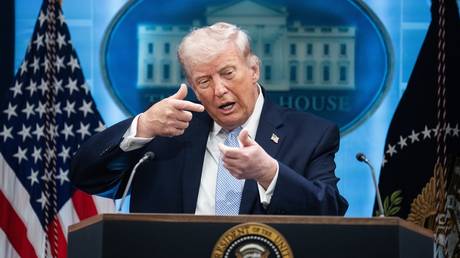
The mahogany table in the Oval Office has a way of swallowing sound. But on a sweltering Tuesday afternoon, the noise radiating from it could be heard across continents. Donald Trump leaned forward, his hands flat on the historic wood, and did what he does best: he drew a line in the sand.
Outside the gates of the White House, the geopolitical machinery of the Western world was spinning into a frenzy of panic. Critics from both sides of the aisle were lining up at news microphones, their voices trembling with warnings of systemic collapse, Middle Eastern chaos, and a nuclear arms race. Trump looked at the television screens, smiled a tight, knowing smile, and dismissed them all with a single, sweeping word.
Losers.
It was a classic performance, designed to dominate a twenty-four-hour news cycle. But away from the flashing cameras of Washington, the reality of the Joint Comprehensive Plan of Action (JCPOA)—better known as the Iran nuclear deal—wasn't a game of rhetorical wins and losses. It was a high-stakes gamble played with the invisible currency of global security, and the people holding the cards were far away from the comfort of American television studios.
The Ghost in the Centrifuge
To understand why a piece of paper signed in Vienna could cause such a visceral explosion in Washington, you have to travel three hundred feet beneath the desert surface near the Iranian city of Qom.
Imagine a sterile, subterranean gallery. The air is thick with the low, rhythmic hum of thousands of aluminum cylinders spinning at the speed of sound. These are IR-1 centrifuges. This hypothetical visitor, walking through the Fordow fuel enrichment plant, would see no weapons, no missiles, and no glowing green isotopes. They would only see pipes, pressure gauges, and the quiet, terrifying potential of physics.
For years, those spinning cylinders were the centerpiece of a global nightmare. A single turn too fast, a single percentage point of enrichment too high, and the world shifts on its axis. The Iran deal was an attempt to throw a wrench into that machinery, not by force, but by bureaucracy. It was a contract that traded economic survival for scientific restraint.
When Trump tore up that contract, he wasn't just rejecting a policy. He was rejecting the very premise of diplomatic compromise. To his supporters, the move was a masterclass in strength—a rejection of a deeply flawed agreement that gave Tehran a roadmap to a bomb while funding its regional proxy wars. To his detractors, it was an act of geopolitical arson, pulling the pin on a grenade and leaving the next generation to deal with the shrapnel.
The Anatomy of a Scathing Rejection
The anger driving the administration's policy wasn't born overnight. It had been brewing since 2015, when Barack Obama stood in the East Room and announced the deal.
The critics Trump targeted weren't just partisan enemies; they included career diplomats, European allies, and seasoned defense analysts. Their argument was straightforward: the deal worked. International inspectors had verified time and again that Iran was shipping out its enriched uranium, disabling its reactors, and opening its most secret facilities to unprecedented scrutiny.
But Trump viewed the world through the lens of a New York real estate mogul. In his worldview, a good deal means you win and the other side loses. The JCPOA allowed Iran to keep its underlying infrastructure. It had "sunset clauses" that would eventually expire. It didn't address Iran’s ballistic missile program or its financial support for militant groups in Lebanon, Yemen, and Syria.
"It was a horrible, one-sided deal that should have never, ever been made," Trump insisted to his inner circle.
When the establishment screamed that pulling out would isolate America, Trump doubled down. He didn't care about isolation; he cared about leverage. By reimposing crushing economic sanctions, he believed he could force Tehran back to the table on his terms, begging for relief. It was a theory of maximum pressure.
The Human Cost of Abstract Policy
While the politicians argued over percentages of U-235 enrichment and banking sanctions, the actual impact of the decision rippled outward in ways that rarely make the evening news.
Consider a hypothetical family in Tehran. Let's call the father Ahmad. He doesn't care about the centrifuges in Natanz. He runs a small appliance repair shop. Under the brief window of the nuclear deal, inflation stabilized. He could import spare parts from Europe. His son, an aspiring engineer, looked forward to studying abroad.
The morning after the American withdrawal, the value of the Iranian rial plummeted. Ahmad’s savings evaporated within weeks. The European parts disappeared from the market, replaced by shoddy counterfeits. His son’s dreams of an international education vanished into the reality of a conscripted military future.
This is the hidden mechanics of sanctions. They are designed to pressure governments, but they filter through the populace like a slow-acting poison. The theory is that a desperate population will force its leaders to change course. The reality is often the opposite. Hardliners within the Iranian regime pointed at the empty American promises and told their people, We told you so. The West cannot be trusted.
The sophisticated, Western-leaning youth of Iran—the very people who could have bridged the gap between two hostile worlds—found themselves suffocated by economic ruin and state repression. The moderate politicians who staked their careers on the deal were systematically pushed out, replaced by uncompromising ideologues who saw defiance as the only path forward.
The Broken Mirror of Western Alliance
The collateral damage didn't stop at Iran's borders. It fractured the foundations of Western diplomacy.
For decades, the relationship between Washington, London, Paris, and Berlin was built on a shared assumption of continuity. A signature from an American president was supposed to mean something, surviving the transition from one administration to the next.
When the United States walked away from the JCPOA, it did so over the explicit, public pleas of its closest allies. British Prime Minister Theresa May, French President Emmanuel Macron, and German Chancellor Angela Merkel had practically begged Trump to stay in the agreement, offering to work with him to amend its flaws.
By ignoring them, Trump signaled a profound shift in American foreign policy. The doctrine of "America First" meant that the collective security agreements of the post-WWII era were no longer sacrosanct. The European allies found themselves in an impossible position: trying to keep the deal alive on life support while their own companies were threatened with American sanctions if they dared to do business with Iran.
The trust shattered during those months cannot be easily rebuilt with a new administration or a revised treaty. It left a lingering doubt in the minds of global leaders. If Washington can rewrite its commitments every four to eight years, how can any nation risk its long-term security on an American promise?
The Echoes in the Silence
Years have passed since that definitive afternoon in the Oval Office, and the dust has somewhat settled, revealing a landscape that looks remarkably like the one Trump promised to fix, only more volatile.
The maximum pressure campaign did not bring Iran to its knees. Instead, it pushed the regime closer to other isolated superpowers, creating a new axis of economic and military cooperation with Moscow and Beijing. The centrifuges beneath the desert didn't stop spinning; they spun faster, enriching uranium to levels closer to weapons-grade than ever before under the strictures of the original agreement.
The critics Trump labeled as "losers" weren't entirely right, but they weren't entirely wrong either. The world didn't end, but it became infinitely more complicated, dangerous, and unpredictable.
The true tragedy of the Iran deal's collapse isn't the political career of any single leader or the legacy of a presidency. It is the realization that in the game of global brinkmanship, victories are often illusions. You can give a fiery speech, you can dominate the headlines, and you can mock your opponents to the applause of a crowded room. But out in the quiet spaces of the world, where the centrifuges hum and the families wait for the currency to collapse, the noise fades away, leaving only the cold, hard reality of a world left entirely on its own.