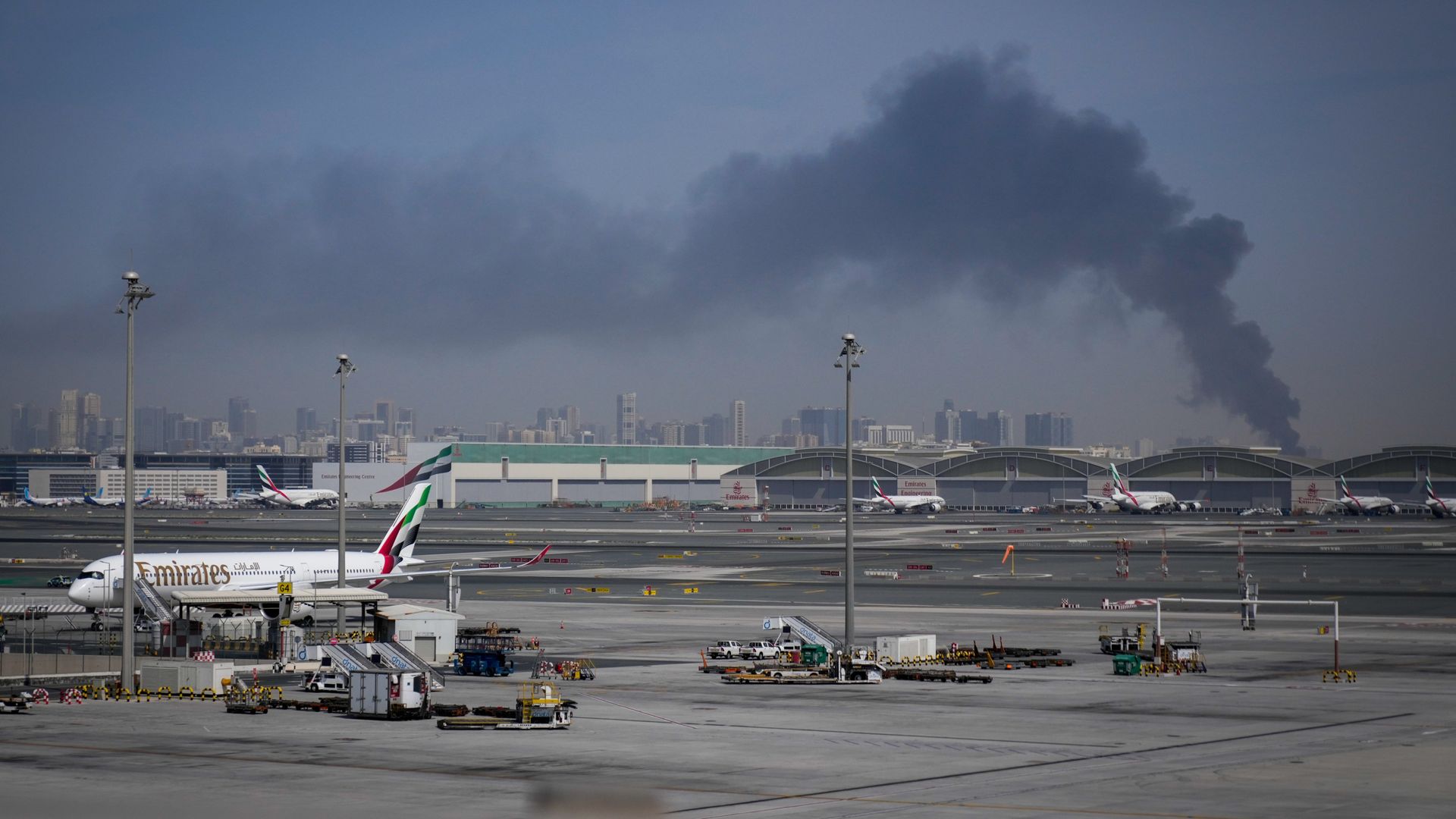
The blue glow of the departure board at Dubai International doesn’t usually feel like a countdown to a crisis. On a typical Tuesday, it is a rhythmic pulse of global connectivity—London, Tokyo, New York, Nairobi. But at 3:00 AM, the rhythm broke. One by one, the status lines flipped from a reassuring green "Boarding" to a cold, digital "Cancelled."
A low hum of confusion began to vibrate through Terminal 3. It started with the business travelers, those seasoned road warriors who usually treat an airport like their living room. They stopped pacing and stared at their phones. Then came the families. A toddler, sensing the sudden spike in parental cortisol, began a jagged, rhythmic cry that cut through the sterile air conditioning.
The world had just shifted.
News of the attack on Iran filtered through the jittery brightness of smartphone screens long before the official announcements echoed over the PA system. This wasn't a weather delay. This wasn't a technical glitch or a localized strike. It was a geopolitical tremor that effectively deleted the airspace above one of the world's most vital transit hubs.
The Invisible Borders
When we fly, we imagine the sky is an open sea. We assume that once the wheels leave the tarmac, we are in a neutral expanse of clouds and wind. We forget that the air is carved into invisible, jagged territories, governed by the same ancient animosities that define the soil below.
To fly from Europe to Southeast Asia, you generally need to cross the "highways" of the Middle East. These are narrow corridors of safe passage. When an escalation of this magnitude occurs, those highways don't just get congested. They vanish.
Consider a hypothetical traveler named Elias. He is sitting on the floor of the terminal in Jordan, leaning against his duffel bag. He was supposed to be in London for his sister’s wedding. To Elias, the "closure of Jordanian airspace" isn't a headline about regional stability. It is the realization that he is trapped in a limestone-and-glass box while the most important day of his family's life happens 2,000 miles away.
The statistics tell us that thousands were stranded. But statistics are a way of hiding the truth. The truth is found in the way Elias stares at his useless boarding pass, or the way a grandmother in Tehran holds her phone to her ear, listening to the dial tone of a daughter whose flight was diverted to a city she’s never heard of.
The Mechanics of Chaos
Airports in Lebanon, Jordan, Iraq, and Israel didn't just "close" as a matter of paperwork. They shuttered because the risk of a civilian aircraft being caught in a crossfire—or being misidentified by a nervous air defense system—became a mathematical certainty.
A modern jetliner is a miracle of engineering, but it is also a giant, slow-moving target. After the lessons of past tragedies in contested skies, no airline is willing to gamble with five hundred souls on a Boeing 777.
When the news broke, pilots already in the air faced a harrowing puzzle. Fuel is a finite resource. You cannot simply "hover" over a war zone. You have to find a "bolt hole"—an airport that is still open, has enough runway for your weight, and can handle an influx of five thousand unexpected guests.
Imagine being the air traffic controller in Cyprus or Turkey suddenly watching dozens of "ghost flights" veer toward your radar screen, all of them screaming for a place to land. The logistics are staggering. Food, water, hotel rooms, and security clearances don't exist in a vacuum. They are part of a delicate supply chain that breaks the moment the first missile is fired.
The Human Toll of Geometry
We often view these events through the lens of oil prices or stock market fluctuations. We talk about "regional escalations" as if they are moves on a chessboard. But for the people on the ground—and the people stuck in the air—the cost is measured in moments lost.
- The student who misses the final exam that determines their career.
- The surgeon delayed for an operation that cannot wait.
- The migrant worker whose one-month leave is being eaten away by a terminal floor.
There is a specific kind of exhaustion that sets in during an indefinite delay. It’s not the fatigue of physical labor; it’s the erosion of the spirit. The bright, artificial lights of the airport never dim. The announcements for flights that aren't leaving never stop. You are suspended in a liminal space, neither here nor there, a refugee of a conflict you didn't start and cannot stop.
Why the Sky Stays Closed
The decision to reopen an airport isn't as simple as checking the weather. It requires a high-stakes negotiation between intelligence agencies and civil aviation authorities. They have to ask: Is the retaliatory cycle over? Are the GPS spoofing signals—used to confuse missiles but also dangerous for planes—still active?
Even after the "all clear" is given, the ripples last for weeks. An airplane that was supposed to be in London is now stuck in Muscat. A crew that was supposed to fly out of Doha has timed out and must sleep for twelve hours. The schedule is a house of cards, and someone just blew on the foundation.
As the sun began to rise over the Persian Gulf, the desert heat started to shimmer against the parked tails of a hundred grounded planes. The silent tarmac looked like a graveyard of ambition.
We live in a world that prides itself on being "frictionless." We believe that technology has conquered geography. We think we can go anywhere, anytime, for the right price. But on nights like this, the friction returns with a vengeance. We are reminded that our ability to move across the globe is a fragile privilege, held together by the thin thread of peace.
Elias eventually stopped checking the departure board. He closed his eyes and tried to sleep, the cold floor radiating the reality of a world that had suddenly grown much, much larger.
The silence in the sky was the loudest sound of all.
Those who manage to get on the first "rescue" flights out won't be cheering. They will be quiet. They will look out the window at the vast, dark expanse of the Iranian plateau or the jagged mountains of the Levant, and they will realize how lucky they are to be moving at all.
Peace is not just the absence of war. It is the ability to go home.
When the engines finally roar back to life, they don't just carry passengers. They carry the hope that the invisible borders have receded, if only for a little while, allowing us to be humans again, instead of targets or statistics.
The board eventually flipped back to green. But the people who walked toward the gates weren't the same ones who arrived the night before. They carried the weight of the realization that at any moment, the sky can simply close its doors.