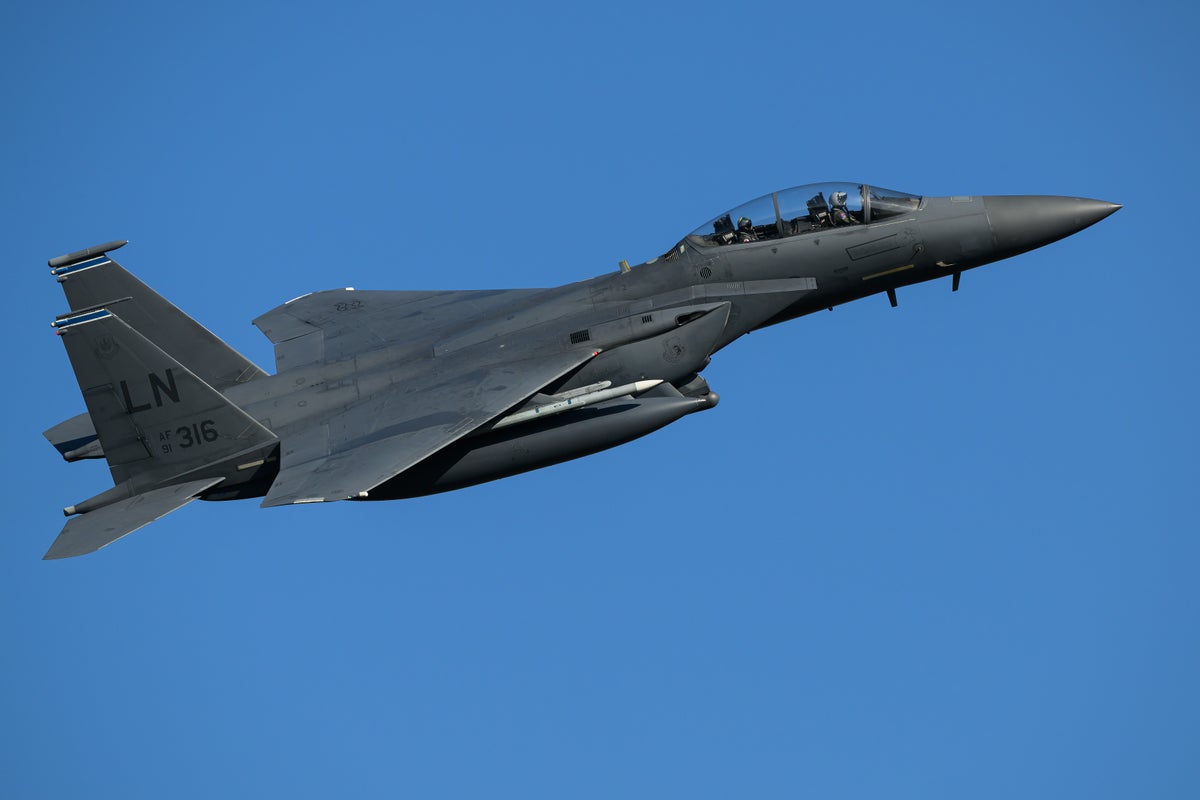
The canopy explodes, and suddenly you are falling through an absolute and freezing void.
When an F-15E Strike Eagle splits apart at high altitude, the survival sequence is not a mechanical checklist; it is a violent tearing away of reality. The wind hits you like a concrete wall. Your lungs flatten. The violent tug of the parachute harness snaps your spine straight, leaving your brain rattling inside your helmet like a loose stone. For another view, see: this related article.
This was the second time in a single conflict that this particular American fighter pilot had been blasted out of the sky. The first had been a tragic error—a friendly-fire incident involving a Kuwaiti jet. But this time, over the jagged, unforgiving topography of Iran during the high-intensity air operations of Operation Epic Fury, the threat was entirely different.
As the pilot drifted down through the dark, cold sky, his home for the next several hours would be a nylon canopy and the whistling wind. But it was what he saw suspended in the dark air before his ejection that would consume the Pentagon’s brightest minds for months to come. Similar reporting on this matter has been provided by Associated Press.
He didn’t just see a threat. He saw a shape.
A Ghostly Geometry in the Dark
Before the cockpit shattered, the pilot looked out into the sky and saw what he later described to intelligence briefers as a "minefield of drones."
But they were not buzzing around haphazardly like a cloud of insects. They were locked into a singular, terrifying geometry. Multiple large aircraft were interconnected, moving in perfect lockstep as one solid entity, while clusters of smaller drones dangled and pulsed directly beneath them like tendrils.
"Real alien s**t," a source familiar with the debriefing quoted the pilot. It looked exactly like a jellyfish drifting through a bioluminescent ocean, only this creature was forged of carbon fiber, lithium batteries, and high explosives, floating over the Iranian mountains.
When special operations forces pulled the pilot from the dirt a few hours later, his body was battered and his brain was swollen from a severe concussion. When he told the interrogators what he saw, the reaction was immediate skepticism. His weapons systems officer, who had ejected with him, was still missing, actively evading capture in the high ridges before being rescued days later. The intelligence team had a duty to ask the hard question: Are you sure you saw what you are saying you saw?
A concussed brain can play tricks on a man who has just survived a catastrophic aircraft failure. But as the data began to settle, the skepticism shifted into a cold, quiet panic.
The Machine Mind of the Swarm
To understand why a jellyfish in the sky terrifies military strategists, you have to understand how we have traditionally thought about automated warfare.
For the past decade, remote aviation has operated on a one-to-one or one-to-few ratio. A team of human operators sits in a climate-controlled trailer, guiding a single predator or a small handful of reconnaissance assets via satellite link. If you want forty drones in the air, you need forty networks, massive bandwidth, and a logistical footprint that resembles a small corporation.
What the pilot likely witnessed is a quantum leap known technically as one-to-many meshed networking.
Imagine a net where every knot thinks for itself but serves the whole. In a meshed network, a single operator commands the "brain" of the formation. The individual drones communicate directly with each other, sharing data, adjusting for wind resistance, and distributing weight in real-time. If you shoot one down, the remaining nodes instantly recalculate, closing the gap.
Consider how this alters the survival mechanics of a $31 million fighter jet. An F-15E is a masterpiece of American engineering, designed to outrun missiles and jam traditional radar systems. But traditional radar is built to spot clean, predictable metal hulls moving at high speeds.
When a jet encounters a distributed, shifting mass of small composite materials—a literal living wall of low-radar-signature explosives—the aircraft’s defensive suites are blinded by the sheer complexity. The drone formation doesn’t need to dogfight. It simply needs to occupy the sky, holding resources in reserve to absorb the first volley and strike with the second. It transforms the airspace from an open highway into an intelligent, shifting minefield.
The Shadow of the Dragon and the Bear
The American intelligence community did not expect Iran to field this level of coordination alone. While Tehran has spent decades perfecting the art of asymmetric warfare—using cheap, mass-produced systems to offset Western technological superiority—the software required to maintain a complex, multi-tiered shape in combat is staggeringly complex.
The breadcrumbs point elsewhere. Analysts are now looking closely at the technical pipelines running between Tehran, Moscow, and Beijing. Both Russia and China have poured billions into autonomous hive algorithms. The fear is no longer that Iran is building better hardware; it is that they have imported the digital nervous system required to turn independent weapons into a collective beast.
For decades, the West has relied on the assumption that our technological edge would always protect our pilots. We believed our platforms were too fast, too stealthy, and too advanced for regional powers to touch.
That illusion died in the mountains of Iran. The downing of the F-15E marks the very first time an American fighter jet was brought down by Iranian forces during this conflict. Whether the jellyfish formation directly caused the crash or acted as a massive electronic and kinetic shield that allowed ground-based systems to lock on is still being investigated. But the result is identical.
The Cost of the Invisible Sky
We are entering an era where the sky itself is becoming an unpredictable, thinking organism. The implications of this shift stretch far beyond a single debriefing room or a bruised pilot trying to convince his superiors that he hadn't lost his mind.
The military will now be forced to spend billions of dollars and an immeasurable amount of human energy trying to defend against an enemy that doesn't fly in straight lines, doesn't use pilots, and doesn't think like an individual. The traditional rules of engagement are melting away.
The 60-day ceasefire window currently taking shape between Washington and Tehran may bring a temporary lull to the physical explosions, but the digital and strategic race has only accelerated. The battlefield has changed permanently, not because the weapons became more powerful, but because they became aware of one another.
As the pilot sits in a recovery room, clearing the fog of a second ejection from his mind, the memory of that cold night sky remains perfectly sharp. He knows what he saw. It wasn't a collection of flying machines. It was a single, undulating phantom of metal and code, drifting through the dark, waiting to pull the sky down around him.


