The air in the north of Paris does not circulate well in August. It hangs heavy, thick with the scent of cheap beer, exhaust fumes, and the metallic tang of anticipation. On a night like this, the cobblestones of the Boulevard de de Clichy act like a radiator, pumping the day's suffocating heat back up into the soles of your shoes.
I stood just outside a café, watching the reflection of the neon sign warp across the hood of a parked Peugeot. Inside, the television screen was a blur of electric green and white. Paris Saint-Germain was ninety minutes away from the one thing their billions could not explicitly buy. The Champions League trophy. The holy grail of European football. In similar updates, take a look at: Inside the Secret Maritime War the Pentagon is Trying to Hide.
For decades, Paris was a fashion city, a literary city, an artistic sanctuary. Football was something relegated to the working-class suburbs, a subculture viewed with a polite, Parisian shrug. Then came the Qatari billions in 2011. Suddenly, the club became a global behemoth. The crest—featuring the Eiffel Tower sheltering a cradle—was no longer just a badge; it was a lifestyle brand worn by influencers from Tokyo to New York. But the soul of the club still belonged to the streets. It belonged to the kids who grew up in the high-rise estates of the Seine-Saint-Denis, who saw the Parc des Princes as a secular cathedral.
When the final whistle blew, validating a historic victory, the city did not breathe a sigh of relief. It exploded. USA Today has provided coverage on this critical topic in great detail.
Chaos is a slow creeping thing before it becomes an avalanche.
The Anatomy of a Fracture
It started with a symphony of car horns. The concert de klaxons is the traditional soundtrack to any French sporting triumph. Hundreds of vehicles surged toward the Champs-Élysées, passengers hanging out of windows, waving red and blue flags into the midnight air. Up close, the energy was infectious. It felt like collective catharsis. After years of heartbreaking near-misses, of being mocked by traditional European royalty like Real Madrid and Bayern Munich, Paris had finally arrived.
But if you watched closely, the edges of the celebration were already beginning to fray.
Consider a hypothetical young supporter. Let’s call him Lucas. He is nineteen, wearing a pristine Kylian Mbappé jersey, suffocated by the sheer joy of the moment. He came to the Champs-Élysées to sing, to feel connected to a million strangers. But as the crowd density swelled near the Arc de Triomphe, the human chemistry changed. Volatility replaced euphoria.
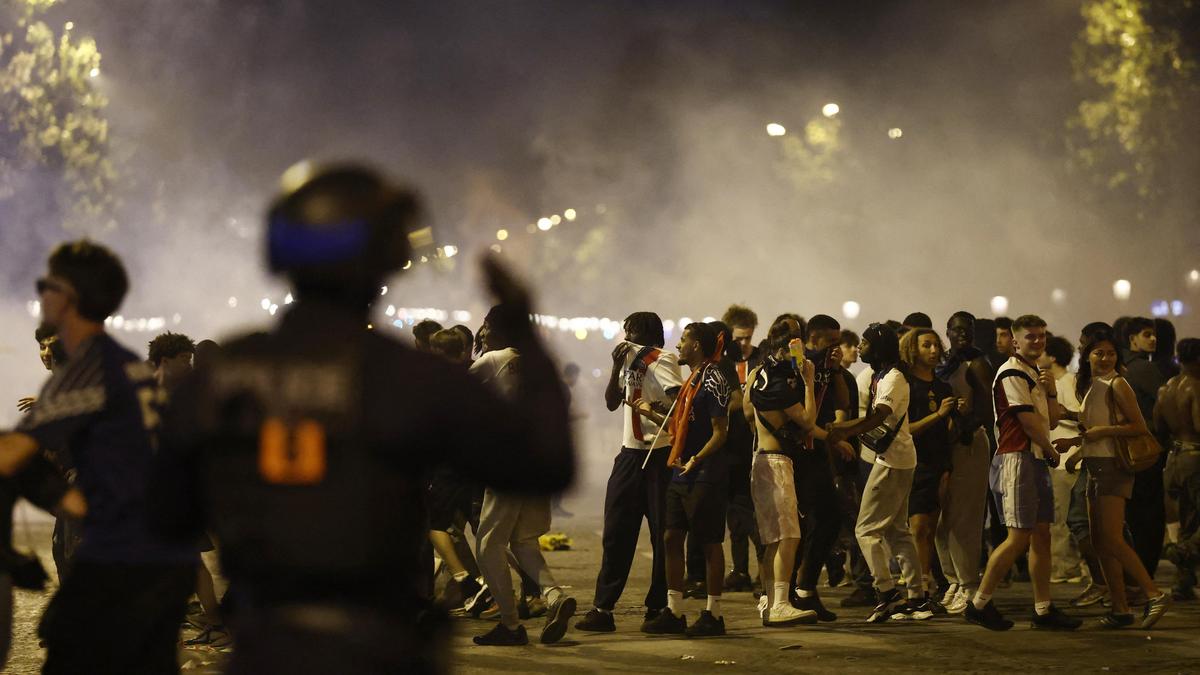
The first tear gas canister fired by the police makes a very specific sound. A sharp, metallic thunk, followed by a hiss that sounds like frying meat. Then comes the burning. It catches in the back of your throat first, a sour, chemical scratch that forces an involuntary cough. Then your eyes stream. The world blurs into a hazy, panicked rush of bodies.
By 2:00 AM, the avenue of luxury boutiques had transformed into a tactical grid.
The facts of the night tell a sterile story. The Prefecture of Police would later confirm that 45 individuals were detained over the course of the night. On paper, it looks like a routine statistic, the expected tax a major metropolis pays for hosting a massive sporting event. But statistics do not capture the sound of a shattering plate-glass window of a boutique, or the sight of an overturned scooter burning on the pavement, casting long, dancing shadows against the limestone facades.
The Invisible Battle Lines
To understand why a football match can turn a historic avenue into a skirmish zone, you have to understand the unique friction built into modern Paris. The police force, heavily armed and wearing armor that makes them look like dystopian centurions, represents the state. The youths crowding the streets often feel entirely alienated by that same state.
When the celebrations began to spill out of control, the police strategy shifted from crowd management to containment.
"The line between a fan celebrating a historic milestone and an agitator looking for a confrontation is paper-thin," a veteran tactical officer once told me during a previous deployment. "Once the alcohol flows and the fireworks start being aimed at us, the football match is over. It becomes a question of who controls the street."
The escalation followed a predictable, tragic script. A small group of individuals, distinct from the thousands of genuine fans, began throwing glass bottles and heavy mortar fireworks at the police cordons. The response was swift and uncompromising: baton charges and repeated volleys of tear gas.
The tragedy of these nights is the collateral damage. For every aggressive agitator, there were ten people like Lucas—fans caught in the middle, running blindly down side streets, their eyes weeping, their lungs burning, wondering how a moment of pure sporting ecstasy had devolved into a street battle.
The violence was not contained to the Champs-Élysées. Around the Parc des Princes stadium, miles to the west, similar fractures opened up. Cars were set alight. Projectiles rained down on security forces. The very geography of the city became a map of flashpoints.
The Morning After the Magic
By dawn, the smell of tear gas had faded, replaced by the mundane aroma of roasting coffee beans from the cafes opening their shutters. The municipal cleaning crews were already out, their green trucks sweeping up the glittering sea of broken glass.
Forty-five people spent the dawn hours in cold holding cells across the city, facing charges ranging from violence against public officials to vandalism and theft. The victory remained. The history books would forever record Paris Saint-Germain as champions of Europe. Yet, the victory felt heavy, stained by the reality of the night's wreckage.
We want sports to be a simple narrative. We want the triumph on the pitch to translate into unity on the streets. We want to believe that a shared crest can bridge the deep, systemic divides that fracture a modern metropolis. But a football club, no matter how wealthy, cannot heal a city's underlying tensions. It can only provide a stage where those tensions are temporarily forgotten—or violently amplified.
As the sun caught the tip of the Eiffel Tower, turning the iron structure a pale, brilliant gold, a solitary street sweeper near the Arc de Triomphe used a plastic broom to push a charred, melted piece of a football scarf into the gutter.