The coffee in your mug didn’t just appear there. It traveled through a jagged, invisible bottleneck between the jagged mountains of Oman and the desert shores of Iran. This stretch of water, barely twenty-one miles wide at its narrowest point, is the carotid artery of the modern world. If you squeeze it, the global heart stops beating.
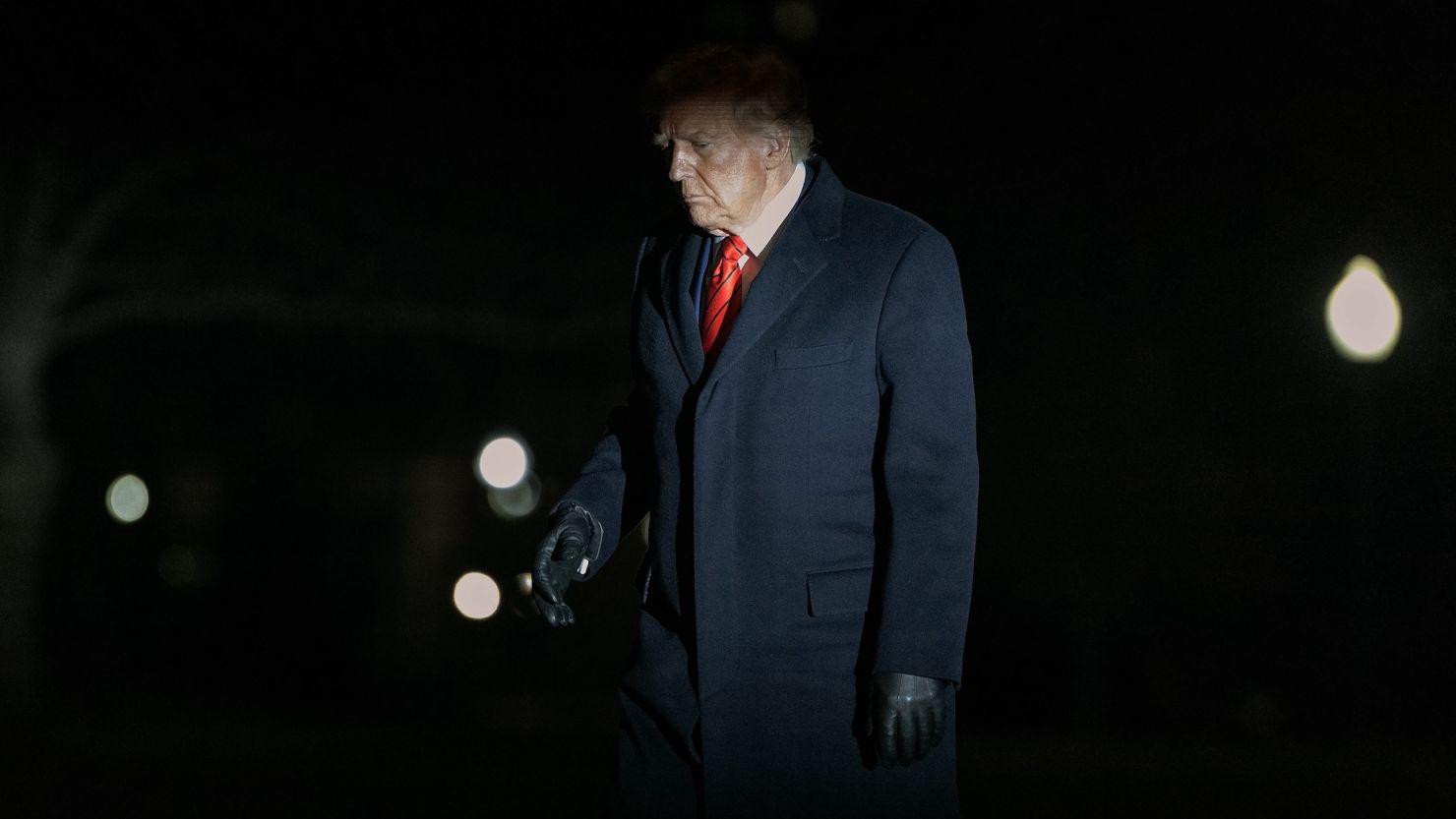
When Donald Trump took to the stage to announce a U.S. blockade of the Strait of Hormuz, he wasn't just discussing a military maneuver. He was pulling the plug on the 21st century.
The Choke Point
Picture a supertanker named the Aris. It is a gargantuan slab of steel, longer than three football fields, carrying two million barrels of crude oil. The captain, a man who has spent thirty years navigating the gray-blue swells of the Indian Ocean, watches the radar. He is entering the Strait. Normally, this is a routine of high-stakes precision. Today, he sees the gray hulls of U.S. Navy destroyers cutting through the wake of commercial vessels. He sees the "No Entry" sign written in gunpowder and steel.
One-fifth of the world’s total oil consumption passes through this single gate every day. It isn't just about gasoline for a Tuesday morning commute in Ohio. It is about the plastic in a surgeon’s gloves in Berlin. It is about the fertilizer used to grow wheat in the Great Plains. It is about the very fabric of physical reality as we have constructed it since the Industrial Revolution.
A blockade here is a shock to the nervous system of the planet.
The Invisible Dominoes
Economics is often taught as a series of dry graphs and shifting curves. In reality, it is a visceral, human chain reaction. When the announcement hit the wires, the reaction was instantaneous.
In Chicago, a commodities trader stared at a screen that turned a violent shade of red. Oil prices didn't just climb; they teleported. $80 a barrel became $120 in the time it took to blink. This isn't just a number on a screen. For a family in a drafty rental house in Maine, that number is the difference between a warm living room and a winter spent in coats indoors.
Consider the logistics manager at a tech firm in Seoul. Her company relies on high-end polymers derived from Middle Eastern petroleum. With the Strait closed, her supply chain evaporated. By noon, she had to tell fifty factory workers that their shifts were canceled indefinitely. By evening, those workers were sitting at kitchen tables, wondering how to explain to their children that the world had suddenly become much smaller and more expensive.
The stakes are not abstract. They are caloric. They are thermal. They are existential.
The Logistics of a Ghost Town
The Strait of Hormuz functions because of a fragile agreement that the water belongs to everyone and no one. It is governed by the United Nations Convention on the Law of the Sea, specifically the concept of "transit passage." This allows ships to move through territorial waters of coastal states as long as they keep moving.
When a superpower decides to park its fleet in the middle of that passage, the rules of the last eighty years are set on fire.
Military experts often talk about "kinetic" solutions. It’s a clean word for a messy reality. A blockade involves boarding parties. It involves warning shots. It involves the constant, vibrating threat of a miscalculation. If a single Iranian speedboat commander loses his nerve, or a single American sonar technician misinterprets a signal, the blockade stops being a political statement and starts being a regional conflagration.
The silence that follows a closed trade route is the loudest sound in the world.
The Ghost of 1973
History isn't a straight line; it’s a circle. We have been here before, though the scale this time is vastly different. During the 1973 oil embargo, the world learned that energy is the ultimate leverage. People waited in lines for hours to buy three gallons of gas. Fights broke out at pumps. National speed limits were slashed.
But in 1973, we didn't have "just-in-time" manufacturing. We didn't have a globalized economy where a chip designed in California, manufactured in Taiwan, and assembled in China depends on energy sourced from a desert five thousand miles away.
Today, our vulnerability is baked into our DNA. We have traded resilience for efficiency. We built a world that works perfectly as long as the ships keep moving. The moment they stop, the "just-in-time" model becomes "never-on-time."
The Human Cost of High Policy
Imagine a small business owner named Sarah. She runs a delivery fleet in a mid-sized city. Her margins are thin. She calculated her costs based on $3.50 a gallon. Within forty-eight hours of the blockade announcement, she is looking at $7.00.
She isn't a geopolitical strategist. She doesn't have an opinion on the nuances of maritime law or the nuclear capabilities of regional powers. She just knows that her business, the one she spent fifteen years building, is now a liability. She has to decide which of her drivers to let go first.
This is the "shocking outburst" translated into the language of the dinner table.
The move is framed as a show of strength, a way to starve an adversary of revenue or force a hand at the negotiating table. But a blockade is a blunt instrument. It doesn't just hit the intended target. It hits the elderly woman on a fixed income whose heating bill just tripled. It hits the hospital that has to pay a premium for life-saving supplies shipped by air because the sea routes are dead.
The Ripple on the Horizon
What happens when the world’s most powerful economy decides to stop the world’s most important trade? Trust, once broken, is notoriously difficult to repair.
Other nations don't just sit and wait. They pivot. They look for ways to bypass the bully. They build pipelines across treacherous mountains. They invest in alternative energies not out of a desire to save the planet, but out of a desperate need for survival. They begin to view the global commons—the oceans and the air—not as shared resources, but as battlegrounds.
The blockade of the Strait of Hormuz is more than a military blockade. It is a blockade of the idea that we are all connected. It is a retreat into a world of walls, where the strongest player decides who gets to eat and who gets to stay in the dark.
As the sun sets over the Persian Gulf, the silhouettes of the warships look like jagged teeth against the orange sky. The sailors on deck are young. They write letters home. They drink lukewarm coffee. They wait for orders. Behind them, the massive tankers sit idle, their engines humming a low, mournful tune. They are full of the lifeblood of a civilization that is currently holding its breath.
The world is waiting to see if the heart starts beating again, or if this is simply the way the old era ends.
Not with a bang, but with a silent, empty sea.