The air inside the Washington Hilton usually smells of expensive cologne, wilted parsley, and the nervous sweat of people trying to be important. On this particular Saturday, the annual White House Correspondents’ Dinner was unfolding with its usual scripted chaos. Tuxedoed journalists rubbed shoulders with Hollywood starlets, and the wine flowed with the desperate urgency of a town that lives and breathes on the proximity to power.
Then came the sound.
It wasn't the rhythmic pop of a champagne cork or the rehearsed laughter of a late-night monologue. It was the sharp, metallic intrusion of reality. Outside the heavy doors of the International Ballroom, in the humid D.C. twilight, a series of gunshots tore through the performative peace of the evening.
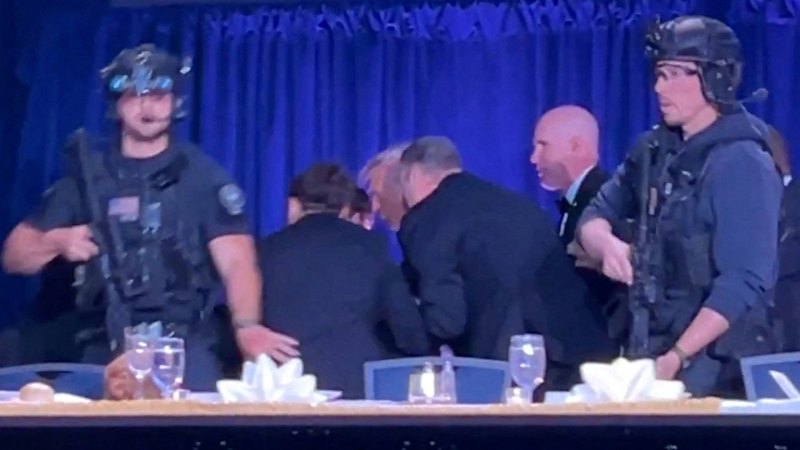
Inside, the transition from celebration to survival happened in a heartbeat. Security detail, typically statuesque and invisible, suddenly became the only thing that mattered. Men in dark suits moved with a terrifying, practiced fluidity. Doors were barred. Shoulders squared. The high-ceilinged room, designed for grand speeches and lighthearted roasts, suddenly felt like a cage.
Donald Trump, the focus of the evening's security apparatus, remained unharmed. But the safety of a single man is only a small part of the story. The real casualty in those frantic minutes was the illusion that the walls of elite institutions can actually keep the world out.
The Mechanics of Panic
Security isn't just about bulletproof glass and secret service cordons. It is a psychological contract. We agree to pretend that we are safe so that we can conduct the business of civilization. When that contract is breached, the machinery of a city like Washington grinds to a visceral halt.
Consider the kitchen staff. While the "A-list" was being ushered toward secure exits or told to stay low, a cook in the back was likely holding a carving knife, wondering if the noise meant his shift was over or if his life was. We often forget that these events are ecosystems. For every politician in the spotlight, there are a hundred service workers, technicians, and security guards who don't get the luxury of a motorcade.
The shots fired outside were not just an attack on a person; they were a puncture wound in the social fabric of the capital.
A History of Proximity
Washington has always been a city of dangerous closeness. From the theater box where Lincoln sat to the driveway of the Hilton itself—the very site where Ronald Reagan was shot in 1981—the geography of power is mapped in blood and narrow misses. There is a haunting symmetry to the fact that violence returned to these specific coordinates.
The Hilton is colloquially known as the "Hinckley Hilton" because of that 1981 assassination attempt. The architecture of the building was literally modified to prevent another tragedy, with a specialized, secure tunnel designed to whisk presidents from their limousines to the ballroom. Yet, despite decades of planning and millions of dollars in tactical upgrades, the unpredictability of a human being with a weapon remains the one variable no engineer can solve.
We build higher fences. We install more sensitive scanners. We vet every name on every list. But the ghost of 1981 never really left the sidewalk.
The Invisible Stakes
Why does this matter beyond the immediate headlines? Because the "Nerd Prom," as the dinner is often called, is meant to be the one night where the two warring tribes of Washington—the press and the politicians—lay down their arms. It is a ritual of stability. It signals to the world that the American system is robust enough to handle satire, disagreement, and even open disdain without resorting to force.
When gunfire echoes within earshot of that ritual, the satire stops being funny. The stakes shift from "who won the news cycle" to "who survives the night."
The shooter, identified later by authorities, wasn't just targeting a ballroom. They were targeting the idea that we can still have a public square. In a time where political rhetoric has reached a fever pitch, the physical manifestation of that anger is a terrifying logical conclusion. It is the moment where the metaphorical "war of words" threatens to become a literal war of attrition.
The Silence After the Noise
Once the perimeter was secured and the "all clear" was whispered into earpieces, the room didn't simply go back to normal. You cannot un-ring a bell of that magnitude. People returned to their tables, but the wine tasted like copper. The jokes felt thin.
There is a specific kind of silence that follows a brush with violence. It is heavy. It sits in the lungs. You could see it in the way the guests looked at the exits, suddenly aware of how far they were from the street, how dependent they were on the men with the earbud wires.
We live in an era where we are constantly told to be afraid, but we rarely experience the cold, sharp edge of a genuine threat. For those inside the Hilton, the abstraction of "political tension" became a physical weight.
The facts will tell you that the former President was safe. They will tell you how many rounds were fired and at what time the suspect was apprehended. They will give you the caliber of the weapon and the radius of the police tape. But the facts won't tell you about the way the light seemed to flicker for a second, or how the most powerful people in the world suddenly looked very small in their expensive clothes.
As the motorcades eventually pulled away and the sirens faded into the distance, the Hilton stood quiet again. The red carpet was rolled up. The glasses were cleared. But the sidewalk remained, scarred by the memory of a sound that shouldn't have been there, a reminder that the distance between a gala and a tragedy is exactly the width of a single door.