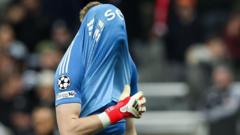
The air in Newcastle during a Champions League night doesn't just sit; it vibrates. It carries the scent of damp wool, spilled brown ale, and a desperate, generational longing that has been passed down like a heavy inheritance. When Barcelona comes to town, that vibration turns into a roar that can be felt in the marrow of your bones. For eighty-eight minutes, the scoreboard at St. James' Park told a story of defiance. For eighty-eight minutes, a group of men in black and white stripes had played beyond their tax brackets, lunging into tackles and sprinting until their lungs burned with the cold Tyneside air.
Then came the whistle. Then came the silence.
It wasn’t the kind of silence that happens when a stadium is empty. This was a pressurized, suffocating quiet—the sound of fifty-two thousand people simultaneously realizing that football is a cruel, indifferent god. As the ball hit the back of the net in the dying embers of the match, the "missed opportunity" wasn't just a statistic or a line in a match report. It was a physical weight. It was the collective slumped shoulders of a city that had dared to believe the elite table was finally set for them, only to have the plate snatched away at the very last second.
The Architecture of a Heartbreak
To understand why a late goal from a Catalan giant hurts more than a standard loss, you have to look at the faces in the Leazes End. Consider a man we will call Arthur. Arthur has held a season ticket since the mid-seventies. He remembers the rainy nights in the second division, and he remembers the dizzying heights of the "Entertainers" era under Kevin Keegan. For Arthur, this match wasn't about three points in a group stage. It was a validation of survival.
Newcastle United is a club that defines itself through its proximity to greatness, often without ever touching it. Against Barcelona, the tactical setup was a masterclass in blue-collar industry. They didn't try to out-pass the masters of tiki-taka; they tried to out-work them. They suffocated the space. They turned a football pitch into a minefield.
Statistics will tell you Barcelona had sixty percent possession. They won't tell you about the fear in the eyes of the Barca midfielders every time Bruno Guimarães hunted them down. They won't tell you about the way the stadium lights reflected off the sweat on Fabian Schär’s forehead as he organized a backline that looked, for the longest time, impenetrable.
But the elite have a terrifying habit. They don't need ninety minutes to beat you. They only need a lapse. One second where a defender's hamstrings scream just a little too loud, or one moment where a midfielder looks at the clock instead of the man over his shoulder.
The Gravity of the "Almost"
In high-stakes European football, the "almost" is a ghost that haunts clubs for decades. Think of the math. A win against a titan like Barcelona doesn't just offer points; it offers a psychological shift. It transforms a team from "happy to be there" to "feared by all."
When the goal went in—a clinical, heartless finish that felt like a surgical incision—the shift went the other way. The missed opportunity here isn't just about the current standings in the Champions League group. It’s about the narrative of the project. Newcastle is currently the richest club in the world on paper, yet on the grass, they are still learning how to close the door on the aristocracy.
The sting comes from the realization that work rate has a ceiling. You can run ten kilometers further than your opponent, you can block five more shots, and you can win every header, but the Champions League is a tournament of moments. Barcelona lives in those moments. Newcastle is still trying to move in.
The Ghost in the Dressing Room
Imagine the walk to the dressing room after that final whistle. The carpet is plush, the facilities are state-of-the-art, but the silence is the same one that filled the old, cramped tunnels of the eighties.
The players don't look at each other. They look at their boots. There is a specific kind of exhaustion that comes from playing a perfect game and losing it in the final two minutes. It is a soul-deep fatigue. In the corner, a younger player might be staring at his phone, watching the replay of the goal, seeing the three inches of space he gave the attacker—space that wouldn't have mattered in a Premier League mid-week game, but space that is a death sentence in Europe.
This is the hidden cost of the climb. To compete with the best, you have to subject yourself to the possibility of the most public, most agonizing failures. You have to be willing to be the "valiant loser" until you find the alchemy to become the "ugly winner."
The Loneliness of the Long Walk Home
The crowd filtered out of the Gallowgate End not with anger, but with a strange, hollowed-out dignity. There were no boos. There was only the low murmur of "what if."
What if the substitution had happened two minutes earlier?
What if the header in the first half had been an inch lower?
What if we were just a little bit luckier?
The problem with "what if" is that it provides no warmth. As the fans walked down the steep hills toward the Tyne Bridge, the reality of the group table began to set in. The margin for error has evaporated. The path to the knockout stages, which looked like a sunlit meadow at the eighty-fifth minute, now looks like a jagged mountain pass.
To the neutral observer, it was a "cracker of a game," a showcase of why we love the Champions League. To the city of Newcastle, it was a reminder that the top of the mountain is slippery, and the fall is a long way down.
There is a beauty in the pain, though. A club that doesn't hurt after a loss to Barcelona is a club that has given up on its own potential. The ache in the chest of every Geordie tonight is proof of life. It is proof that they are no longer spectators in the grand theater of European football; they are protagonists.
But being a protagonist means you have to endure the tragedies written into the script. As the stadium lights finally flickered off, leaving the cathedral on the hill in darkness, the lesson was clear. In this league, you don't get points for bravery. You don't get trophies for effort. You only get what you take, and for one agonizing night, Barcelona simply wouldn't let go.
The metro trains rattled away from the city center, packed with people who would go to work the next morning and talk about the defense, the referee, and the unfairness of it all. They will carry that late goal with them for weeks. It will be the "remember when" of a dozen pub conversations.
The opportunity wasn't just missed; it was felt. And in the cold light of a Tyneside Wednesday, that feeling is the only thing that remains.