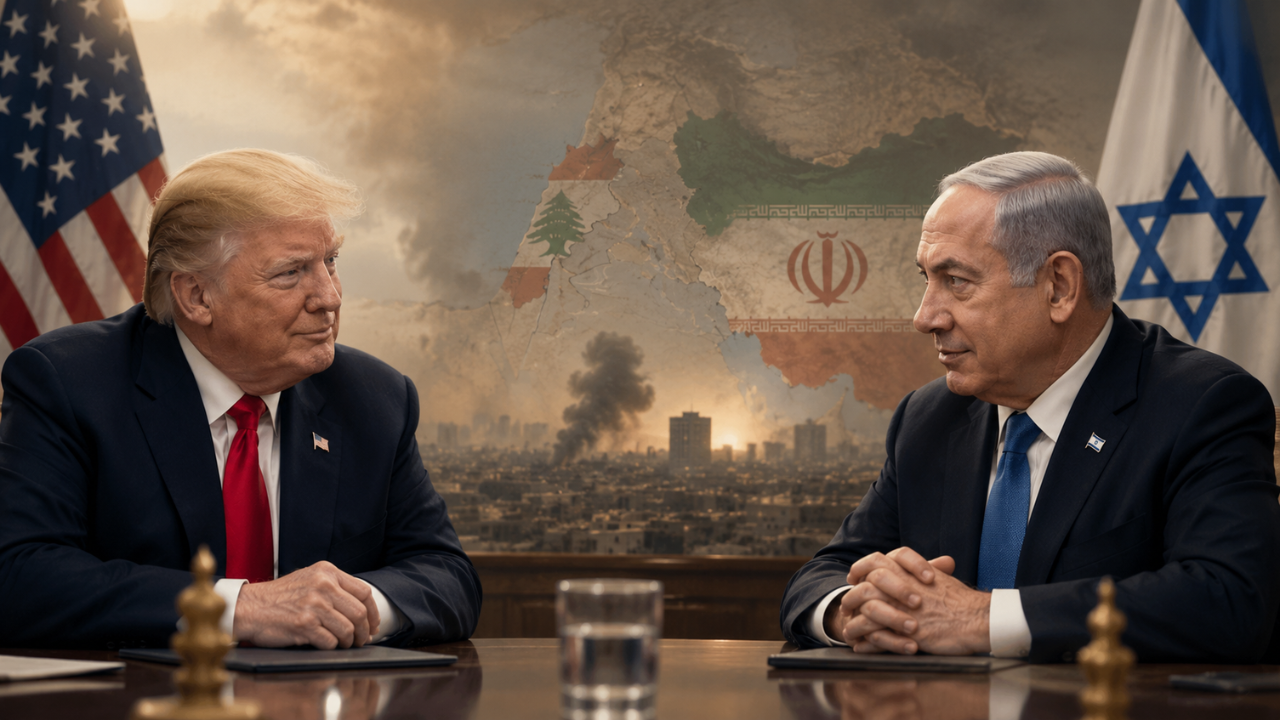
Donald Trump wanted out of the war, and he found his exit ramp. The latest diplomatic shift out of Switzerland has sent shockwaves through Jerusalem, leaving Israeli Prime Minister Benjamin Netanyahu fundamentally exposed. A newly signed 14-point memorandum of understanding between Washington and Tehran has completely rewritten the security rules for the Middle East, and Israel didn't even get a seat at the table. For months, Netanyahu told his citizens that joint military action with the United States would permanently break the back of the Iranian axis. Instead, the emerging US-Iran understanding has done the exact opposite. It has effectively solidified Iran's political influence in Lebanon while tying Israel's hands.
Behind closed doors, the panic is palpable. Israeli officials aren't hiding their fury over how quickly the Trump administration moved from joint airstrikes in February to a bilateral diplomatic track in June. The real kicker isn't just about centrifuges or uranium enrichment anymore. It is about southern Lebanon. It is about Hezbollah. Netanyahu bet his political future on a promise of absolute victory, expecting Washington to bankroll and back a prolonged campaign. Instead, he got sidelined by a real estate president who prizes a quick deal over an endless war. According to intelligence insiders, Netanyahu is completely hysterical about the reality of this new arrangement. He sees the writing on the wall, and it threatens his entire political survival ahead of the critical October elections.
The Secret Architecture of the US-Iran Understanding
The diplomacy didn't happen overnight, but its final execution was remarkably swift. Representatives from Washington and Tehran quietly gathered in Bürgenstock, Switzerland, to draft an interim peace agreement that effectively ends a three-month-old hot war in the Persian Gulf. The core document, a 14-point memorandum of understanding, outlines an immediate cessation of military operations across all active fronts.
Look at the wording of the first clause. It binds the United States, Iran, and their respective regional allies to an immediate freeze on hostilities. This explicitly covers Lebanese territory. The deal explicitly guarantees the sovereignty and territorial integrity of Lebanon, a clause that Tehran fought aggressively to include. Iran essentially used its leverage—including threats to indefinitely choke off shipping through the Strait of Hormuz—to force Lebanon into the center of the text.
The structural breakdown of this new diplomatic reality shows just how much has changed:
- The new de-escalation cell includes the United States, Iran, and the Lebanese Republic as primary actors.
- Regional facilitation is being handled directly by Qatar and Pakistan.
- Israel is entirely absent from the direct monitoring mechanism.
- The old 2024 framework, which allowed Israel unilateral freedom to strike back at Hezbollah violations, has been practically overridden.
This represents a massive departure from previous diplomatic arrangements. Under the old 2024 understandings brokered during the Biden presidency, Israel maintained a recognized right to enforce a ceasefire through unilateral military action if Hezbollah moved south of the Litani River. The new Trump-sanctioned text strips away that consensus. If Israel launches cross-border strikes now, it isn't just violating Lebanese airspace; it is actively disrupting a diplomatic framework signed by its primary superpower patron.
Why Lebanon Is the Real Breaking Point
While global media remains hyper-focused on sanctions relief and oil export waivers, Jerusalem is hyper-ventilating over the northern border. Netanyahu is reportedly far more panicked about the Lebanon provisions of this US-Iran understanding than any nuclear compromise. The reasons are entirely practical.
Israel currently maintains a self-declared security zone in southern Lebanon, holding ground it seized during the brutal spring fighting. Netanyahu explicitly declared that Israeli forces wouldn't pull back. He insists they will stay in South Lebanon for as long as he deems necessary. But the new memorandum demands a total termination of military operations. This sets up an immediate, inevitable collision between Israeli military policy and American foreign policy.
Trump wants the troops out. He wants the oil flowing again. He wants to claim he stopped a global economic crisis before it wrecked Western markets. When asked directly about Netanyahu's deep anxieties regarding the deal, Trump didn't offer the usual flowery reassurances about an unshakeable bond. He kept it purely transactional. He noted that he is a problem solver who gets things solved fast, including with Bibi. That isn't a statement of support. It is a warning to fall in line.
Backchannels, Truth Social, and Broken Alliances
Netanyahu didn't take this sitting down. Realizing he was losing control of the narrative, he deployed his closest confidant, Ron Dermer, to launch an aggressive backchannel lobbying campaign. Dermer worked his deep connections within the MAGA inner circle, attempting to convince Trump's advisers that the deal was a historic betrayal of Israeli security.
The lobbying yielded some temporary, public noise. Dermer's pressure successfully prompted a characteristically aggressive post on Truth Social, where Trump threatened Iran with massive consequences if it failed to keep Hezbollah on a tight leash. For a moment, Netanyahu's team thought they had successfully shifted the tide. They were wrong. The public rhetoric was just cover for the underlying policy. The technical talks in Switzerland kept moving forward without a single pause.
The frustration within the Israeli security establishment is boiling over. Senior military leaders acknowledge privately that the preliminary agreement is a disaster for their long-term strategy. The chief of staff and top intelligence commanders all share the same view. They feel they were baited into an aggressive regional escalation under the assumption that the US would help them finish the job. Instead, Washington changed direction mid-stream, leaving Israeli forces deeply entangled in a hostile southern Lebanon with no clear political exit strategy.
The Electoral Trap Closing on Jerusalem
You can't separate this strategic panic from Israel's domestic political calendar. October is coming fast. Netanyahu's entire re-election strategy relies on presenting himself as the ultimate protector of the nation, the only leader capable of managing Washington while dismantling the Iranian ring of fire.
If the US-Iran understanding holds, that narrative falls apart completely. Hezbollah remains entrenched along the northern border, politically protected by a Washington-sanctioned memorandum. The residents of northern Israel, who have been displaced from their homes for months, won't be able to return under conditions they consider safe. Netanyahu's promises of absolute victory will be exposed as empty wartime rhetoric.
Political opponents are already smelling blood in the water. Rivals are pointing out that Netanyahu's aggressive strategy actually isolated Israel from its most important ally. They argue that by pushing for a massive regional war, he forced Trump's hand, prompting the White House to cut a direct deal with Tehran just to stabilize global energy markets and stop the bleeding.
Moving Past the Rhetoric
Israel cannot afford an open, sustained diplomatic war with a Trump-led White House, yet it cannot accept a status quo that leaves Hezbollah protected by American-Iranian diplomacy.
The immediate next steps for Israeli defense planners require an urgent pivot away from public complaints and toward cold strategic reality. First, Jerusalem must quietly negotiate a bilateral side-letter with Washington that explicitly preserves Israel's tactical right to self-defense inside Lebanon, regardless of what the Swiss memorandum says. Dermer's focus needs to shift from trying to break the US-Iran deal to securing ironclad, written American guarantees that cross-border threats will still face immediate containment.
Second, the Israeli military needs to define a realistic, limited security layout for the northern border rather than clinging to an unsustainable long-term occupation of southern Lebanese villages. Holding ground deep inside Lebanon without American diplomatic backing is a recipe for a war of attrition that Israel cannot win alone. Netanyahu needs to stop managing the war for his October campaign commercials and start managing it for the nation's long-term survival. The Washington-Tehran axis is shifting, and Israel must adapt before it gets left behind entirely.


