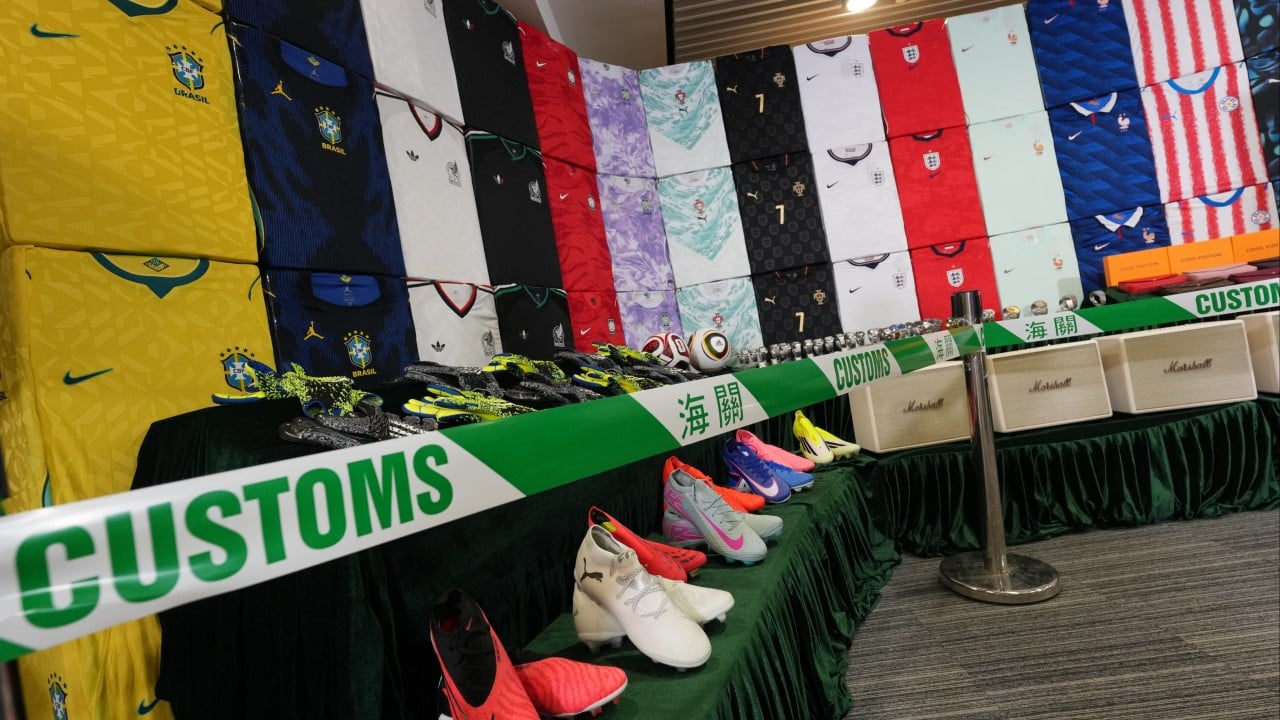
Law enforcement agencies love a high-profile seizure. It makes for a perfect press conference. Tables stacked high with confiscated sports jerseys, pristine footballs, and imitation luxury gear. The headlines write themselves. Hong Kong customs officials seize 156 million dollars in counterfeit World Cup merchandise. Six people are arrested. The public applauds, brand owners send letters of appreciation, and bureaucrats check a box indicating the streets are safer for intellectual property.
It is a beautiful narrative. It is also entirely meaningless.
The traditional media views these operations as major victories against a criminal underworld. In reality, these busts represent a fundamental misunderstanding of modern trade economics. They treat a highly fluid, decentralized global supply chain as if it were a rigid, 1980s drug cartel. By focusing on the spectacular optics of physical seizures, enforcement agencies and corporate brand protection teams are fighting a ghost. They are burning millions of dollars to suppress a symptom while entirely ignoring the market forces that drive the trade.
The standard consensus is that counterfeit crackdowns protect consumers and salvage corporate profits. That premise is flawed from the ground up.
The Myth of the Lost Sale
The foundational argument for every intellectual property raid is financial damage. Brands claim that a hundred-million-dollar seizure translates directly to preserved revenue. This logic requires you to believe that a consumer buying a twenty-dollar imitation football jersey outside a transit hub would otherwise walk into a flagship boutique and spend two hundred dollars on the licensed authentic version.
They would not.
The target demographics for high-end authentic merchandise and street-level counterfeits are almost entirely mutually exclusive. A massive percentage of counterfeit consumption is driven by absolute price elasticity. The buyer is fully aware the product is a copy. They are buying the aesthetic, not the provenance. When a raid wipes out a local supply network, that demand does not magically transform into retail revenue for major sportswear conglomerates. The demand simply goes dormant until the next vendor sets up a digital storefront, or it shifts to a different unlicensed alternative.
I have watched consumer goods brands dump seven-figure budgets into regional enforcement campaigns, only to see zero statistical lift in their authorized retail channels within those same zip codes. You cannot force a low-income fan into a luxury pricing tier by taking away their cheaper options.
The Whack A Mole Mechanics of Decentralized Production
The imagery of a centralized "counterfeit kingpin" running a massive underground factory is a relic of Hollywood. Modern illicit manufacturing looks exactly like modern legitimate manufacturing: outsourced, fragmented, and agile.
A single counterfeit tournament jersey does not roll off a solitary assembly line.
- The fabric is sourced from one textile mill.
- The embroidery is done by a third-party contractor.
- The brand tags are printed at a separate facility.
- The final assembly happens in a nondescript warehouse days before shipping.
When customs officials intercept a container or raid a distribution node in a major transit hub like Hong Kong, they are cutting a single thread of a massive web. The component manufacturers face zero downtime. The digital infrastructure used to coordinate the logistics remains untouched. Within forty-eight hours of a major bust, alternative shipping routes through secondary ports are activated.
The cost of losing a shipment is already factored into the counterfeiters' business model. It is a standard cost of goods sold. When law enforcement announces a record-breaking seizure, they are simply celebrating a temporary operational delay for an entity that operates with better supply chain agility than most Fortune 500 companies.
The Digital Displacement Enforcement Cannot Touch
Physical seizures assume that geography matters. Historically, stopping a shipment at a strategic port like Hong Kong crippled regional distribution. That reality evaporated with the rise of cross-border e-commerce and decentralized logistics networks.
The modern counterfeit trade relies heavily on micro-shipping. Instead of moving ten thousand fake items in a single sea container, operations utilize direct-to-consumer postal networks. Thousands of individual packages move through international mail centers every day, disguised as low-value gifts or unbranded apparel. Scanning every single small parcel entering a country is logistically impossible without completely halting global commerce.
Furthermore, the advertising mechanism has shifted away from public marketplaces to closed-loop digital spaces. Encrypted messaging groups, private social media forums, and ephemeral live-stream shopping events serve as the modern storefront. A buyer views a sample on a temporary video stream, pays via a peer-to-peer digital wallet, and receives a package with no external branding on the box.
Chasing physical warehouses in maritime hubs is an archaic response to an ethereal digital network. It is equivalent to trying to stop digital piracy by confiscating blank DVDs at a customs checkpoint.
The Unintended Consequence of Market Optimization
There is an even more uncomfortable truth that brand protection executives refuse to acknowledge. Aggressive enforcement often acts as an accidental quality filter for the illicit market.
When low-level, sloppy counterfeit operations are wiped out by routine customs sweeps, it eliminates the poorest quality products from the market. The operators who survive are the ones with the most sophisticated supply chains, the highest capital reserves, and the best manufacturing capabilities. By clearing out the amateur competitors, enforcement agencies inadvertently help the highly organized networks consolidate market share.
The resulting products get better, the logistics become more resilient, and the operations become harder to detect. The industry optimizes under pressure.
Dismantling the Standard Assumptions
Let us break down the flawed logic that populates standard industry analysis regarding intellectual property enforcement.
| Common Flawed Assumption | Economic Reality |
|---|---|
| Seizures bankrupt illicit syndicates. | Losses are pre-calculated into the margin; production assets remain completely intact. |
| Authenticity tracking labels stop fake goods. | Packaging and holographic tags are replicated faster than the actual physical product. |
| Raids protect vulnerable consumers from deception. | The vast majority of buyers are fully aware of the product's origin and choose it based on price. |
Rethinking the Strategy from the Ground Up
If massive physical seizures are nothing more than expensive theater, how should legitimate brands actually protect their ecosystem? The answer requires abandoning the reliance on state-sponsored raids and shifting toward market-driven containment.
Lower the Barrier to Entry
The most effective way to eliminate an illicit market is to undercut its economic viability. When official merchandise is priced at exorbitant premiums, it creates a massive margin vacuum that counterfeiters are eager to fill. Brands must develop tiered product strategies. Offer authenticated, lower-tier options specifically designed for cost-conscious consumer segments. If an official, basic version of a tournament jersey is available for a reasonable price, the incentive to navigate sketchy digital forums for an imitation drops significantly.
Focus on Platform Accountability, Not Ports
Stop chasing the physical containers and start choking the financial and digital infrastructure. Illicit operations cannot scale without access to mainstream payment processors and visible digital discovery channels. Brand protection budgets should be entirely redirected away from maritime private investigators and toward aggressive, automated litigation against the digital platforms that facilitate discovery and payment processing. Cut off the capital flow and the ability to acquire customers at scale, and the physical supply chain collapses on its own weight.
Embrace the Signal
Counterfeit volume is a direct metric of cultural relevance. If a product is not being copied, it means the market no longer cares about the brand. Instead of viewing imitation goods solely as an existential threat, smart companies treat counterfeit hotspots as real-time market research. If a specific unreleased design or regional colorway is trending in the illicit market, it serves as a zero-cost validation of consumer demand. Use that data to optimize legitimate production schedules and distribution strategies.
Stop celebrating the optical illusion of the hundred-million-dollar bust. The trucks will keep rolling, the digital storefronts will keep opening, and the consumer demand will remain unchanged. The only entities winning in the current paradigm are the public relations departments capitalizing on a headline. Treat the problem like an economic equation, or keep wasting capital chasing shadows at the border.


