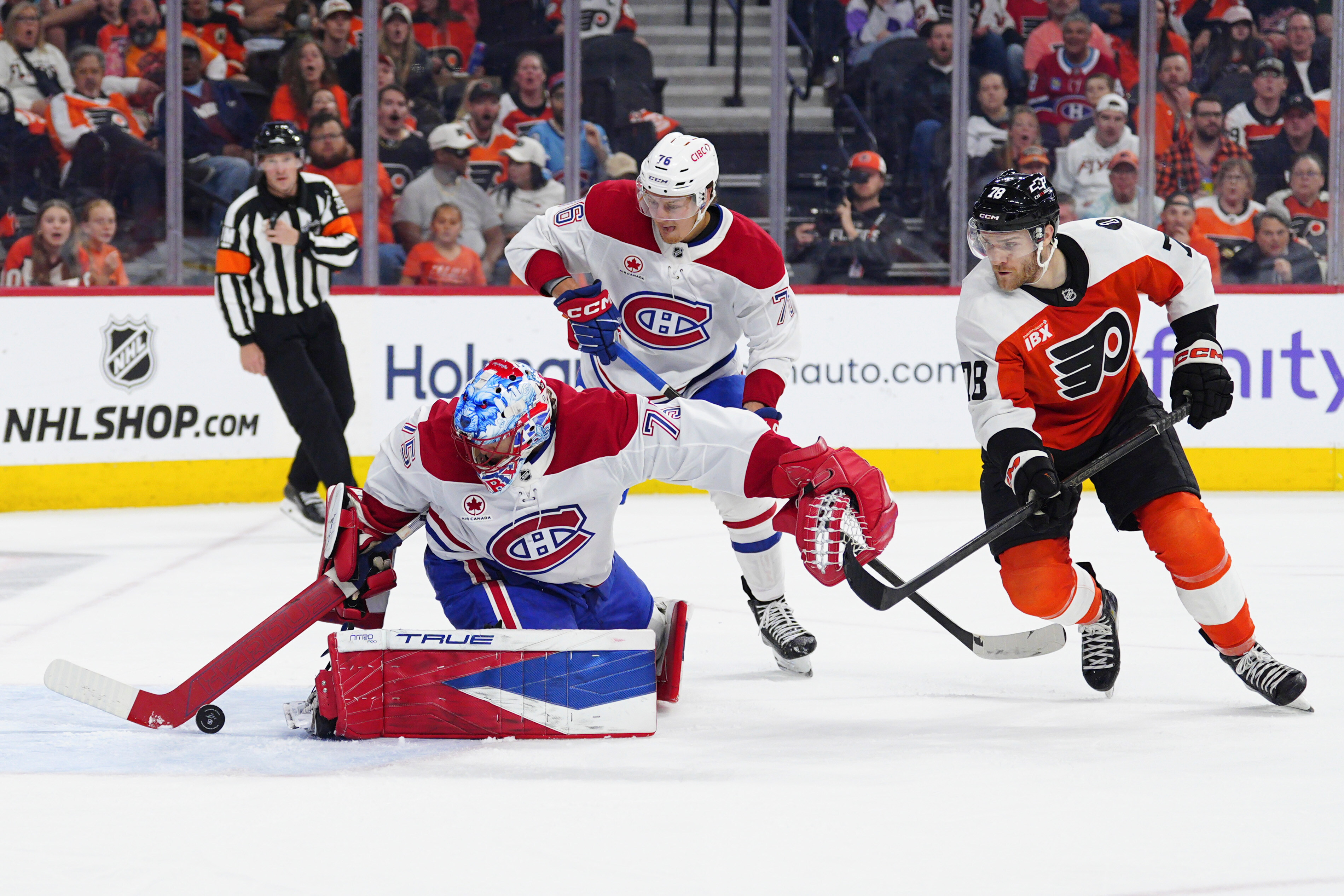
The Montreal Canadiens’ 4-2 loss to the Philadelphia Flyers was not a throwaway game. It was a diagnostic report. When a rebuilding team drops a late-season contest to a direct rival, the temptation for local media and exhausted fanbases is to brush it off as a meaningless data point in a "lost" season. That is a dangerous mistake. These games reveal the structural integrity of a locker room and the actual depth of a prospect pool beyond the highlight reels. Montreal didn’t just lose a game in Philadelphia; they displayed a recurring lack of defensive structure and an inability to match the heavy, checking-style pressure that defines playoff hockey.
The Myth of the Meaningless Game
Professional hockey players do not play "throwaway" games. Their contracts, their leverage in summer negotiations, and their spots on next year’s roster are decided in these late-March and April windows. For the Montreal Canadiens, every shift is an evaluation of whether management’s "New Era" is actually taking root or if they are simply spinning their wheels in the mud of a perpetual rebuild.
The Philadelphia Flyers, led by John Tortorella, provided a blueprint that Montreal currently lacks. Philadelphia is not a team overflowing with elite, game-breaking talent, yet they systematically dismantled Montreal by winning the small battles—the puck retrievals, the net-front positioning, and the transition defense. Montreal’s inability to adjust to this physical reality suggests that the "culture" being built under Martin St. Louis is still heavily reliant on vibes rather than on-ice execution.
Defensive Rot and the Youth Excuse
For two years, the narrative in Montreal has been shielded by the youth of the blue line. While it is true that Kaiden Guhle, Jordan Harris, and Arber Xhekaj are learning on the job, the grace period is expiring. In the loss to Philadelphia, the defensive breakdowns weren't the result of athletic inferiority. They were the result of mental lapses.
Positioning remains the primary culprit. Too often, Montreal’s defenders find themselves chasing the puck toward the boards, leaving the high-danger scoring areas—the "home plate" in front of the net—completely vacated. Philadelphia’s forwards didn't have to work for their space; they were gifted it.
- The First Goal: A failure to tie up sticks in the crease.
- The Transition Gap: Defenders backing up too far, allowing Flyers puck carriers to gain the zone with speed.
- The Cycle Break: An inability to kill plays along the wall, leading to extended shifts that gassed the Montreal forwards.
This isn't just about age. It is about a system that seems to prioritize offensive creativity from the back end at the total expense of fundamental area defense. If the Canadiens intend to be "in the mix" for a playoff spot next season, this defensive porosity must be addressed through coaching, not just waiting for players to turn 25.
The Nick Suzuki Ceiling
Nick Suzuki is a fine hockey player. He is a capable leader and a consistent producer. However, the Philadelphia game highlighted a hard truth that Montreal’s front office must face: Suzuki is being asked to do too much because there is no true elite secondary support behind him.
When opposing teams can focus their entire defensive game plan on neutralizing the Suzuki-Caufield-Slafkovsky line, Montreal’s offense evaporates. Against Philadelphia, the depth scoring was non-existent. This creates a ripple effect. Because the top line knows they have to carry the entire offensive load, they begin to cheat for offense, taking risks at the blue line and neglecting their 200-foot responsibilities.
The "core" is talented, but it is currently a skeleton crew. Without a legitimate second-line center who can win 55% of his draws and drive play against top-four defenders, Suzuki will continue to be run into the ground by April.
Goaltending and the False Security of Cayden Primeau
Cayden Primeau’s performance in Philadelphia was a microcosm of his career: flashes of brilliance interrupted by goals that a starting NHL netminder simply cannot allow. The organization has spent months juggling a three-goalie rotation, a move that likely stunted the rhythm of everyone involved.
Primeau has the size and the pedigree, but he lacks the lateral explosiveness required to compensate for Montreal’s defensive breakdowns. In a game where the Canadiens were already struggling to generate shots, they needed a goaltender to "steal" a period. Primeau couldn't do it.
The front office’s decision to move Jake Allen was necessary, but it has exposed the reality that Sam Montembeault is currently the only goaltender on the roster capable of providing league-average stability. If the plan is to rely on Primeau as a long-term 1B option, the scouting department might need to recalibrate their expectations.
The Slafkovsky Paradox
Juraj Slafkovsky’s development is the one bright light in an otherwise murky season, yet even he was neutralized by Philadelphia’s physical play. The Flyers realized early that if you finish your checks on Slafkovsky at the half-wall, you take away his ability to scan the ice.
Slafkovsky is learning to use his frame, but he still lacks the "mean streak" necessary to dominate the dirty areas of the ice. He is a playmaker trapped in a power forward's body. In the loss to the Flyers, he was frequently pushed off the puck in the offensive zone, a reminder that while his point totals are up, his physical maturity is still a work in progress.
The concern here is not his talent, but the pressure placed upon him. In a market like Montreal, a first-overall pick is expected to be the savior. When the team around him fails to provide a physical deterrent, Slafkovsky becomes a target.
Coaching vs. Connectivity
Martin St. Louis talks a lot about "concepts" and "connectivity." These are modern coaching terms that resonate well in press conferences. On the ice, however, "connectivity" looked like a disorganized mess in Philadelphia.
The power play remains a stagnant exercise in perimeter passing. There is a lack of movement at the point, and the reliance on the "bumper" play has become predictable for every penalty kill in the league. Philadelphia’s PK didn't have to work hard because Montreal’s puck movement was slow and telegraphed.
There is a fine line between giving young players the freedom to make mistakes and failing to implement the discipline required to win "boring" games. Right now, Montreal is very good at losing exciting games and even better at losing boring ones.
The Asset Management Gap
The trade deadline has passed, and Montreal sits with a mountain of draft picks and a roster that still feels three pieces short of a functional puzzle. The decision to hold onto certain veterans while failing to integrate more high-upside youth from Laval is a conservative strategy that may backfire.
If these late-season games are truly about evaluation, why are we seeing heavy minutes for players who clearly won't be part of the roster in 2026? Every minute given to a replacement-level veteran is a minute taken away from a prospect who needs to feel the speed of an NHL transition.
Philadelphia is a team that was supposed to be rebuilding, yet they are ahead of Montreal in almost every meaningful metric: goal differential, expected goals for, and points in the standings. They did this by being harder to play against. Montreal is currently an "easy" team to play against. They are skilled, they are fast, but they are soft in the corners and indecisive in their own end.
The Road Ahead
The Canadiens are at a crossroads. They can continue to sell the "growth" narrative to a loyal fanbase, or they can admit that the current roster construction has fundamental flaws that a few more draft picks won't fix.
The loss to Philadelphia wasn't an outlier. It was a mirror. It showed a team that is talented enough to stay close but lacks the collective will and structural discipline to close out games against disciplined opponents.
The off-season needs to be about more than just drafting well. It needs to be about identifying which players on the current roster are actually capable of playing winning hockey when the "vibes" aren't enough. The time for moral victories is over.
Montreal needs to stop celebrating "competitive losses" and start questioning why they aren't the ones dictating the pace of the game. The Philadelphia Flyers showed them exactly what a cohesive, gritty identity looks like. Montreal looked like a team still searching for its soul in the middle of a 41-shot barrage.
Until the Canadiens find a way to stabilize their defensive zone and provide Nick Suzuki with elite-level support, they will remain exactly what they were in Philadelphia: a high-effort, low-result squad that is easier to beat than their talent suggests. The rebuild doesn't end when the prospects arrive; it ends when the team stops making excuses for losing games they should have won.
Fix the defensive gap. Find a second-line center. Stop treating April games like preseason exhibitions.