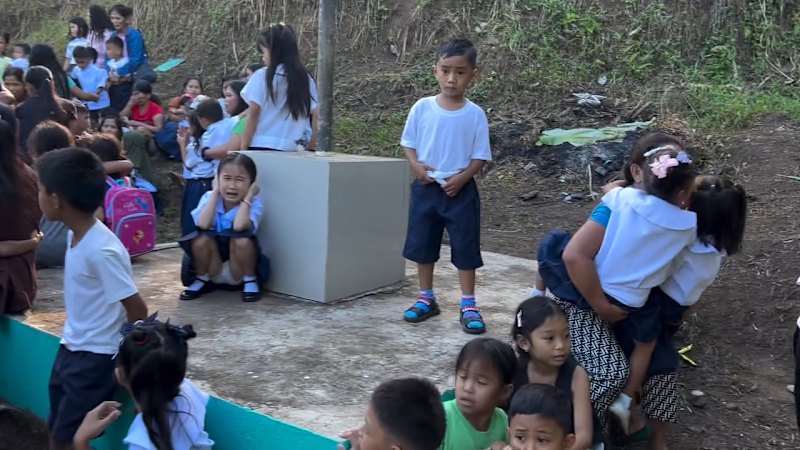
The ground started shaking at 7:37 AM on what was supposed to be a standard first day back to school. Instead of listening to welcome speeches, thousands of students across the southern Philippines found themselves sprinting for their lives. A massive magnitude 7.8 offshore earthquake struck just south of General Santos City in Mindanao, turning morning flag ceremonies into scenes of pure terror.
Videos tearing across social media show exactly how vulnerable our public infrastructure remains. At Mahayahay Elementary School in Davao Occidental, children standing in formation suddenly start screaming as the earth shifts violently. In another clip verified from Davao del Sur, a school building structure crumples to the ground, sending up thick plumes of dust while onlookers yell in sheer panic.
We talk a big game about disaster preparedness, but when a major seismic event happens, the footage exposes the gaps we still fail to close. The morning tremor left at least 12 people dead and over 200 injured across the region, with local police actively checking reports of students trapped inside a collapsed two-story school building in General Santos City.
When the First Day of School Becomes a Disaster Zone
The timing couldn't have been worse. Public schools throughout the country opened their doors for the new academic year on Monday morning. Thousands of kids were packed into courtyards and classrooms when the offshore quake triggered. The depth was shallow, recorded at around 10 kilometers by the Philippine Institute of Volcanology and Seismology, which always guarantees violent surface shaking.
I've looked closely at the emergency response protocols implemented during the chaos. Teachers tried their best to enforce standard "duck, cover, and hold" tactics. But let's be honest, when a concrete roof shed or an entire upper floor starts pancaking right in front of you, human instinct takes over. You run.
Over 100 students attending morning assemblies in the region sustained bruises, and dozens fainted simply from the crushing panic of the crowd. The Philippine Red Cross ended up deploying teams to multiple high schools just to treat traumatized children who witnessed structures give way around them.
The Infrastructure Problem We Choose to Ignore
Every time a big one hits the Philippine fault zones, the post-incident analysis follows a predictable script. Officials express shock, structural engineers point to substandard materials, and the news cycle moves on.
Look at what happened in downtown General Santos City during this specific quake. A commercial building housing a popular Jollibee fast-food restaurant was completely reduced to rubble. Concrete walls of multiple commercial complexes simply sheared off and crashed onto the streets.
Mindanao Earthquake Quick Data:
- Magnitude: 7.8
- Depth: 10 km (Shallow)
- Core Impact Zone: General Santos City, Sarangani, Davao del Sur
- Casualties: 12 dead, 200+ injured (Numbers fluid)
When commercial structures and school buildings fold like lawn chairs during a 7.8 quake, it means the local building codes aren't being enforced properly. The police station in Alabel town, Sarangani province, suffered immediate structural cracks, with officers barred from re-entering. If the police can't even trust their own headquarters to stand up, how can we expect parents to trust the structural integrity of a decades-old public school building?
Tsunami Panics and Regional Chaos
The initial quake was powerful enough to trigger immediate tsunami warnings across the Pacific region, covering the coastlines of the Philippines, Indonesia, Palau, Taiwan, and Papua New Guinea. The Pacific Tsunami Warning Center warned that waves exceeding one meter could hit the coast.
Philippine President Ferdinand Marcos Jr. immediately ordered residents in coastal Mindanao areas to move inland. His directive was clear: "Move to higher ground now. Do not wait."
"Your life is more important than anything left behind." — President Ferdinand Marcos Jr.
Fortunately, the tsunami threat passed after about five hours without causing major coastal casualties, but the sheer logistics of evacuating coastal towns while dealing with collapsed urban buildings paralyzed local transport. The international airport in General Santos shut down operations, canceling domestic flights to clear the airspace for emergency logistics.
What Needs to Change Before the Next Fault Line Shifts
This isn't a freak occurrence. The Philippines sits squarely on the Pacific Ring of Fire. We know the earthquakes are coming. If you're a parent, local official, or school administrator, here are the immediate, non-negotiable next steps that need to happen before classes resume:
- Mandatory Structural Audits: Local government units must deploy independent structural engineers to inspect every single public school building in the affected provinces. Visually checking for cracks isn't enough; structural integrity testing of older concrete supports is required.
- Enforce Building Code Penalties: Contractors who use watered-down concrete mix or inadequate steel reinforcement rebar must face criminal liability. The destruction in General Santos proves that code violations cost lives.
- Redesign Emergency Assembly Points: Gathering students directly underneath or adjacent to covered courts and multi-story concrete awnings is a design flaw. Assembly points must be located in true open spaces completely clear of potential structural debris fall zones.
President Marcos Jr. suspended school classes across the affected areas of Mindanao until further notice, stating that the safety of the children comes first. He's right. But keeping kids home only delays the inevitable if they are eventually sent back into the exact same vulnerable structures. We don't need more thoughts and prayers; we need better concrete and stricter enforcement.