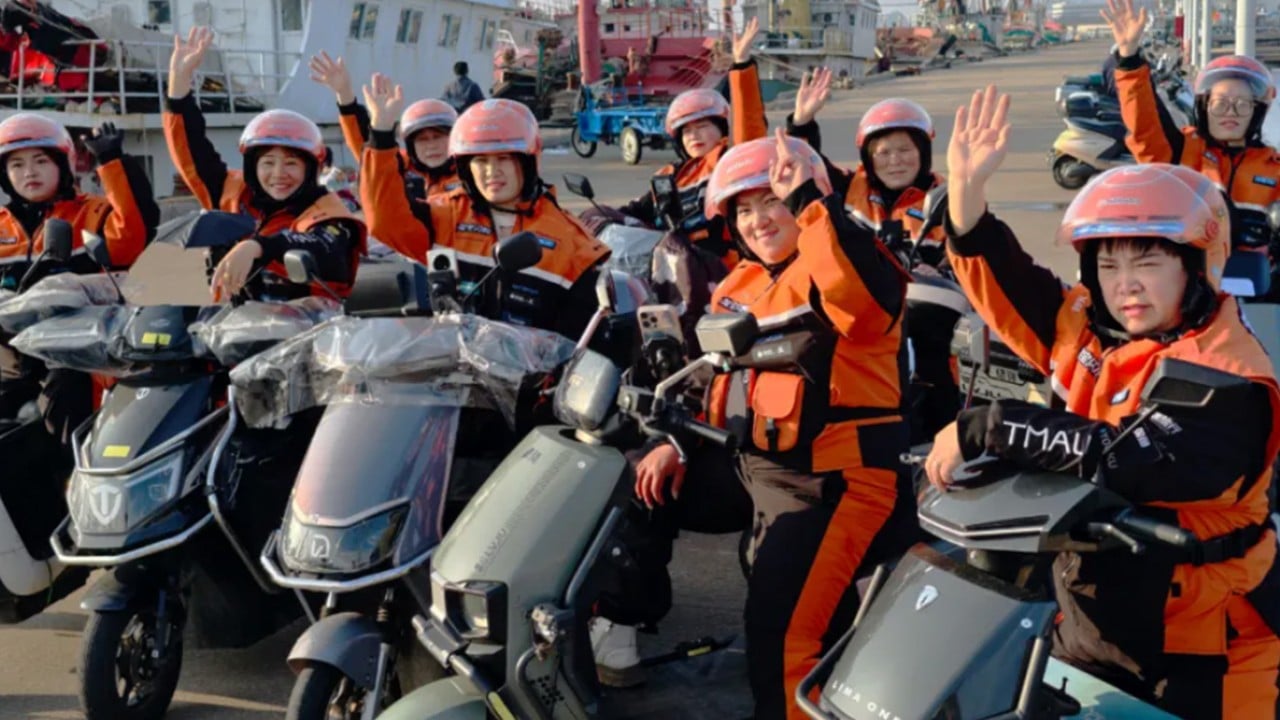
Rain slickens the pavement of Hangzhou until the streetlights look like smeared oil paintings. Somewhere in the middle of this blur, a yellow scooter idles. The engine vibrates against the knees of a woman named Chen. She is thirty-four, her hair is pulled into a practical knot under a plastic shell, and she is currently calculating the exact speed required to beat a red light without dying. In her insulated box, three bowls of spicy noodles are steaming. In her mind, a six-year-old boy is waking up from a nap and wondering where his mother is.
Chen is one of the "Female Knights." It is a romantic name for a job that smells like exhaust and lukewarm soup.
For years, the narrative of China’s gig economy was written in the sweat of young men from the provinces, the "runners" who fueled the digital boom. But a quiet, domestic shift has occurred. The face of the delivery driver is changing. It is becoming older, more weary, and distinctly female. These are not just workers; they are mothers playing a high-stakes game of Tetris with their own lives, trying to slot the demands of a relentless algorithm into the gaps left by a failing social safety net.
The Illusion of the Open Road
The pitch is simple. Flexibility. Be your own boss. Work when you want.
To a mother in a Tier-2 Chinese city, this sounds like a lifeline. Traditional office jobs or factory shifts demand presence from 8:00 AM to 6:00 PM, a rigid block of time that ignores the reality of school runs, sick toddlers, and the invisible labor of the home. Delivery work offers a fragmented alternative. You can log on after the school gates close and log off before dinner.
But flexibility is a ghost.
In reality, the algorithm does not care if your child has a fever. The platform rewards consistency and speed. To earn enough to make the insurance and the scooter battery rentals worthwhile, these women must lean into the "peak" hours. This means lunch rushes and dinner surges—the exact moments when families usually gather.
Consider a hypothetical driver we will call Wei. Wei doesn't work for the thrill of the ride. She works because her husband’s construction salary was slashed, or perhaps because she is one of the millions of "left-behind" parents in urban outskirts. When she pulls on her bright blue Meituan or Ele.me jacket, she is performing a transformation. She ceases to be a mother and becomes a data point.
The pressure is physical. Heavy bags of groceries hanging from handlebars. The frantic climb up six flights of stairs in a walk-up apartment building because the elevator is broken. The "Female Knights" are often preferred by customers for their perceived care—they are less likely to spill the coffee, less likely to be rude. But that emotional labor is unpaid. It is a tax they pay for existing in a space that was never built for them.
The Math of Survival
Let’s look at the numbers through the lens of a Tuesday afternoon.
A single delivery might net a driver between 3 and 7 yuan. That is roughly 50 cents to a dollar. To clear a modest daily goal of 200 yuan ($28), a mother must complete thirty to forty deliveries. If each delivery takes an average of twenty minutes—accounting for restaurant wait times, traffic, and finding the correct door in a sprawling complex—she is looking at a twelve-hour day.
Twelve hours.
Where does the "family" part of the "freedom and family" equation go? It happens in the margins. It happens on speakerphone. It is a common sight in Beijing or Shanghai to see a woman in a delivery vest parked on the sidewalk, hunched over her phone, not looking at a map, but video-calling her child to check if they’ve finished their homework.
"Did you eat? Is the door locked?"
The screen shows a grainy image of a child in a quiet apartment. The mother is surrounded by the roar of the city. This is the "synergy" the tech giants talk about, though they use different words. They call it "empowering women with diverse income streams." A more honest term might be "the monetization of desperation."
The Invisible Stakes
There is a specific kind of courage required to weave a scooter through a sea of SUVs while carrying a child’s future on your back.
Safety is the silent predator in this industry. Data from various urban traffic bureaus suggests that delivery drivers are involved in a disproportionate number of accidents, largely due to the "late delivery" penalties enforced by the apps. For a mother, an accident is not just a medical bill; it is a total system collapse. If she goes down, the childcare stops, the income stops, and the household stalls.
Yet, they continue to flock to the platforms. Why? Because the alternative—staying home—is no longer viable in an economy where the cost of living has outpaced the traditional single-income model.
There is a psychological weight to this as well. In traditional Chinese culture, the "virtuous mother" is centered in the home. By taking to the streets, these women are defying a long-standing social script. They are visible. They are out in the sun, their skin darkening, their hands becoming calloused. They are "knights" not because they seek glory, but because they are in a state of constant, low-level warfare against poverty and time.
The Architecture of the Algorithm
We often talk about "the algorithm" as if it were a weather pattern, something natural and unavoidable. It isn't. It is a set of choices made by engineers in glass towers who have likely never had to choose between a $0.50 late penalty and a dangerous U-turn.
For the Female Knight, the algorithm is a demanding boss that never sleeps. It calculates her route based on the "ideal" path, which often ignores pedestrian crowds, closed gates, or the fact that she might need a bathroom break—a notoriously difficult task for women in the urban delivery landscape where public facilities are sparse and scooters cannot be left unattended.
The tech companies have made gestures toward reform. They have introduced "safety modes" and slightly extended delivery windows. But these are bandages on a structural wound. The business model relies on a surplus of labor that is willing to work for pennies, and mothers are the ultimate surplus labor. They are reliable. They are disciplined. They are terrified of failing their children.
The Weight of the Helmet
Back in Hangzhou, Chen finally reaches the eighteenth floor. She hands the noodles to a young man who doesn't look up from his phone. He mumbles a thanks. The door shuts.
She walks back to the elevator, and for a brief moment, the silence of the hallway is absolute. She catches her reflection in the polished metal of the elevator doors. She looks like a soldier. The yellow helmet is slightly crooked. There is a smudge of grease on her cheek.
She thinks about the playground near her house. She hasn't been there in the daylight for three weeks.
This is the reality of the "reshaping" of food delivery. It is not a triumph of feminist liberation, nor is it a simple story of corporate greed. It is a messy, human compromise. It is the sound of millions of women's footsteps echoing in stairwells, driven by a love so fierce it is willing to be commodified.
The "Female Knights" are reshaping the industry, but the industry is also reshaping them. It is hardening them. It is stripping away the luxury of "free time" and replacing it with "billable minutes."
As the sun begins to rise over the smog-heavy horizon, thousands of these women are just finishing their "extra" shifts. They return home as the city wakes up, passing the office workers who will soon be ordering the coffee they just delivered. They peel off their damp vests, stow their helmets, and step back into the role of mother. They wake their children, cook breakfast, and walk them to school.
They do not look like knights then. They look like tired women. But as they watch their children disappear into the school gates, there is a look in their eyes that suggests they would do it all again. They would ride through the rain, the insults, and the exhaustion.
The algorithm can track their location, their speed, and their customer ratings. But it can never quite calculate the value of the reason they are out there in the first place.
The scooter cools in the alleyway. The battery is drained. The woman sleeps for four hours before the lunch rush begins again. The cycle is perfect, efficient, and utterly heartless. It is the new frontier of the global economy, and it is being built on the backs of mothers who have no other choice but to ride.