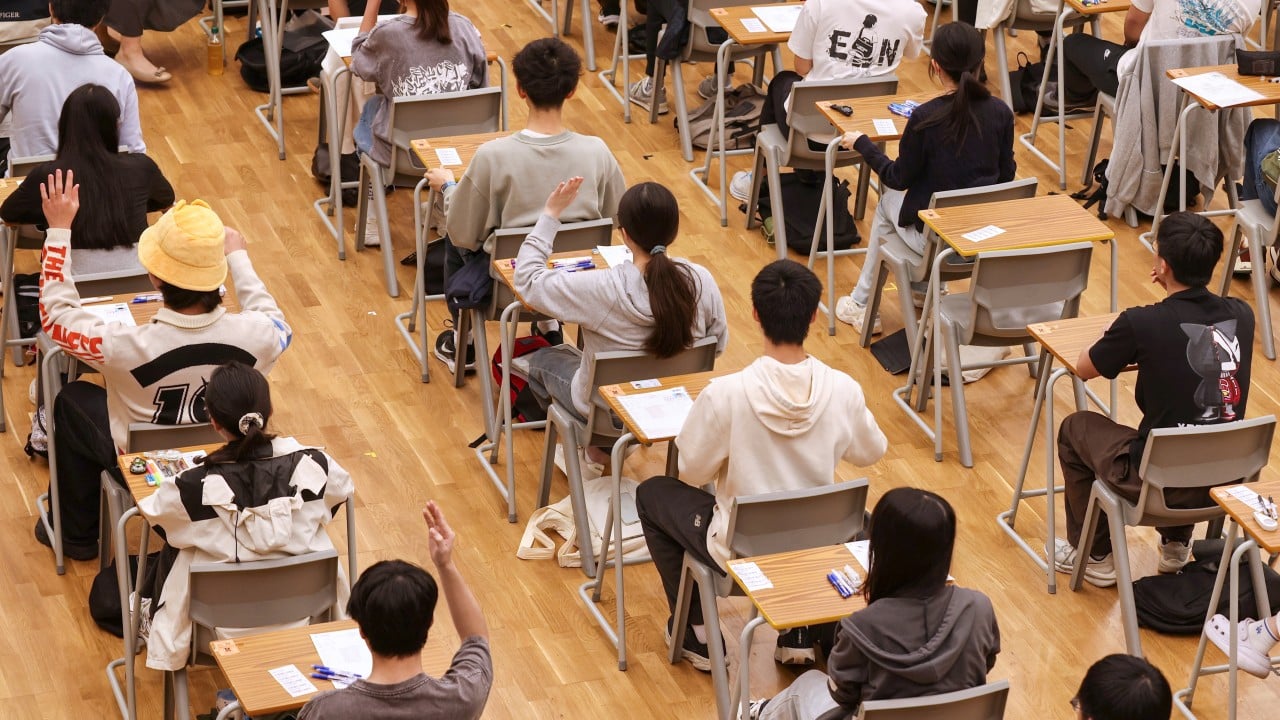
The click of the switch is the loudest sound in the flat. It happens around 2:00 AM, a sharp, plastic snap that cuts through the hum of the air conditioner. Then comes the pool of harsh, white LED light, illuminating a battleground of practice papers, highlighters, and a half-empty mug of cold green tea.
Let us call her Yan-yee. She is seventeen, though her shoulders carry the posture of someone decades older. Outside her window, the neon high-rises of Hong Kong blink in a restless rhythm, but Yan-yee’s eyes are locked onto a single number scrawled in red ink at the top of a Mock Diploma of Secondary Education (DSE) exam. Don't forget to check out our earlier article on this related article.
Ninety-two. In almost any other corner of the world, this is a triumph. In Yan-yee’s world, it is a flashing red light. It means she failed to secure the perfect score required for a coveted medical slot at the University of Hong Kong. It means her mother’s subtle, worried sighs over breakfast will continue. It means, in her own mind, she is falling behind in a race where the runners are never allowed to stop for air.
This is the psychological reality of Hong Kong's academic engine. It is a system built on the premise that excellence is not merely a goal, but a baseline requirement for survival. The pursuit of these scores has evolved from a pathway to success into something much more fragile. It has become a high-stakes arena where the toll is measured not just in sleepless nights, but in human crisis. To read more about the background here, WebMD provides an informative summary.
The Numbers Under the Fluorescent Lights
The data paints a stark picture of this pressure cooker. According to recent mental health surveys conducted by local NGOs and university researchers, more than 50% of secondary school students in Hong Kong report symptoms of severe anxiety and depression. Even more alarming are the systemic tracking figures from the Coroner’s Office and educational bureaus, which consistently reveal spikes in youth suicide rates during peak exam seasons—specifically around the spring DSE administration and the release of results in July.
Consider the sheer weight of the competition. Every year, roughly 50,000 students sit for the DSE. They are all vying for around 15,000 publicly funded undergraduate places. The math is brutal. The odds are stacked. When the margins between a future of professional security and a future of perceived failure come down to a fraction of a percentage point, the classroom ceases to be a place of learning. It becomes an incubator for chronic stress.
Imagine a boiler room where the pressure valve has been welded shut. That is the internal landscape of a student who believes their entire worth as a human being hinges on a single set of examination papers.
The pressure does not originate in a vacuum. It is deeply woven into the socio-economic fabric of the city. In a metropolis with some of the highest real estate costs on the planet, where upward mobility feels increasingly out of reach for the younger generation, education is viewed as the solitary golden ticket. Parents, remembering their own struggles, pour immense resources into after-school tutoring clinics.
Step into any commercial district in Mong Kok or Causeway Bay at 8:00 PM. You will see towering billboards featuring "tutor gods"—celebrity educators dressed in sharp suits, promising secret formulas to crack the DSE code. They look like pop stars, but they sell salvation in the form of exam tips. Parents pay premium rates, sometimes spending a significant chunk of the household income, to buy their children a perceived edge.
This financial sacrifice creates an invisible ledger of debt in the child’s mind. The student knows exactly how much their family is sacrificing. Every dollar spent on a tutorial center is a dollar that demands a return on investment. The burden of gratitude can be heavier than the burden of the syllabus itself.
When the Safety Nets Fail
We often treat youth resilience as an infinite resource. We assume that because young people are adaptable, they can absorb any amount of pressure. But human psychology has hard limits. When a student spends twelve hours a day memorizing marking schemes, the brain's emotional regulation centers begin to fray.
The signs are often quiet before they are loud. It begins with chronic insomnia. Then comes the isolation—withdrawing from friends because hanging out feels like "wasting time." Finally, it manifests as a profound, paralyzing sense of hopelessness.
The traditional response from authorities has been to bolster counseling services in schools. But adding a few more social workers to a school of a thousand students is like putting a band-aid on a structural fracture. The core problem is not a lack of coping mechanisms; it is the presence of an unsustainable environment.
We have conditioned an entire generation to believe that their life’s trajectory is determined by the time they turn eighteen. This is a profound logical fallacy, yet it operates as absolute truth within the school system.
The cost of this fallacy is tragic. When a young person encounters an academic setback, they do not just see a bad grade. They see a ruined life. They see a disappointed family. In the darkest moments of exhaustion, when the mind is starved of sleep and perspective, the exit signs begin to blur.
Shifting the Baseline of Worth
To dismantle this crisis, the conversation must shift from "how do we make students tougher?" to "how do we make the environment safer?"
True reform requires looking beyond the curriculum. It demands a cultural reassessment of what success actually looks like. If the only celebrated path is the one that leads to medicine, law, or finance, we will continue to lose young people to the margins of that narrow highway.
Universities have begun to experiment with broader admission criteria, looking at portfolios, talents, and non-academic achievements. This is a step toward sanity. But the change must go deeper, reaching the dinner tables where expectations are set. Parents must be supported in understanding that a child’s mental well-being is a far more reliable predictor of long-term life success than a perfect score in advanced mathematics.
Let us return to Yan-yee.
The clock now reads 3:45 AM. The city outside has finally quieted, the neon lights softened by a low-hanging coastal fog. She closes her textbook. Her eyes sting, and her chest feels tight with a familiar, dull ache.
She walks over to the window and presses her forehead against the cool glass. She is trying to remember what she used to enjoy before everything became a graded assessment. She used to draw. She used to read stories that weren't on a syllabus.
Yan-yee is not a statistic, though the system tracks her as one. She is a teenager standing at the edge of her life, looking out at a city that demands everything she has, and wondering if who she is will ever be enough. The light from her desk lamp stays on, a tiny, lonely beacon in a concrete mountain, fighting against a darkness that cannot be cleared by an exam score.