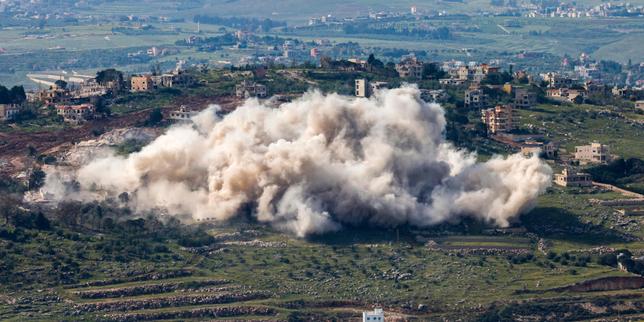
The ink on a ceasefire agreement rarely dries before the first rounds are fired, but the current situation in Lebanon has moved beyond simple "violations" into a systematic dismantling of the diplomatic process. Since the nominal start of the April 17 truce, at least 40 people have been killed in a series of strikes that Israel characterizes as preemptive defense. This isn't just a failure of diplomacy. It is a calculated recalibration of what a "ceasefire" actually means in modern warfare. The reality is that the cessation of hostilities exists only on paper, while the ground reality is dictated by a doctrine of perpetual engagement.
The death toll, verified by local medical sources and international monitors, highlights a grim trend. Israel maintains that its operations target the re-emergence of infrastructure and the movement of specialized units. However, the recurring pattern of civilian casualties suggests that the "active defense" perimeter has expanded to include anything that moves within a vaguely defined buffer zone. To understand why this is happening, one must look past the press releases and into the strategic desperation of a region where no one can afford to stop fighting, yet no one can afford a total war.
The Illusion of the April 17 Accord
When the international community brokered the April 17 agreement, the objective was to provide a "breathing space" for humanitarian aid and political realignment. It was sold to the public as a hard stop to the kinetic phase of the conflict. It wasn't. For the Israeli Defense Forces (IDF), the agreement was viewed as a conditional pause—one that would only remain valid as long as their specific security requirements were met without friction.
The disconnect lies in the definition of "threat." For the Lebanese side, a ceasefire means no bombs. For the Israeli cabinet, a ceasefire means the absence of any potential for future threat, a definition so broad it permits the continued use of precision-guided munitions against static and mobile targets alike. This ambiguity isn't an accident. It is the primary tool used by military planners to navigate the gray zone between international law and national security imperatives.
The Mechanics of Justified Escalation
Israel’s justification for the 40 deaths since April 17 rests on the claim of "imminent threat neutralization." In the language of military intelligence, this refers to the disruption of logistics chains. They argue that allowing the opposition to regroup during a truce is a strategic blunder that would lead to a more lethal conflict later.
This logic creates a self-fulfilling prophecy. Every strike intended to prevent a future war serves as the catalyst for the next round of retaliation. The casualty list from the past weeks includes not just combatants, but individuals caught in the "collateral" radius of strikes on residential areas suspected of housing weapons caches. When you treat a ceasefire as a tactical window rather than a diplomatic end-state, the distinction between peace and war evaporates.
The Human Toll of Kinetic Diplomacy
Behind the statistics are the residents of Southern Lebanon and the border regions. For them, the "ceasefire" is a cruel semantic joke. They returned to their homes based on the promise of the April 17 date, only to find that the sky was still occupied by the hum of surveillance drones and the sudden, sharp crack of incoming fire.
The 40 deaths are not just numbers on a spreadsheet; they represent the collapse of trust in international mediation. If a signed agreement cannot protect a family returning to their village, then the agreement has no value. This leads to a radicalization of the civilian population, who begin to see the "peace process" as nothing more than a cover for continued aggression.
Why the International Response is Muted
You might ask why the global powers that brokered this deal aren't screaming from the rooftops about these violations. The answer is found in the corridors of power in Washington and Brussels. There is a profound fatigue regarding Middle Eastern diplomacy. As long as the conflict doesn't boil over into a regional conflagration that spikes oil prices or triggers a massive refugee wave into Europe, the "low-intensity" killing of 40 people is seen as an acceptable margin of error.
This silence is interpreted by the IDF as a green light. It suggests that as long as they provide a veneer of "justification"—citing specific intelligence or a breach of the technical terms of the truce—they will not face any real diplomatic consequences. We are witnessing the normalization of the "permanent conflict" model.
Strategic Ambiguity as a Military Doctrine
Israel has mastered the art of the "gray zone" operation. By maintaining that they are still technically adhering to the ceasefire while simultaneously conducting "targeted interventions," they keep their adversaries off balance. This prevents the opposition from establishing a stable front line or a reliable supply route.
However, this strategy has a shelf life. You cannot kill 40 people in a week and expect the other side to remain passive. The restraint shown by Lebanese factions is not a sign of weakness, but a calculation. They are waiting for the diplomatic pressure to mount, or for a specific threshold of civilian suffering to be crossed that would justify a massive, coordinated response.
The Failure of Monitoring Mechanisms
One of the biggest flaws in the April 17 agreement was the lack of an independent, empowered monitoring body. Currently, the "violations" are reported by the parties involved or by underfunded NGOs. There is no neutral arbiter with the authority to penalize the aggressor.
- UNIFIL's Limitations: The UN force in the region has a mandate that is largely observational. They can document a strike, but they cannot stop it.
- The Intelligence Gap: Israel often cites "classified intelligence" as the reason for a strike. Without a way to verify this data, the international community is forced to take their word for it or ignore the incident entirely.
- Political Gridlock: Any move to officially condemn the ceasefire violations is met with a veto or a diplomatic stall in the UN Security Council.
The Economic Cost of the Non-Ceasefire
The 17th of April was supposed to be the day that local businesses began to rebuild. In the border towns, reconstruction is at a standstill. No contractor will move heavy machinery into a zone where "justified" strikes are still taking place. The result is a stalled economy and a population that remains dependent on emergency aid.
This economic stagnation is a strategic objective for some. A broken, impoverished border region is easier to monitor and harder for an insurgency to use as a base of operations. But it also creates a vacuum of authority. When the state cannot provide security or a livelihood, the people turn to the very militant groups the strikes are intended to weaken.
The Intelligence Trap
The IDF claims their strikes are based on "surgical intelligence." But history shows that intelligence in a conflict zone is often faulty, outdated, or manipulated by local informants with their own agendas. When a building is leveled because of a "suspected meeting," and the result is five dead civilians, the strategic gain of the strike is far outweighed by the political and social blowback.
The "40 killed" figure suggests that the intelligence-to-action pipeline is moving too fast, prioritizing speed over accuracy. In the rush to prevent the "next threat," the military is creating ten new threats in the form of grieving families and vengeful communities.
Reframing the Conflict
To view the current situation as a series of "unfortunate incidents" is to miss the broader picture. We are looking at a fundamental shift in how modern states handle non-state actors. The traditional "war then peace" cycle has been replaced by a "constant pressure" model. In this model, a ceasefire is not the end of a conflict, but merely a change in the frequency of the violence.
The 40 lives lost since April 17 are the price of this shift. They are the collateral of a world where diplomacy is used as a tactical delay rather than a pursuit of resolution. The Israeli justification—that these actions prevent a larger war—is a gamble. It bets that the international community will stay quiet and that the opposition will stay restrained.
If that gamble fails, the April 17 ceasefire won't just be remembered as a failure; it will be seen as the period where the groundwork for a much larger, much bloodier conflict was laid under the guise of peace. The "brutal truth" is that the ceasefire died the moment it was signed, and we are simply watching the funeral procession play out in real-time.
Security is not found in the barrel of a gun during a truce, but in the integrity of the agreements made when the guns are supposed to be silent.