The tarmac on the runway at RAF Brize Norton did not just get hot. It softened. It lost its structural integrity and turned into something resembling black chewing gum under the weight of aircraft tires. A few miles away, inside a typical brick terraced house in Oxfordshire, the air inside the upstairs bedroom reached forty-one degrees Celsius. There was no breeze. There was no relief.
For generations, the British relationship with summer was defined by a specific kind of optimistic patience. You waited through months of gray drizzle for that one perfect weekend where you could sit in a pub garden, get slightly pink shoulders, and complain mildly about the humidity. It was a cultural ritual. But forty degrees Celsius—one hundred and four degrees Fahrenheit—is not a hot summer day. It is an environmental assault on an infrastructure built entirely for a different century.
Consider an ordinary person. Let us call her Elena. She lives in a standard top-floor flat in south London. Her building was constructed in the late Victorian era, designed with thick brick walls meant to trap heat and keep the damp winter chill at bay. On an ordinary July day in the past, her flat was a sanctuary. But when the thermometer crosses the forty-degree threshold, those historic brick walls turn into a thermal battery. They absorb the relentless solar radiation all day and radiate it backward into the living space all night.
Elena does not have air conditioning. Virtually no one in the UK does; less than five percent of residential homes are equipped with cooling systems. By midnight, the ambient temperature inside her bedroom is still thirty-four degrees. Her skin feels tight. Her heart rate is elevated as her body struggles to pump blood to her extremities to shed heat. This is the invisible, exhausting labor of a body trying to stay alive in an environment it was never evolved to handle.
The numbers coming out of Western and Southern Europe over the last few seasons read like a fever chart. Forty-three degrees in Spain. Forty-two in parts of France. Forty in London. We look at these digits on our phone screens and see abstract statistics. But the reality of forty degrees is intensely physical. It is the sound of sirens echoing through dry city streets as emergency services respond to a surge in heatstroke and cardiovascular failures. It is the smell of parched, yellowing grass in city parks that usually resemble lush green carpets.
We have historically viewed extreme heat as a Mediterranean problem, or something confined to the expanding deserts of the global south. When it struck England and Northern France with such ferocity, it exposed a profound systemic vulnerability.
The human body is an incredibly efficient thermal engine, but it relies on a simple mechanism to cool down: the evaporation of sweat. When the air temperature exceeds your core body temperature and the humidity climbs, that mechanism begins to stutter. In the medical world, they talk about the wet-bulb temperature—the threshold where a human being can no longer survive outdoors for more than a few hours, regardless of how much water they drink. We used to think of that threshold as a distant, theoretical threat. Suddenly, it feels like it is knocking on the front door.
The infrastructure we take for granted is shockingly fragile when exposed to sustained thermal stress. Take the rail networks. The steel tracks crisscrossing the UK and France are laid down with pre-set tolerances for expansion. They are designed to withstand the average historical highs of a temperate maritime climate. When the temperature peaks at forty degrees, the internal stress within the steel causes it to buckle and warp into gentle, lethal curves. Trains must slow to a crawl, or stop entirely, paralyzing the movement of millions of people.
The electricity grid experiences a simultaneous, conflicting pressure. As the heat rises, the efficiency of power lines actually drops. At the exact moment people plug in portable fans or portable cooling units, the grid’s capacity to deliver energy is compromised. It is a slow-motion collision between surging demand and failing supply.
But the truest cost of these sweltering days is not measured in warped steel or canceled trains. It is measured in the quiet, isolated spaces of our communities.
The elderly are always the first to bear the brunt. In the historic European heatwave of 2003, tens of thousands of people died across the continent, with France being hit hardest. Many of them were elderly individuals living alone in top-floor apartments, cut off from social networks, unable to cool their surroundings, and lacking the mobility to seek help. We promised ourselves we would learn from that disaster. We built warning systems and created color-coded alerts. Yet, when the forty-degree days returned recently, the excess mortality statistics spiked once again.
It turns out that changing a culture is much harder than issuing a weather warning.
In countries like Spain or Italy, life has adapted over centuries to accommodate the midday sun. Shops close, window shutters are bolted shut against the light, and cities go quiet during the hottest hours. In northern climates, the instinct is the opposite. When the sun shines, people go outside. They run in the park; they sit in the sun; they work through the midday heat because the cultural programming says that sunshine is a scarce commodity to be exploited. Overcoming that deeply ingrained habit is a painful, confusing process.
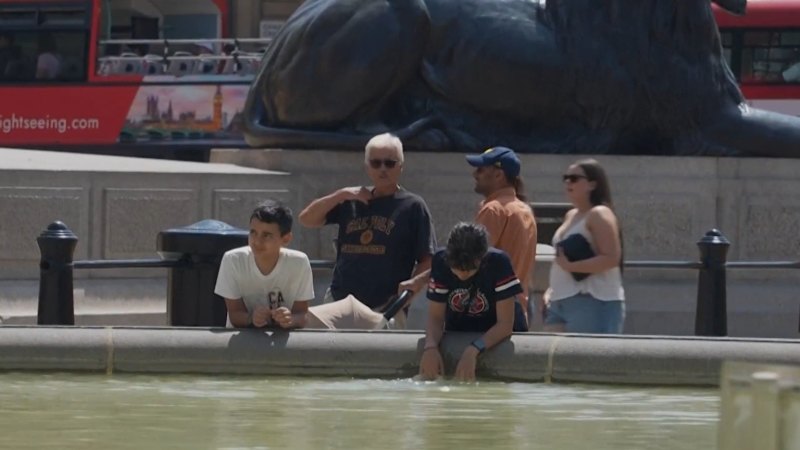
The heat changes the very nature of public space. In the evening, when the sun finally dips below the horizon, the air does not cool. The concrete, asphalt, and stone of the city continue to bleed heat into the night sky, creating what climatologists call the urban heat island effect. A city becomes an oven that refuses to cool down. Neighbors who rarely speak to one another find themselves sitting on front stoops at two in the morning, gasping for a breath of fresh air, united by a shared, sleepless misery.
There is a psychological weight to this kind of weather. It creates a subtle, persistent anxiety. You realize that the very climate that shaped your culture, your architecture, your childhood memories, and your sense of place is shifting beneath your feet. The familiar rhythm of the seasons feels broken. Summer is no longer a season of liberation and outdoor play; it is becoming a season where you check on your elderly neighbors, close your curtains to block the sky, and worry about the stability of the power grid.
The response to this cannot simply be a mad scramble to install millions of energy-guzzling air conditioning units, which would only pump more heat into the streets and more carbon into the atmosphere. That is a short-term patch that accelerates the long-term crisis. Instead, it forces a radical rethinking of how we build, live, and care for one another. It means retrofitting historic buildings with external shading, planting vast urban forests to cool our neighborhoods naturally, and altering the very structure of the working day.
The threshold has been crossed. The forty-degree day is no longer a freak anomaly to be recorded in the history books and forgotten. It is a preview of the ordinary.
As the sun rises on yet another brilliant, terrifyingly clear morning, the brick walls of the city are already warm to the touch from the day before. The birds are quiet in the parched trees. Inside her flat, Elena opens her window, but the air that enters is heavy, dry, and hot, offering no comfort, only the stark realization that the world outside has fundamentally changed.