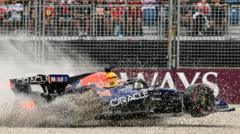
Stop celebrating the "changing of the guard" in Melbourne.
The narrative being shoved down your throat is simple, clean, and entirely wrong. The story goes like this: Max Verstappen, the invincible machine, finally blinked. He pushed too hard, clipped the wall, or suffered a mechanical hiccup—the details vary depending on which tabloid you read—and in his wake, George Russell ascended to a heroic pole position. It’s the kind of underdog story that sells tickets and keeps TV ratings from cratering during a period of Red Bull dominance.
It is also a statistical hallucination.
If you believe Russell’s pole position at Albert Park represents a genuine shift in the competitive order, you aren't watching the telemetry. You’re watching a movie. We are witnessing a perfect storm of track temperature fluctuations, tire graining issues, and a specific technical vulnerability in the RB21 that has nothing to do with long-run pace.
Russell didn't win that session. Verstappen lost it. And there is a massive, uncomfortable difference between the two.
The Myth of the Mercedes Resurrection
The paddock is currently vibrating with talk of "the upgrade package that finally worked." Engineers are giving vague, optimistic quotes about correlating wind tunnel data.
Ignore them.
Mercedes has spent the last three seasons trapped in a cycle of "false dawns." They find a setup window that works for exactly one hour on a Saturday when the track temperature hits a specific 32°C mark, and suddenly the media treats it like the second coming of the W11.
The W17—or whatever iteration of the "no-pod" or "some-pod" concept they are currently running—is still a fundamentally compromised platform. It lacks the aerodynamic efficiency of the Red Bull and the mechanical grip of the Ferrari in low-speed transitions. Russell’s lap was a "hooked-up" anomaly. He took immense risks in Sector 2, carrying mid-corner speeds that the car’s current downforce levels cannot sustainably support over a full race stint.
When you look at the trace, Russell was gaining time on the entries by delaying his braking points beyond the theoretical limit of the tires. That works for one "glory lap" when the rubber is fresh and the fuel load is vapor. It is a suicide mission on a Sunday afternoon with 100kg of fuel onboard.
Verstappen’s Crash Was a Data Point, Not a Downfall
The "Verstappen is cracking under pressure" crowd needs a reality check. Max crashed because he was hunting for a gap that didn't need to exist.
Red Bull’s RB21 is designed with a very specific philosophy: race trim over qualifying glory. Adrian Newey’s parting influence on this lineage of cars ensures they are monsters in clean air and even better at managing thermal degradation. Verstappen knew he had the faster race car. His mistake in qualifying was an ego play, not a technical failing.
By pushing for a 1:15.8 when a 1:16.1 would have likely secured the front row anyway, he found the limit of the floor’s "sealing" effect. When an F1 car at this level of ground effect loses its seal due to a curb strike or a sudden gust, the downforce doesn't just diminish—it vanishes.
$$F_d = \frac{1}{2} \rho v^2 C_d A$$
In that equation, the coefficient of lift ($C_l$, which relates to $C_d$ in a total aero map) becomes a chaotic variable the moment the car’s rake is disturbed. Verstappen’s "crash" was a physics experiment gone wrong, not a sign that his talent has hit a ceiling or that Russell has bypassed him.
The Tire Temperature Trap
The real reason for the shuffled grid in Melbourne is the Pirelli C5 compound. It is a diva of a tire.
Most teams struggled to get the front axle and the rear axle into the operating window simultaneously. Usually, you bake the rears and the fronts stay cold, leading to massive understeer at Turn 1 and Turn 6. Mercedes, by sheer luck of their high-drag setup, managed to put enough energy into the tires during the out-lap to start the timed run in the "Goldilocks" zone.
- Mercedes: Perfect tire prep, high risk, peak track conditions.
- Red Bull: Over-indexed on race pace, caught out by dropping track temperatures.
- Ferrari: Traffic management disaster.
This isn't a "new era." It’s a clerical error in the Red Bull garage.
Stop Asking if Russell is "World Champion Material"
This is the most tired question in the sport. Everyone on the grid, from Logan Sargeant to Lewis Hamilton, is "material" given the right car. The question is whether Russell can manage a lead.
History shows that when Russell starts from the front, he drives with a defensive anxiety that destroys his tires. He focuses on the mirrors instead of the apex. Contrast this with Verstappen or prime Hamilton, who disappear into a rhythmic flow state.
I’ve sat in hospitality suites and watched data engineers pull their hair out because a driver ignored the "delta" to fight a battle they’d already won. Russell has a tendency to over-drive the car when he feels the pressure of a faster opponent breathing down his neck. In Melbourne, that opponent will be a very angry Dutchman with a point to prove.
The Harsh Reality of the "Melbourne Pole"
Statistics tell us that pole position at Albert Park is becoming increasingly irrelevant for the win. The introduction of the fourth DRS zone has turned this into a slipstream fest.
If you are leading on Lap 1, you are essentially a giant wind-break for the cars behind you. Unless Russell can pull a two-second gap in the first three laps—which the Mercedes' lack of straight-line speed suggests is impossible—he is a sitting duck.
The logic of the "competitor" article suggests that Russell has the momentum. Logic, however, suggests he is in the worst possible position: at the front of a pack with a car that burns through its rear tires 15% faster than the car starting behind him.
What You Should Actually Be Watching
Instead of obsessing over the grid order, look at the high-fuel long runs from FP2.
Verstappen’s average lap time on the Medium compound was nearly four-tenths faster than Russell’s. Over a 58-lap race, that is a 23-second deficit. Russell’s "pole" is a trophy that will be reclaimed by the end of the first pit stop cycle.
We have seen this movie before. We saw it in Brazil. We saw it in Hungary. A silver car starts at the front, the fans get excited, and then the blue car passes them on the straight like they’re standing still.
The Professional Verdict
Mercedes is still the third-best team on the grid. They are currently benefiting from Ferrari’s strategic incompetence and Red Bull’s occasional hubris.
If you want to bet on the race, don't bet on the guy who "won" Saturday. Bet on the physics of tire degradation and aerodynamic efficiency. Red Bull hasn't lost its edge; it just tripped on its own shoelaces.
Russell’s pole isn't the start of a revolution. It’s a stay of execution.
The lights will go out, the hybrid systems will deploy their 120kW of recovered energy, and the reality of the 2026 technical gap will settle back over the field like a heavy blanket.
Enjoy the highlight reel while it lasts. By Lap 15, the status quo will be restored, and we'll be back to wondering why we let one qualifying session trick us into believing in miracles.
Get used to the sight of the Red Bull rear wing, George. You’ll be seeing a lot of it by mid-afternoon.