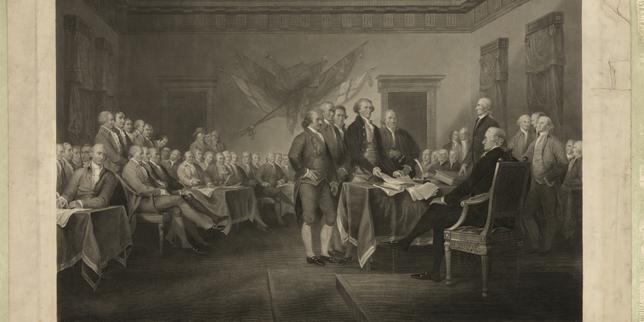
The creation of a sovereign state requires more than military force; it demands the execution of a foundational text capable of aligning disparate internal factions while securing external capital. In July 1776, the Continental Congress faced a complex optimization problem: they needed to draft a document that served simultaneously as a radical manifesto, a legal brief, and a geopolitical venture prospectus. The resulting text was not a sudden burst of romantic inspiration, but the product of a highly compressed, multi-stage editing pipeline designed to mitigate existential risk.
By analyzing the production of the American Declaration of Independence through the lens of institutional design and structural game theory, we can isolate the operational mechanics that transformed a heavily redacted committee draft into a document that reconfigured global geopolitics.
The Iterative Cost of Consensus
The drafting process reveals how collective editing alters the strategic utility of a foundational text. The Continental Congress appointed a Committee of Five to author the document, but the primary mechanics of composition fell to Thomas Jefferson. This initial stage operated under a specific constraint: translating abstract Enlightenment political theory into an actionable legal framework that thirteen highly autonomous colonies could uniformly endorse.
Jefferson’s initial draft relied heavily on the contractual theory of governance, adapting John Locke’s triad of life, liberty, and property. The substitution of "property" with "the pursuit of happiness" was a deliberate linguistic optimization. Property laws varied significantly across the northern merchant economies and southern agrarian systems. Introducing a universal right to property would have immediately triggered internal legal friction regarding state-level jurisdiction, slavery, and land tenure. The phrase "pursuit of happiness" neutralized these structural contradictions by shifting the metric from a tangible asset to an abstract, unquantifiable objective.
The editing phase by the broader Continental Congress functioned as a risk-minimization filter. Congress subjected the draft to approximately 86 alterations, cutting the total length by roughly one-quarter. Every deletion targeted a specific liability:
- The Deletion of the British People Clause: Jefferson’s draft explicitly condemned the British electorate for re-electing parliamentarians hostile to the colonies. Congress excised this section entirely. Blaming the British populace would have permanently alienated potential anti-monarchical allies within England and closed the door to future bilateral trade agreements post-conflict.
- The Eradication of the Anti-Slavery Grievance: The most structurally significant edit was the removal of a long passage arraigning King George III for perpetuating the transatlantic slave trade. This clause created an immediate existential threat to the fragile colonial coalition. The delegations from South Carolina and Georgia refused to sign any document containing this language, while northern shipping interests faced exposure regarding their complicity in the maritime slave trade. The removal of the clause demonstrates that the primary objective of the text was short-term consensus maximization, even at the cost of embedding a profound, long-term institutional contradiction into the state's architecture.
The Three Operational Pillars of the Text
The structural framework of the final text operates on a tri-partite logical progression designed to establish maximum legal and moral authority.
The Axiomatic Premise
The document opens with a statement of universal principles, establishing a baseline of natural law that supersedes monarchical sovereignty. This section functions as the mathematical axiom of the argument. By asserting that governments derive their just powers solely from the consent of the governed, the text establishes a clear formula for legitimacy. If consent is withdrawn, the institutional framework of the state is rendered null.
The Empirical Evidence Block
The core of the document shifts from philosophy to data collection. The list of 27 specific grievances against George III acts as a legal indictment. This section avoids abstract complaints, focusing instead on quantifiable violations of the existing colonial contracts:
- The suspension of local legislatures.
- The obstruction of immigration and naturalization laws.
- The quartering of standing armies without legislative approval.
- The imposition of taxes without formal representation.
By framing these actions as a systematic pattern of tyranny, the text establishes empirical justification for secession. The grievances are ordered to build a cumulative case that the British Crown had systematically broken its covenant, satisfying the legal requirements of contract termination under 18th-century international jurisprudence.
The Formal Declaration of Sovereignty
The final section executes the actual transition of status. It explicitly states that the colonies are now "Free and Independent States." This was the core operational objective. Without this formal shift in legal status, colonial forces were technically rebels engaged in a civil war, making them ineligible for formal foreign alliances under European law.
Geopolitical Signaling Mechanics
The primary audience for the document was not George III, nor was it the American public. The text was engineered as a high-stakes signaling mechanism directed at Versailles and Madrid.
In 1776, the Continental Army lacked the capital, manufacturing capacity, and naval power to sustain a long-term war against the British Empire. Securing a military alliance with France was the sole path to survival. However, Louis XVI could not openly back a colonial rebellion within another empire without establishing a dangerous precedent, nor could France risk investing capital in a conflict that might end in a domestic British reconciliation.
[Colonial Secession Text]
       │
       ▼
[Formal Sovereign Status] ──► [Elimination of Reconciliation Risk]
       │
       ▼
[Access to Foreign Capital/Navies]
The Declaration resolved this information asymmetry. By formalizing a total, irreversible break from the British Crown, Congress signaled to French foreign minister Vergennes that reconciliation was impossible. The document functioned as a corporate prospectus, demonstrating that the colonies were fully committed to the total destruction of British hegemony in North America. This clear commitment lowered the strategic risk for France, eventually unlocking the critical naval support and financial subsidies that secured victory at Yorktown.
The Structural Debt of 1776
The compromises required to pass the text created a profound institutional vulnerability. By prioritizing immediate wartime unity over the resolution of fundamental legal and human rights contradictions, the authors deferred a systemic crisis.
The omission of the slavery clause preserved the coalition but hardcoded an existential flaw into the foundation of the republic. The tension between the foundational assertion that "all men are created equal" and the legal protection of chattel slavery established a high-degree of structural debt. This debt accumulated interest over the succeeding decades, eventually destabilizing the state's constitutional framework and resulting in the systemic collapse of 1861.
The document also failed to establish a functioning centralized authority, a deliberate choice reflecting the signers' profound distrust of concentrated power. The immediate institutional iteration—the Articles of Confederation—maximized local autonomy but lacked the power to levy taxes or regulate commerce. This structural weakness produced economic instability and domestic insurrections, forcing a complete overhaul of the state's architecture just eleven years later with the drafting of the United States Constitution.
The Strategic Projection
As the constitutional framework established by the events of 1776 approaches its 250th anniversary, the mechanics of its founding continue to dictate its operational limits. The document’s reliance on universal, unquantifiable rights creates an ongoing governance challenge: how to reconcile absolute individual liberties with the collective regulatory requirements of a highly integrated technological state.
The historical data indicates that institutional longevity depends on an organization's capacity to resolve its founding contradictions. The United States faces a recurring cycle where the abstract principles of the 1776 text are forced to collide with shifting economic and social realities. The stability of the next phase of governance will depend entirely on whether the state can systematically clear its remaining structural debt without fracturing the foundational consensus that the original text was engineered to secure.