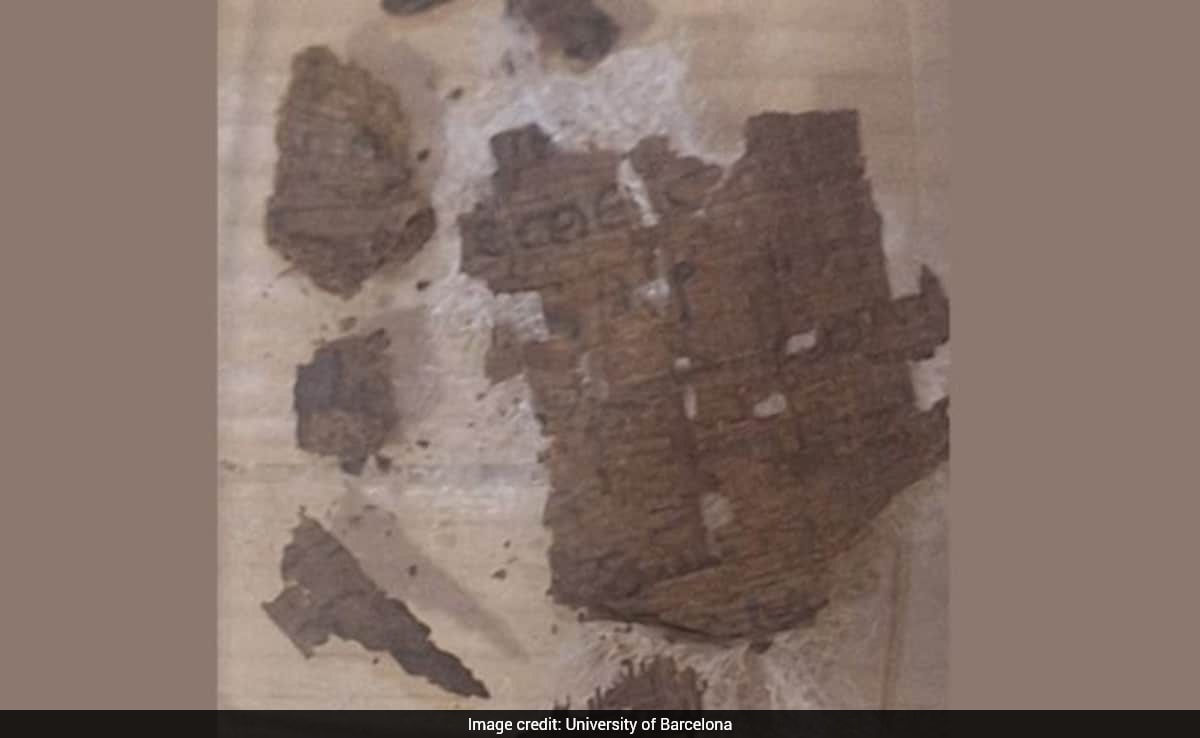
The discovery of a Greco-Egyptian mummy wrapping incorporating fragments of a structural literary text challenges traditional assumptions regarding ancient waste management, literate economies, and cross-cultural assimilation. P.Rob. inv. 45, a papyrus fragment retrieved from the decomposed cartonnage of a mummy dating to the late Ptolemaic period (circa 1st century BCE), contains a previously unknown hexameter narrative detailing a conflict resembling Homeric epic conventions. Rather than treating this artifact as an isolated curiosity, an empirical analysis reveals a highly systematic intersection of material science, economic resource allocation, and regional sociolinguistics in Hellenistic Egypt.
To understand how a classical Greek poem concluded its lifecycle inside an Egyptian mortuary apparatus, the object must be evaluated through a rigorous structural framework. This trajectory is defined by the resource lifecycle of papyrus, the industrial mechanics of cartonnage production, and the linguistic stratification of the Ptolemaic administrative state. Meanwhile, you can read similar stories here: The Anatomy of War Time Inflation: Quantifying the Rural Tolerance for Macroeconomic Shocks.
The Cartonnage Lifecycle: From High-Value Text to Industrial Waste
The presence of a literary text within a funerary structure is explained by the economic lifecycle of papyrus (Cyperus papyrus). Papyrus production in Ptolemaic Egypt operated under a strict state-monitored regime where high manufacturing costs dictated prolonged usage cycles. The transformation of a high-value intellectual asset into secondary industrial components follows a predictable cost-minimization function.
[Phase 1: Virgin Papyrus] ──> High structural integrity; reserved for state records or elite literature.
         │
         ▼
[Phase 2: Administrative Recycled Document] ──> Marginalia, account balances, palimpsests.
         │
         ▼
[Phase 3: Mechanical Maceration] ──> Pulping, stripping, and binding for cartonnage layers.
The structural degradation of papyrus dictated its classification into three distinct functional tiers: To explore the bigger picture, we recommend the detailed analysis by TIME.
- Primary Tier (Virgin Material): High tensile strength, optimal ink absorption, and minimal surface defects. Reserved exclusively for state administrative decrees, fiscal ledgers, and elite literary copies.
- Secondary Tier (Palimpsests and Marginalia): Used documents re-purposed for local business accounts, private correspondence, or educational exercises. Textual layers were frequently washed or overwritten, compromising the structural matrix of the fibers.
- Tertiary Tier (Cartonnage Mass): Stripped or macerated papyrus sheets deemed structurally non-viable for writing. These sheets were acquired in bulk by regional embalming workshops (necrotaphoi) to serve as the structural substrate for molded mummy casings.
The competitor narrative presumes that the inclusion of an epic war poem implies a deliberate, reverent burial of a warrior or a scholar with their preferred literature. Material analysis refutes this romantic hypothesis. Cartonnage manufacturing was an indiscriminate recycling process. Workshops purchased discarded records by weight from local archives, temples, and private estates.
The structural logic of cartonnage required overlapping layers of wet papyrus saturated with an adhesive agent—typically an animal-hide glue or a starch-based paste—before being coated with a layer of plaster (gesso) for painting. Consequently, P.Rob. inv. 45 survived not because it was prized, but because its mechanical density fulfilled the load-bearing requirements of a funerary mask.
Epigraphic Quantification and Narrative Typology
The text preserved on P.Rob. inv. 45 consists of three broken columns of Greek hexameters. The physical preservation metrics indicate a localized discard pattern rather than long-distance transport prior to processing.
| Metric | Value / Attribute | Systemic Implication |
|---|---|---|
| Script Type | Rapid Literary Bookhand | Professional scribe; mid-to-late Ptolemaic period |
| Ink Composition | Carbon-based (soot and gum arabic) | High chemical stability; resistant to organic decay |
| Dialect | Epic-Ionic with Hellenistic features | Standardized educational curriculum in regional nodes |
| Column Width | ~12–14 cm (estimated) | Standard professional roll dimensions |
The narrative content details an elite combat sequence, featuring structural formulae reminiscent of the Iliad, yet distinct from known canonical texts. The presence of specific vocabulary relating to military hardware indicates that the composition post-dates the classical era, signaling a localized Hellenistic adaptation of epic themes.
This text points to a broader systemic reality: the decentralization of Greek literary production. The existence of an obscure, high-register epic poem in a regional embalming workshop demonstrates that Greek literary text distribution was not confined to major intellectual hubs like the Museion of Alexandria. Instead, it confirms the presence of active private libraries, traveling rhapsodes, or advanced educational institutions throughout the Fayum oasis and Upper Egypt.
Socio-Economic Bottlenecks in Artifact Recovery
The analysis of cartonnage recovery presents severe methodologies bottlenecks that limit the gathering of pristine historical data. The primary friction point lies in the extraction process. Historically, recovering papyrus from cartonnage required the complete dissolution of the binding matrix, a process that inherently destroys the structural context of the mummy casing.
[Intact Cartonnage Complex]
         │
         ├──> Chemical Dissolution (Water/Enzymatic Baths) ──> Recovored Papyrus Sheets (Context Severed)
         │
         └──> Computed Tomography (Multi-Spectral Imaging) ──> Virtual Unrolling (Low Contrast Bottleneck)
The modern analyst must weigh the information yield of text recovery against the structural destruction of the primary artifact. The deployment of non-destructive multi-spectral imaging and X-ray microtomography provides a digital alternative, yet these technologies encounter systemic limitations when processing carbon-based inks. Because carbon ink possesses an atomic density nearly identical to the underlying papyrus substrate, standard radiographic methods often fail to yield sufficient contrast.
The second limitation is administrative. The vast majority of cartonnage discovered in the late 19th and early 20th centuries was stripped without precise stratigraphic logging. We can deduce the general regional source based on dialect and paleography, but the absolute provenance—the specific tomb, the associated grave goods, and the socio-economic standing of the deceased—remains permanently obscured.
Strategic Historical Synthesis
The structural analysis of P.Rob. inv. 45 yields a definitive conclusion regarding the cultural mechanics of Ptolemaic Egypt. The artifact provides direct, material proof of linguistic stratification and resource optimization.
The Egyptian elite adopted Greek administrative and literary conventions not as a superficial replacement for native traditions, but as a concurrent system of status and utility. The physical fusion of a Greek military epic with Egyptian mummification technologies exemplifies this dual-track system. The text was composed in the language of the ruling class, read within an elite or sub-elite household, discarded when its economic value shifted from intellectual to material, and ultimately used to preserve a body according to traditional Egyptian religious protocols.
Future computational models analyzing Ptolemaic papyrus distribution must treat mortuary recycling data as an accurate reflection of local literacy rates and document retirement velocity. The transition rate of a text from its composition date to its burial date serves as a key metric for determining the velocity of information and material usage across the ancient Mediterranean.