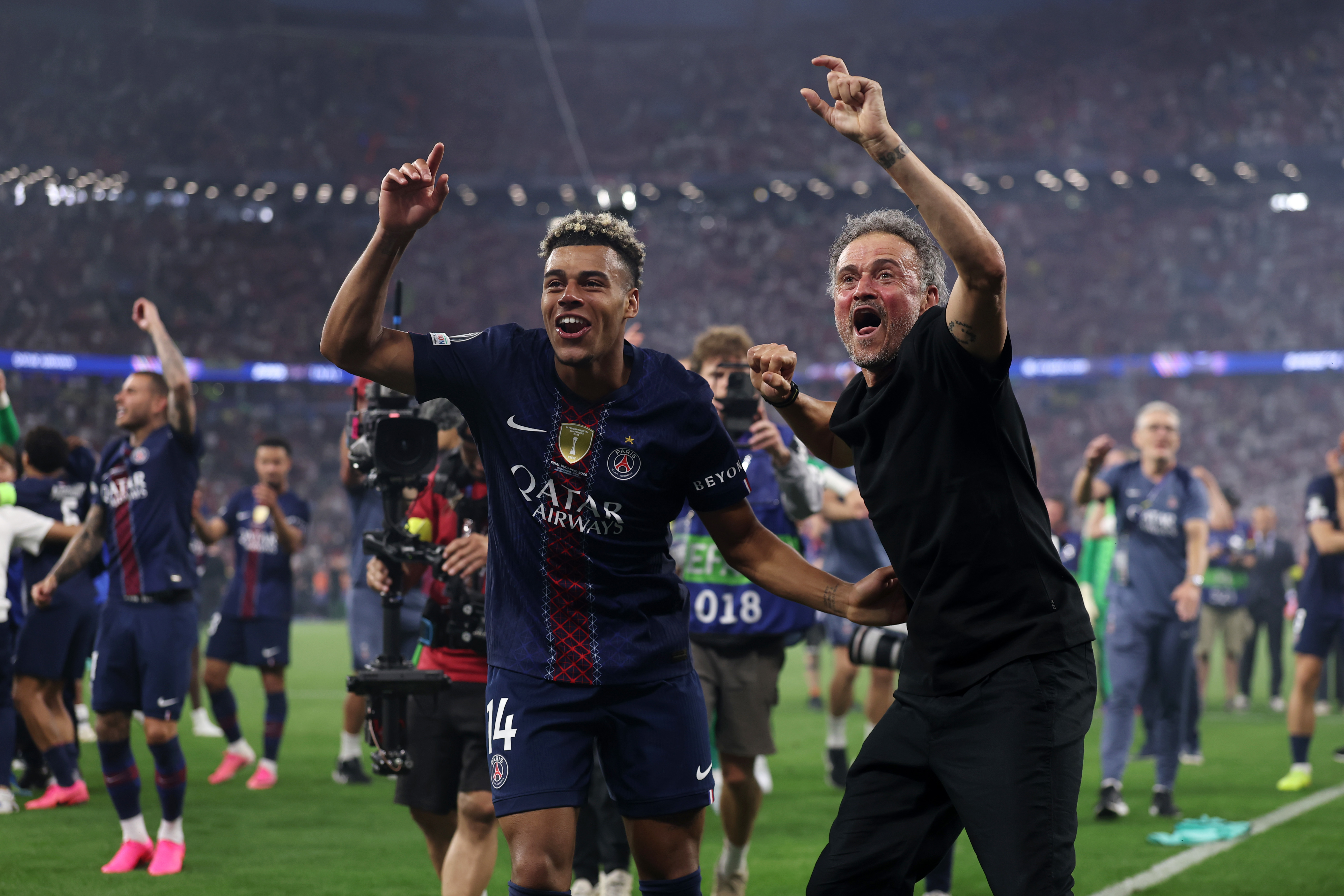
Paris Saint-Germain’s consecutive Champions League title—secured via a penalty shootout victory over Arsenal—will be widely analyzed through the lens of sporting drama and individual heroism. This narrative is incomplete. Reduced to its core components, elite football at the final stage of the UEFA Champions League is an exercise in mitigating high-variance events while exploiting specific structural chokepoints.
To understand how PSG retained the European crown, we must move past simplistic post-match commentary and break down the match into three analytical pillars: the suppression of Arsenal’s systemic pressing triggers, the deliberate forcing of a low-probability game state (the penalty shootout), and the psychological asset management required to execute under peak cognitive load. In related updates, read about: The Postseason Metamorphosis of UCLA Baseball.
The Structural Inversion: Neutralizing Arsenal’s Pressing Triggers
Arsenal’s tactical identity under Mikel Arteta relies on structural suffocating out of possession. Their defensive block operates on highly coordinated pressing triggers: trapping opponents against the touchline, suffocating the central progressive passing lanes, and forcing hurried long balls into isolated aerial duels.
PSG's tactical framework successfully inverted this pressure by employing a deep-lying asymmetric build-up. Instead of dropping both central midfielders to form a standard double-pivot, the Parisian side utilized a single flexible pivot supported by inverted full-backs moving into the half-spaces. This created a numerical superiority ($4 + 1$ against Arsenal’s front three) in the initial phase of progression. Yahoo Sports has also covered this critical issue in great detail.
The Mechanics of Pressing Dissipation
- Decoy Central Positioning: By positioning technical midfielders explicitly within Arsenal’s first line of engagement, PSG baited the North London side's central advanced midfielders out of their disciplined defensive zones.
- Touchline Avoidance: PSG deliberately avoided circulating the ball along the lateral boundaries of the pitch in their own defensive third. This negated Arsenal's favorite pressing trap—the touchline squeeze.
- Vertical Restraint: Rather than seeking rapid vertical transitions, which introduce high turnover risks, the French champions prioritized horizontal circulation until Arsenal’s pressing energy depreciated over the 90-minute timeline.
This approach transformed the match from a high-tempo transition battle into a low-event, possession-heavy chess match. By suffocating the rhythm of the game, PSG reduced the number of total possessions per team, inherently lowering the probability of a chaotic, unforced defensive error breaking the deadlock.
Defending the Half-Spaces and the Low-Block Matrix
When Arsenal did establish sustained possession in the final third, PSG shifted from an active possession model to a highly rigid low-block matrix. Arsenal’s primary mechanism for chance creation relies on the relationship between their wingers and overlapping or underlapping full-backs, specifically targeting the "half-spaces"—the vertical channels between the flanks and the center of the pitch.
PSG neutralized this threat by abandoning a traditional man-marking system in favor of a strict zonal space-denial model.
[Arsenal Winger] ----> (Double-Teamed by PSG Full-back + Winger)
                             |
                      [Half-Space Blocked]
                             |
                     [PSG Center-back]
The distance between PSG’s defensive line and midfield line was capped at a strict maximum of ten meters. This compressed verticality denied Arsenal’s creative playmakers the pocket of space required to turn and slip passes behind the defensive line.
Arsenal was consequently forced into wide, low-value crossing situations. Statistically, crosses from deep or wide positions yield an exceptionally low Expected Goals (xG) value per attempt, typically hovering below 0.05 xG. PSG’s central defenders, positioned optimally within a packed penalty box, cleared these predictable trajectories with high structural consistency. The match was systematically steered away from open-play variance.
The Strategic Concession: Driving Toward the Penalty Shootout
To the casual observer, playing for a penalty shootout is viewed as a high-risk, desperate gamble. For a modern, data-driven coaching staff, it can represent a calculated strategic concession when facing an opponent with superior athletic momentum in the latter stages of extra time.
As fatigue set in during the extra 30 minutes, Arsenal’s physical metrics—specifically high-intensity sprints and recovery runs—demonstrated superior durability. Recognizing this physiological bottleneck, PSG minimized risk exposure. They ceased all aggressive counter-attacking behaviors that would leave their defensive shape disorganized upon a turnover.
The choice to force a penalty shootout can be modeled as a rational transition between two distinct probability distributions:
- Open-Play Extra Time Risk: An open, fatigued game state where a single tactical error or physical lapse yields a high-probability scoring chance for the opponent, with minimal time remaining to equalize.
- The Penalty Shootout Baseline: A sequence of isolated, repeatable events where the historical baseline success rate sits at roughly 75-80% for the kicker, transforming the contest into a test of micro-execution and goalkeeper analysis.
By locking the game down into a stalemate, PSG elected to take the match out of the fluid, unpredictable realm of tired tactical shifts and place it into a hyper-studied, discrete sequence of events where their analytical preparation could be fully leveraged.
Game Theory and Micro-Execution from 11 Meters
A penalty shootout is not a lottery; it is an optimization problem governed by game theory and psychological stress management. The outcome of the shootout that crowned PSG back-to-back champions was determined by superior execution of two distinct variables: shot placement variance and goalkeeper signaling.
Shot Selection and the Nash Equilibrium
Penalty takers face a classic game-theoretic dilemma: hit the ball to their natural side (higher power and accuracy, but predictable) or their unnatural side (lower control, but unexpected). PSG’s shooters demonstrated a highly disciplined commitment to high-velocity strikes into the upper regions of the net—zones that are statistically unreachable for a diving goalkeeper, regardless of whether they guess the correct direction.
Goalkeeper Analytics and Deception
The Parisian coaching staff provided their goalkeeper with an exhaustive empirical dossier on Arsenal’s historic penalty preferences under pressure. Goalkeepers are trained to look for specific physical tells: the angle of the kicker's run-up, the orientation of the planting foot, and the final hip rotation prior to contact.
PSG's goalkeeper executed a strategy of delayed commitment. By remaining perfectly stationary until the exact micro-second of ball contact, he denied the Arsenal penalty takers the ability to utilize a "keeper-dependent" strategy (waiting for the goalkeeper to move first and rolling the ball into the opposite corner). This forced the Arsenal shooters to rely on pure accuracy under extreme cognitive load, increasing the probability of mechanical error, which ultimately manifested in the decisive misses.
The Compounding Returns of Championship Experience
The concept of "championship pedigree" is frequently dismissed as sporting mysticism. In a rigorous organizational analysis, however, it translates directly to institutional memory and reduced cognitive friction.
A team defending a title has already validated its operational processes under peak pressure. This creates a stabilizing feedback loop within the squad. When Arsenal pressed aggressively or dominated possession phases, there was no panic-induced breakdown of the Parisian defensive shape. The players had already executed these exact damage-limitation protocols successfully twelve months prior.
The cognitive load of competing in a Champions League final is immense. Teams experiencing this for the first time in a generation often suffer from "hyper-vigilance"—an over-concentration on basic mechanics that usually flow automatically, leading to hesitation and physical stiffness. PSG’s structural familiarity with the environment allowed them to conserve mental energy, preserving their executive functioning for the clinical execution required in the shootout.
The Asymmetric Risks of the Two-Box Bottleneck
While this triumph solidifies PSG’s position at the apex of European football, an objective analysis must highlight the inherent fragility of the strategy they deployed. Relying on defensive resilience and a penalty shootout is an asymmetric risk model that offers zero margin for error.
The primary limitation of this approach is the total surrender of offensive agency. By prioritizing defensive solidity and risk aversion above all else, PSG generated an exceptionally low non-penalty xG over the 120 minutes. Had Arsenal managed to score via a deflected shot, a controversial refereeing decision, or a moment of individual brilliance from a dead-ball situation, the Parisian strategy would have faced catastrophic failure.
When an elite side constructs its entire match plan around control and variance reduction, breaking that control forces an immediate, chaotic shift into an aggressive attacking posture that the line-up is no longer structurally optimized to sustain. PSG accepted this vulnerability, gambling that their defensive execution would remain flawless enough to reach the 120-minute mark. The wager paid off, but it is an operational model characterized by extreme downside risk.
The Strategic Blueprint for Continental Hegemony
With back-to-back European titles secured, the strategic imperative for Paris Saint-Germain shifts from validation to sustainability. To prevent tactical stagnation and maintain this era of dominance, the club's sporting hierarchy must execute three precise operational moves before the next continental campaign begins.
First, the squad must undergo a deliberate profile diversification in the attacking transition phases. Relying purely on a low-block and penalty variance is unsustainable across a multi-year horizon. The club needs to recruit internal or external profiles capable of vertical ball progression through dribbling—specifically players who can break a high press individually without requiring structural support from the inverted full-backs. This introduces an element of controlled unpredictability that will prevent future opponents from committing their entire defensive blocks so aggressively high up the pitch.
Second, the club must optimize its squad rotation to protect the physiological integrity of its defensive core. The low-block matrix demands an extraordinary level of physical and mental concentration. If the central defensive partnership suffers from cognitive fatigue or soft-tissue injuries during the upcoming domestic campaign, the structural synchronization required to deny elite opposition space in the half-spaces will decay.
Finally, the organizational leadership must combat the inevitable psychological complacency that follows consecutive triumphs. The institutional memory that served as an asset in this final can easily mutate into a liability if the squad develops a belief that they can simply coast through high-variance matches and rely on historical precedent to save them. The tactical framework must be continuously iterated, introducing subtle shifts in pressing triggers and build-up patterns to ensure that opponents cannot spend an entire domestic cycle building a perfect counter-blueprint to the Parisian system. Continual tactical evolution is the only mechanism that guarantees permanent structural superiority.