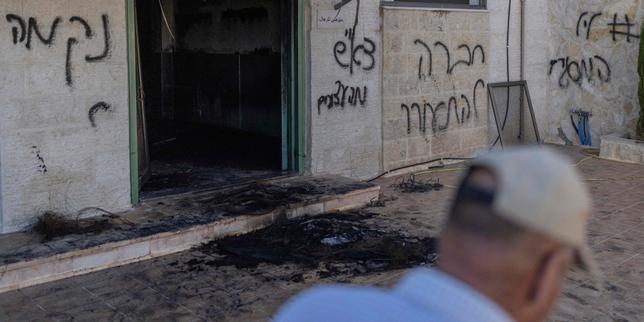
Property destruction within contested territories functions not as isolated, sporadic outbursts of religious or ethnic animosity, but as a deliberate tactical mechanism designed to shift baseline territorial control. The reported arson of a mosque in the West Bank by Israeli settlers provides a clear operational case study in how low-cost, high-visibility actions generate disproportionate geopolitical friction. To understand the trajectory of these flashpoints, analysts must look past the immediate emotional and religious rhetoric and instead evaluate the structural incentives, the asymmetry of law enforcement protocols, and the strategic compounding effects on regional stability.
This analysis deconstructs the operational reality of West Bank property violence through three distinct analytical frameworks: the cost-to-signal ratio of asymmetric tactics, the institutional enforcement gap, and the escalatory feedback loops that undermine centralized governance.
The Tripartite Framework of Territorial Friction
Low-intensity conflict in contested environments operates under a predictable set of strategic inputs. Property targeted for arson or vandalism—specifically religious infrastructure—serves three distinct structural functions for the non-state actors executing the attack.
1. The Territorial Marker
In a fragmented geography where legal boundaries are continuously contested, physical space is claimed through presence and psychological dominance. Damaging a permanent structure associated with the adversary population serves as a high-visibility marker of non-permissiveness. It signals to the local population that their presence is insecure and that the state's protective umbrella is incomplete.
2. High Signal to Cost Ratio
Asymmetric actors often operate with limited institutional resources but require massive media and political amplification. Arson requires zero advanced logistics, minimal financing, and negligible specialized training. However, the strategic output—international news coverage, emergency diplomatic briefings, and heightened localized mobilization—is massive. The return on investment, measured in strategic destabilization per unit of capital expended, is exceptionally high.
3. The Institutional Stress Test
Every act of violence against property within Area C or adjacent zones forces the governing military and civil authorities into a resource-allocation dilemma. It tests the reaction speed, political will, and investigative capacity of security forces. When these actions occur without immediate judicial or physical deterrence, they recalibrate the risk matrix for future actors, effectively lowering the perceived cost of illegal operations.
+-------------------------------------------------------+
|                 TACTICAL INPUT: ARSON                 |
|       (Minimal Capital, Low Risk, Zero Training)      |
+-------------------------------------------------------+
                           |
                           v
+-------------------------------------------------------+
|              STRATEGIC AMPLIFICATION                  |
+-------------------------------------------------------+
|  1. Spatial Deterrence (Psychological displacement)  |
|  2. Media Leverage (Internationalized visibility)     |
|  3. Regulatory Strain (Testing state law enforcement) |
+-------------------------------------------------------+
The Cost Function of Localized Law Enforcement
The persistence of settler-related violence relies directly on an asymmetry in legal application and operational jurisdiction. The West Bank exists under a complex, layered legal architecture where civilian and military laws intersect, creating systemic enforcement bottlenecks.
The primary systemic vulnerability stems from split jurisdictions. Israeli citizens in the West Bank fall under Israeli domestic penal law and are subject to civilian court systems, whereas the Palestinian population is subject to military law administered by the Israel Defense Forces (IDF). When property damage occurs, the initial responders on the scene are almost exclusively military personnel trained for high-intensity security operations rather than forensic criminal investigation.
This structural mismatch produces a predictable chain of failures:
- Evidentiary Degradation: Military personnel rarely secure a civilian crime scene effectively. By the time civilian police investigators arrive from specialized units, physical evidence is frequently compromised.
- The Identification Bottleneck: Non-state actors operating in these areas routinely mask their identities, strike during optimal environmental conditions (low light, minimal security patrol presence), and withdraw into highly insular communities that resist external investigation.
- Prosecutorial Disincentives: The political cost of prosecuting domestic citizens for actions in contested territories creates institutional inertia. Without explicit, high-level political directives, local judicial bodies face structural pressure to deprioritize property crimes in favor of counter-terrorism operations.
The quantitative reality of this enforcement gap is stark. Historical tracking of ideologically motivated property crimes in the region demonstrates that only a fractional percentage of open investigations yield formal indictments, and an even smaller percentage result in meaningful sentencing. This lack of legal friction acts as an implicit subsidy for radical actors, driving the operational risk of committing arson close to zero.
Escalatory Feedback Loops and Governance Decay
When an act of targeted property destruction occurs, it initiates a predictable sequence of socio-political reactions that erode the authority of moderate governance structures on both sides of the perimeter.
The first casualty of unpunished property violence is the credibility of local governance—specifically the Palestinian Authority (PA). When a mosque is targeted under the nominal jurisdiction or security oversight of Israeli forces, the PA’s inability to protect its citizenry or its holy sites is laid bare. This structural impotence accelerates the internal shift of political capital away from institutional actors toward decentralized, armed factions who argue that security can only be achieved through retaliatory deterrence.
[Act of Structural Arson]
          │
          ▼
[Perceived Impunity / Absence of State Prosecutions]
          │
          ▼
[Erosion of Moderate Governance Authority (PA)]
          │
          ▼
[Capital Shifts to Decentralized Militant Factions]
          │
          ▼
[Kinetic Retaliation Against Settler Infrastructure]
          │
          ▼
[State Security Mobilization / Hardening of Positions]
This dynamic creates a self-reinforcing kinetic loop. The civilian population, observing no systemic accountability for attacks on their infrastructure, begins to view local security as a zero-sum, self-defense proposition. This shifts the conflict from a political negotiation over land boundaries to an existential defense of identity and physical survival.
The second loop involves the radicalization of the state’s political periphery. As low-level property violence succeeds in shifting demographics or altering the local security posture without triggering severe state backlash, the political actors aligned with these radical groups gain leverage. They use the resulting instability to argue for increased military presence, the legalization of unauthorized outposts, or the formal expansion of state jurisdiction, citing the need to manage the very chaos their constituents initiated.
Strategic Realities and the Limits of Containment
Managing these flashpoints through a strategy of tactical containment is fundamentally flawed. Relying on reactive military deployment to suppress the immediate rioting or protests that follow an arson attack addresses the symptom while ignoring the structural incentives driving the behavior.
To break this cycle, any state actor serious about stabilization must re-engineer the risk-reward equation for non-state actors. This requires the implementation of targeted operational adjustments designed to inject friction into their calculus:
- Unified Forensic Jurisdictions: Mandating that military units operating in high-friction zones possess the legal training and equipment to secure evidence immediately, closing the gap between military presence and civilian police arrival.
- Economic Accountability Frameworks: Shifting the punishment mechanism from difficult-to-secure criminal convictions to collective or community-level economic disincentives. When property damage is linked to specific outposts or communities, the state can freeze infrastructure funding, delay construction permits, or withdraw discretionary subsidies for those specific geographic sectors.
- Continuous Surveillance Infrastructure: Eliminating the operational cover of darkness and isolation through the systematic deployment of persistent aerial and terrestrial surveillance arrays around vulnerable religious and cultural sites.
Without these specific structural interventions, property destruction will remain a highly efficient, low-cost tool for actors seeking to dictate the geopolitical realities of the region from the ground up. The arson of a mosque is never just a localized fire; it is a calculated, low-tech leverage point applied to a highly volatile political axis. Failure to treat it with the same analytical and investigative rigor applied to high-intensity kinetic threats guarantees its continued use as a primary mechanism of territorial revisionism.