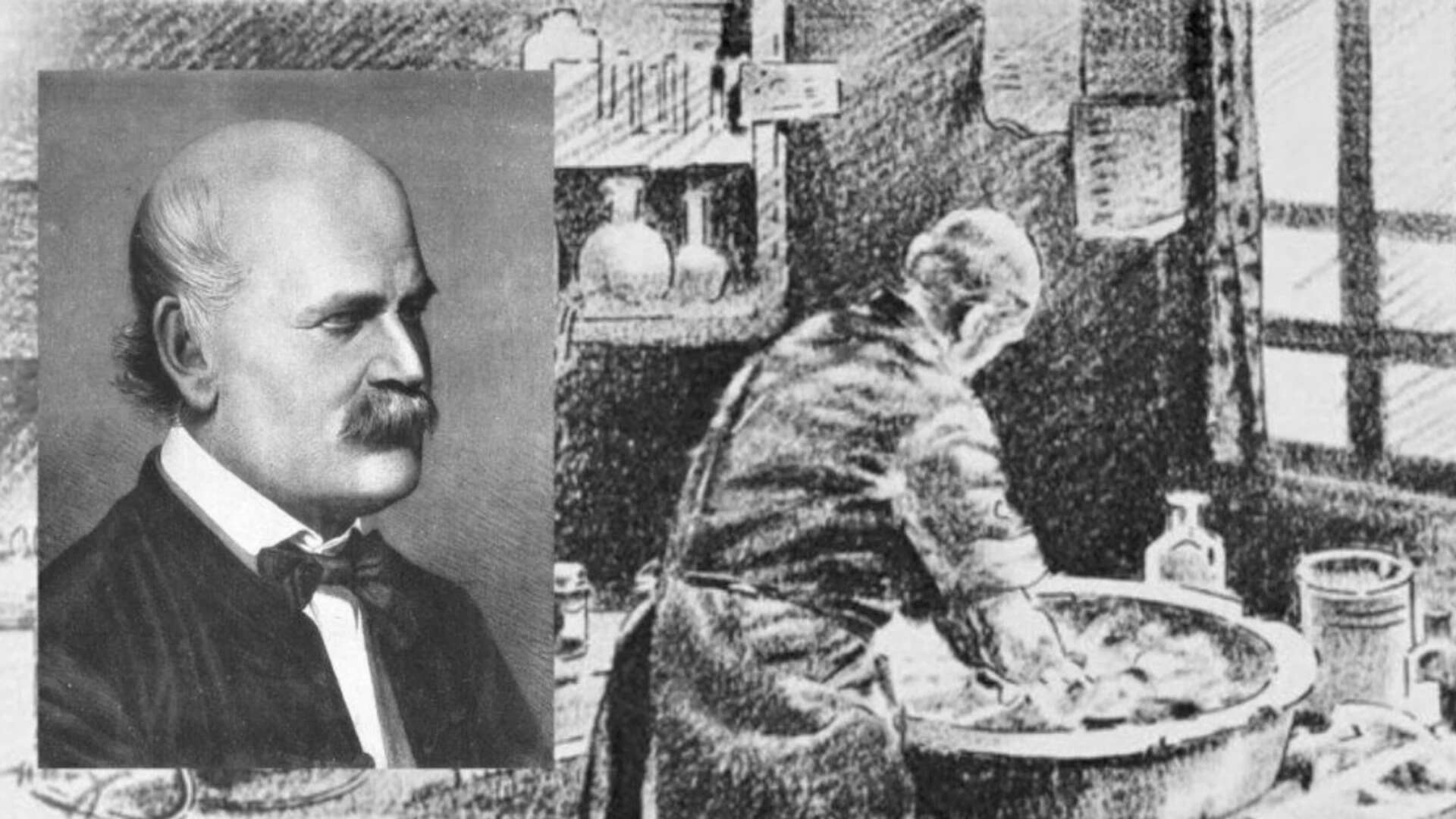
In 1847, Hungarian physician Ignaz Semmelweis discovered that childbed fever, which was slaughtering mothers in Europe's finest hospitals, could be virtually wiped out if doctors simply washed their hands with a chlorinated lime solution. It was a cheap, immediate fix that dragged mortality rates from nearly 20% down to less than 2%. Yet, the medical establishment did not celebrate him. They broke him. The truth behind the rejection of Semmelweis is not a simple comforting fable about a backwards past. It is a terrifying case study in institutional arrogance, cognitive bias, and the lethal cost of protecting professional status.
The Deadly Hierarchy of the Vienna General Hospital
The Vienna General Hospital operated two separate maternity clinics. The First Clinic was a training ground for medical students. The Second Clinic trained midwives.
A stark, terrifying disparity existed between them. Women begged on their knees not to be admitted to the First Clinic. They preferred to give birth in the streets rather than face its doors.
The data justified their terror. The maternal mortality rate from puerperal fever—childbed fever—in the student-run clinic was routinely three times higher than that of the midwife-run clinic. Medical authorities blamed everything from miasma (bad air) to cosmic-telluric influences, bowel irregularity, and even the emotional trauma caused by the priest ringing a bell as he walked through the ward to administer last rites.
Semmelweis could not accept these excuses. He looked at the variables systematically. The air was the same. The climate was the same. The food was the same.
The breakthrough came via tragedy. In 1847, Jakob Kolletschka, a professor of forensic medicine and a close friend of Semmelweis, was accidentally poked by a student’s scalpel during an autopsy. Kolletschka soon died, displaying the exact same agonizing symptoms as the women dying of childbed fever.
Semmelweis realized the grim truth. The medical students and doctors were performing autopsies in the morning, decomposing cadaverous matter sticking to their bare hands, and then walking straight into the maternity ward to perform pelvic examinations on laboring women. The midwives did not perform autopsies.
The doctors themselves were the vectors of death.
The Chlorine Cleanse and the Immediate Drop in Mortality
Armed with this realization, Semmelweis instituted a strict regime. Everyone entering the First Clinic had to wash their hands in a solution of chlorinated lime before touching a patient.
He chose chlorine not because he knew about bacteria—Louis Pasteur’s germ theory was still decades away—but because he found it was the best agent to remove the lingering stench of death from the doctors' hands.
The results were instantaneous and undeniable.
| Period | Clinic | Intervention | Mortality Rate |
|---|---|---|---|
| May 1847 | First Clinic (Doctors/Students) | Pre-Handwashing Regime | 12.2% |
| Mid-1847 | First Clinic (Doctors/Students) | Post-Chlorine Introduction | 2.4% |
| 1848 | First Clinic (Doctors/Students) | Strict Enforcement | 1.3% |
In certain months, the mortality rate dropped to absolute zero. Semmelweis had defeated the scourge of the maternity wards with a bucket of chlorinated water that cost pennies.
Why the Medical Elite Chose Mass Infection Over Truth
Instead of receiving accolades, Semmelweis faced a wall of vitriol, skepticism, and bureaucratic exile. To understand why his peers rejected a discovery that saved lives, one must look at the psychological and social architecture of mid-19th-century medicine.
Gentlemen did not carry filth. The medical elite of Vienna were high-status professionals. The suggestion that their hands were contaminated, and that they had spent years inadvertently murdering the very patients they were sworn to protect, was an intolerable assault on their ego and social standing. It was far easier to dismiss Semmelweis as a fanatic than to accept the crushing guilt of a lifetime of accidental slaughter.
Furthermore, medicine was dominated by the humoral theory and the belief that diseases were individual systemic imbalances or the result of environmental miasmas. Semmelweis was suggesting a single, universal cause for a disease, transmitted by a physical substance that could not be seen. His theory lacked a foundational mechanism that the science of his day could grasp. He could show that it worked, but he could not explain why it worked down to the microscopic level.
His temperament worsened the crisis. Semmelweis was not a diplomat. He was an intense, impatient man driven mad by the ongoing deaths of women. He did not publish his data quickly, preferring instead to write furious, public letters to prominent obstetricians across Europe, openly labeling them as murderers.
His superior at the Vienna General Hospital, Dr. Johann Klein, was deeply invested in the old theories and resented the young upstart’s implicit criticism of how the hospital was run. When Semmelweis’s term expired, Klein refused to renew his position.
The Fatal Mechanics of institutional Inertia
Driven out of Vienna, Semmelweis returned to Budapest, where he repeated his success at the St. Rochus Hospital, dropping childbed fever rates to less than 1%. Still, the broader medical community refused to adopt his methods.
Prominent British physicians argued that if handwashing worked, it was only because of English cleanliness, not Semmelweis’s strange theories. German pathologists rejected his findings on anatomical grounds.
The tragedy deepened as Semmelweis’s mental health deteriorated under the weight of the medical world’s indifference. He grew obsessed, erratic, and paranoid. In 1865, his wife and colleagues deceived him, committing him to a Viennese insane asylum.
When he realized what was happening, Semmelweis tried to escape. The asylum guards beat him severely. He suffered wounds that became infected, and within two weeks, the man who discovered how to prevent blood poisoning died of sepsis at age 47. The very condition he fought killed him, contracted in a dirty asylum cell.
The Semmelweis Reflex Still Governs Modern Sectors
The tragedy spawned a term known to psychologists and historians as the Semmelweis Reflex. It is the automatic, knee-jerk rejection of new knowledge or a new discovery because it contradicts established norms, beliefs, or paradigms.
We see this reflex play out continually across various industries today. When a disruptive truth threatens the prestige, financial model, or foundational beliefs of an entrenched elite, the institutional response is rarely objective analysis. The default response is defensive aggression.
Consider how long it took the tobacco industry, backed by compromised scientists, to accept the link between smoking and lung cancer. Consider the initial ridicule faced by the scientists who argued that stomach ulcers were caused by bacteria rather than stress, a discovery that eventually won a Nobel Prize long after the pioneers were dismissed as contrarians.
The lesson of 1847 is not that people in the past were foolish. The lesson is that human institutions are inherently wired to protect their own status over inconvenient truths, regardless of the body count.
True systemic reform requires more than just undeniable data. It requires an institutional culture that values humility over prestige, and outcomes over comfort. Without that cultural shift, brilliance will continue to be sacrificed on the altar of professional pride.