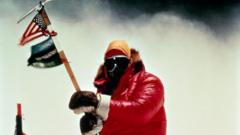
The air at 29,000 feet doesn’t behave like air. It is a thin, freezing ghost of a substance that refuses to fill the lungs. It is a place where the human body begins to digest its own muscle for fuel, where the brain flickers like a dying candle, and where every step upward feels like an argument with God. On May 1, 1963, a six-foot-five man from Seattle named Jim Whittaker stood in that impossible thinness and became the first American to look down on the rest of the planet.
He died this week at the age of 97.
To speak of his death is to reckon with a specific kind of American titan—the kind that didn't seek fame in a studio or a boardroom, but in the terrifying silence of the high ice. Whittaker wasn’t just a climber; he was the physical manifestation of a nation’s mid-century ambition. While the rest of the country looked at the stars and dreamed of the moon, Whittaker looked at the "Third Pole" and decided he would be the one to plant the flag.
The Weight of Oxygen and Expectations
The 1963 American Mount Everest Expedition was not a casual hiking trip. It was a massive, quasi-military operation involving 900 porters, 27 tons of gear, and the crushing weight of national pride. The British had reached the summit in 1953. The Swiss had followed. The Americans, meanwhile, were late to the party and desperate to prove their mettle.
Whittaker, a mountain guide and the first employee of a then-tiny co-op called REI, was the powerhouse of the team. They called him "Big Jim."
Imagine the physical reality of that climb. This wasn't the era of lightweight Gore-Tex or ultra-refined bottled oxygen. Whittaker was draped in heavy wool, reindeer-fur boots, and cumbersome external-frame packs. Every movement was a chore. Every breath was a negotiation.
As the team moved higher into the Death Zone, the mountain began to cull the group. Illness, exhaustion, and the sheer psychological terror of the Khumbu Icefall—a shifting, cracking river of frozen debris—turned men back. But Whittaker kept moving. He had a singular, terrifying focus. He wasn't there to admire the view. He was there to win.
A Summit Shared with a Shadow
When Whittaker finally approached the summit ridge, he wasn't alone. He was roped to Nawang Gombu, a Sherpa of incredible strength and the nephew of Tenzing Norgay. Their partnership was the heartbeat of the mission.
As they neared the top, their oxygen ran out.
Think about that sensation. Your heart is hammering against your ribs like a trapped bird. Your vision is blurring at the edges. You are standing on a knife-edge of ice with a two-mile drop on either side, and the very thing keeping you conscious has just hissed its last breath. In that moment, most people would turn around. Most people would survive by retreating.
Whittaker and Gombu didn't retreat. They stumbled through the "Hillary Step," gasping for what little molecules of oxygen remained in the freezing blue sky, and clawed their way to the highest point on Earth.
They stayed for twenty minutes.
Whittaker planted the American flag, but the wind was so violent it threatened to tear him off the mountain. He didn't feel a rush of poetic triumph. He felt a desperate, clawing need to get back down before his heart stopped. The descent is where most climbers die, and Whittaker knew that his feat would mean nothing if he became a permanent landmark in the snow.
The Return to a Different Earth
When Whittaker came home, he was a hero in a way we no longer understand. He was invited to the White House. He became a close friend of the Kennedys, eventually teaching Bobby Kennedy how to climb. He was the face of rugged American masculinity.
But the mountain had changed him.
Whittaker didn't spend the rest of his life resting on that one twenty-minute window in 1963. He understood that the summit isn't the point of the climb; the point is what you do with the perspective you gained while you were up there. He went on to lead the first successful American ascent of K2—a mountain far more technical and deadly than Everest—and dedicated his later years to environmentalism and the simple, radical act of getting people outside.
He saw the planet from its highest steeple and realized how fragile it actually was. He saw the glaciers receding. He saw the "Earthly paradise" he loved beginning to fray at the edges.
The Long Descent
Growing old is its own kind of mountain. For a man who defined himself by his strength and his reach, the slow decline of the body is a cruel irony. Yet Whittaker handled his final years with the same grit he showed in the Khumbu Icefall. He remained a fixture in the Pacific Northwest, a towering figure who could still be found in the aisles of REI, looking at the modern, ultralight gear with the wry smile of a man who had done it all in wool and leather.
His death at 97 marks the end of an era. We live in a time when Everest is a tourist destination, where wealthy hobbyists pay six figures to be clipped into ropes and guided to the top in a literal queue. It has become a trophy room.
Whittaker's Everest was different. It was a mystery. It was a dragon.
When he stood up there in 1963, gasping for air and squinting against the glare of the sun on the roof of the world, he wasn't just a man on a mountain. He was the vanguard of a human spirit that refuses to accept the horizon as a limit. He proved that we can exist in places where we don't belong, provided we have the courage to keep breathing when the oxygen runs out.
The ice remains. The wind still howls across the South Col. But the man who first mastered that silence for his country has finally stepped off the ridge. He didn't just summit a peak; he lived a life that was, in every sense, vertical.
The rest of us are just walking on flat ground.



