The ice does not care about your experience. It does not respect a resume. On Mount Everest, the border between a triumphant return and an permanent icy grave is often thinner than a single layer of GORE-TEX.
When a Sherpa guide vanishes into the Death Zone, the mountain usually keeps them. The narrative is predictably tragic. Search parties scramble, the weather closes in, and eventually, hope freezes over. But a few years ago, a 35-year-old veteran guide named Pemba Gelje Sherpa rewrote the script of Himalayan survival. He did it on his hands and knees, dragging his dying body through six days of absolute isolation. Recently making headlines in this space: The Airbnb Discrimination Illusion and the Broken Economics of Trust.
To understand what happened to Pemba, you have to understand the invisible engine of the tourism industry in Nepal. Western climbers pay tens of thousands of dollars to stand on the roof of the world. They bring their ambitions, their brands, and their fragile lungs. The Sherpa people bring the infrastructure. They fix the ropes, carry the oxygen, cook the meals, and quite literally carry human lives on their backs.
It is a grueling, perilous profession. Yet, we rarely hear their names until a disaster occurs. More information on this are explored by The Points Guy.
The Cold Disappearance
The expedition was supposed to be standard. If anything on Everest can be called standard. Pemba was working with a team, moving between the high camps where the air is so thin it feels like inhaling broken glass. At heights above 8,000 meters, the human body is actively dying. Brain cells starve. Blood thickens into sludge. Decision-making degrades.
Then, the static on the two-way radios went quiet.
Pemba was gone.
Imagine standing at Camp IV, looking out over a white desert of jagged crevasses and howling winds, knowing your teammate is out there alone. The initial search was frantic. Ropes were checked, nearby drop-offs scanned. Nothing. In the harsh mathematics of high-altitude mountaineering, a man missing for twenty-four hours above the Western Cwm is widely considered a casualty.
Two days passed. Then three. Then four.
By day five, the logistical machinery of the mountain began to move on. Tents were packed. Official reports were likely being drafted in Kathmandu. The ice was supposed to have won. The mountain had taken another soul, a statistic to be filed away under the heavy cost of adventure tourism.
But Pemba was still breathing.
Six Days in the Dark
What goes through a man’s mind when the world forgets he is alive?
He was trapped in an unforgiving labyrinth of ice, suffering from severe frostbite, profound dehydration, and the creeping, hallucinatory madness of high-altitude sickness. Without a tent, without sleeping bags, and without a stove to melt ice into drinking water, he was living a nightmare that would break the psychological resolve of almost any human being.
Consider the sheer physical toll. At those temperatures, exposed skin freezes in minutes. The toes go first, turning a bruised, stony purple. Then the fingers. The body draws all its remaining warmth inward to protect the core, leaving the extremities to rot. To survive six hours in those conditions is a miracle. To survive six days is an impossibility.
Pemba survived because he refused the easy peace of freezing to death. Hypothermia plays a cruel trick on the mind; right before the end, it makes the victim feel warm, inducing a strange desire to strip off clothes and sleep. Falling asleep means never waking up.
He didn’t sleep. He crawled.
When his legs could no longer support his weight, he dropped to his knees. When his hands became too numb to grip the ice, he used his forearms. He dragged himself millimeter by millimeter down the brutal terrain of the Khumbu Icefall, a shifting, chaotic jigsaw puzzle of towering ice seracs that can collapse at any second.
Every breath was an agony of coughing. Every movement required a conscious act of will. He was driven by something primal, an instinct buried deep beneath the cultural modesty of the Sherpa community—a fierce, quiet determination to see his family again.
The Ghost at Base Camp
On the sixth day, the relative comfort of Everest Base Camp was shattered.
Base Camp is a sprawling, colorful tent city at 5,364 meters. It is a place of satellite phones, hot dining tents, and the hum of solar generators. It feels connected to civilization.
A climber looking through binoculars toward the lower edges of the icefall spotted something moving. It wasn't the rhythmic, upright stride of a descending mountaineer. It was a shape, low to the ground, moving with agonizing slowness.
It looked like a ghost.
As the figure drew closer, the realization rippled through the camp like an electric shock. It was Pemba. He was alive. He had dragged himself all the way back from the dead, arriving at the edge of the camp on his hands and knees, his face haggard, his clothes shredded, his body broken but his spirit intact.
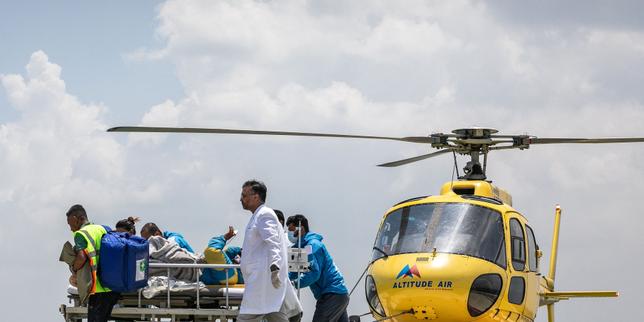
The camp erupted into chaos. Medics rushed forward. He was quickly wrapped in thermal blankets, pumped with fluids, and evacuated via a high-altitude helicopter rescue to a hospital in Kathmandu.
The Anatomy of a Miracle
How did he do it? The medical community often struggles to explain cases like Pemba’s.
From a purely physiological standpoint, his survival defies the known limits of human endurance. Part of the answer lies in genetics; the Sherpa people have adapted over thousands of years to hypoxic environments, possessing a highly efficient hemoglobin metabolism that utilizes oxygen far better than lowlanders.
But biology only gets you so far. The rest was psychological grit.
SURVIVAL TIMELINE: SIX DAYS IN THE DEATH ZONE
+----------------+-------------------------------------------------------+
| Day 1 - 2      | Disappearance, initial disorientation, onset of severe|
|                | frostbite. Search parties find no trace.              |
+----------------+-------------------------------------------------------+
| Day 3 - 4      | High-altitude hallucinations, extreme dehydration.    |
|                | Pemba begins descending by crawling through icefall.  |
+----------------+-------------------------------------------------------+
| Day 5          | Official search efforts scale down. Pemba continues   |
|                | moving through sheer force of will despite injuries.  |
+----------------+-------------------------------------------------------+
| Day 6          | Reaches the perimeter of Everest Base Camp on hands   |
|                | and knees. Evacuated to Kathmandu.                    |
+----------------+-------------------------------------------------------+
This survival story forces us to look at Everest with different eyes. The mountain is often portrayed as a playground for wealthy foreigners testing their limits. We celebrate the clients who reach the summit, the records broken, the flags waved for Instagram photos.
Pemba’s six-day crawl reminds us who the real masters of the mountain are.
It exposes the fragile underbelly of the entire climbing industry. Without the quiet resilience of guides like Pemba, the grand illusions of high-altitude mountaineering would crumble instantly. They are the ones who brave the icefall dozens of times a season while a client might only cross it twice. They are the ones who stay behind to ensure others make it home.
Pemba Gelje Sherpa didn't just survive a mountaineering accident. He gave the world a masterclass in what a human being can endure when they refuse to let the cold win.
Somewhere on those upper slopes, his footprints have long been erased by the wind, covered over by fresh snow as if he were never there. But the path he crawled down remains an invisible monument to human stubbornness, etched permanently into the history of the mountain.