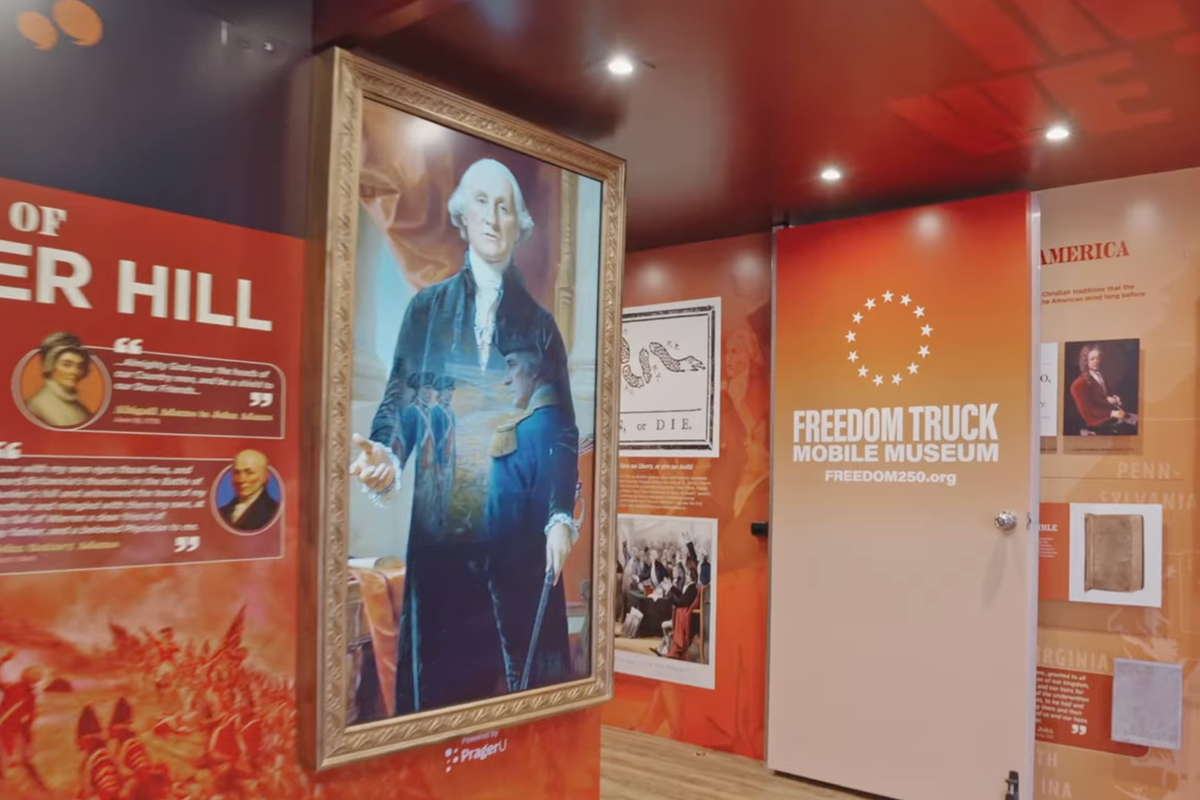
The corporate press is panicking over a digital ghost.
When conservative media organization PragerU deployed an AI-generated avatar of George Washington on Donald Trump’s "Freedom Truck" tour, the media reaction followed a predictable script. Journalists wrung their hands. Critics sounded the alarm over political disinformation. Pundits warned that historical accuracy was under assault by silicon-valley tech weaponized by partisan actors.
They are completely blind to reality.
The hand-wringing over historical desecration and deepfake manipulation misses the entire mechanics of modern attention acquisition. The critics think they are witnessing a dangerous breakdown of truth. In reality, they are watching a masterclass in low-cost, high-yield cultural branding that exploits the media’s own predictable outrage loops.
I have spent over a decade analyzing media architecture and brand deployments. I have seen organizations spend millions on slick, highly produced public relations campaigns that yielded zero organic reach. Meanwhile, a rudimentary digital avatar slapped onto the side of a mobile billboard achieves total market saturation for pennies.
The lazy consensus says this is a threat to democracy. The truth is much colder. It is an optimized arbitrage of public attention.
The Flawed Premise of the Disinformation Panic
Every critique of the AI George Washington deployment rests on a fundamentally flawed premise. The assumption is that voters look at a screen mounted to a truck, listen to a synthetic voice delivering modern talking points, and genuinely believe the first president of the United States has returned from the dead to endorse a political platform.
This assumption treats the public with immense condescension. It assumes absolute gullibility.
No one is being deceived. Deception requires an intent to substitute reality with a false copy. Nobody stands in a parking lot looking at an animated historical portrait and suffers an existential crisis regarding its authenticity.
The avatar is not a tool of deception. It is an explicit, self-aware mascot.
By framing this as a crisis of truth, critics reveal their own technological naivety. They mistake a highly visible marketing gimmick for a stealth psychological operation. When a brand uses a digital asset to personify a value system, it functions exactly like any other corporate mascot in history. The only difference is the software used to animate the mouth.
The Attention Loop Mainstream Pundits Keep Funding
Consider the economics of this campaign.
Building a physical infrastructure for a national political tour costs an astronomical amount of money. Staging events, buying advertising space, and maintaining momentum across thousands of miles eats through capital rapidly.
To survive, a campaign needs a force multiplier. It needs free distribution.
Enter the outraged journalist.
By publishing breathless exposés on the "danger" of a digital founding father speaking at a rally, legacy media outlets hand the campaign millions of dollars in free advertising. They provide the exact distribution the creators wanted. The controversy becomes the product.
Every article condemning the project validates its existence to its target audience. The core demographic for this specific political movement does not trust legacy institutions. Therefore, when legacy institutions condemn a tool, that tool instantly gains credibility among the target base.
The media is not covering the story. The media is funding the distribution network.
The Mechanics of Synthetic Historical Avatars
To understand why this strategy works, look closely at how historical memory functions in the public consciousness.
History is rarely consumed as a dry collection of verified facts. Instead, history operates as a shared national mythology. Every political faction across the spectrum constantly recreates historical figures in their own image. Politicians have quoted Jefferson, Lincoln, and Washington out of context to justify contemporary policy decisions for over two centuries.
The use of an AI avatar merely translates this age-old practice into a digital format.
Text vs. Performance
In the past, a campaign would publish a pamphlet claiming a founding father would support their tax plan. The reader had to perform the mental heavy lifting of imagining that endorsement.
The digital avatar removes the friction of imagination.
- It provides an immediate visual anchor.
- It delivers a physical performance.
- It synthesizes a complex ideological stance into a twenty-second audio clip.
This is not a technological shift. It is a distribution optimization. The software compresses a complex historical appeal into an easily consumable, highly shareable piece of micro-content.
The Illusion of Objective History
The critics who demand that AI representations of historical figures remain entirely neutral are chasing a fantasy. There is no such thing as an objective, neutral historical simulation. Every biography, every textbook, and every museum exhibit reflects the editorial choices of its creators.
An AI model trained on historical texts will inevitably reflect the biases of its training data and the guardrails set by its engineers. Expecting an interactive digital historical figure to be a neutral arbiter of truth is a fundamental misunderstanding of how generative software operates. It is an editorial engine, not an oracle.
Why the Tech Industry Gets the Critique Wrong
Silicon Valley commentators often look at these deployments and scoff at the quality. They point out the uncanny valley effects, the slight synchronization errors between the audio and the video, and the rigid posture of the avatar. They argue that because the technology is not perfect, it is ineffective.
They are looking at the wrong metrics.
In political marketing, technical perfection is often an impediment to authenticity. A highly polished, Hollywood-grade digital human looks expensive, engineered, and corporate. It alienates the viewer.
A slightly unpolished, obvious digital rendering feels accessible. It signals to the audience that this is a grassroots or mid-tier production rather than a product of a massive, shadowy conglomerate. The rough edges are a feature, not a bug. They reinforce the anti-establishment ethos that the tour aims to project.
Imagine a scenario where a political campaign spends five million dollars developing an indistinguishable, photorealistic digital simulation of a historic figure. The immediate public reaction would not be awe; it would be deep suspicion. The public would ask who funded it and what hidden agendas are baked into the code. By keeping the deployment obviously synthetic, the creators avoid the backlash of hidden manipulation.
The Real Risk Nobody Is Talking About
The true danger of this trend is not that the public will believe false histories. The danger is the hyper-fragmentation of historical authority.
When anyone can deploy a highly articulate, visually convincing version of a historical figure, the collective cultural anchor points begin to dissolve. We are entering an era where there will not be one digital George Washington; there will be thousands.
- One version will advocate for isolationist foreign policy.
- Another version will advocate for global intervention.
- One will argue for strict fiscal conservatism.
- Another will be programmed to support progressive economic reform.
When every ideological faction possesses its own proprietary version of the past that speaks directly to its followers, the shared baseline of national identity erodes. You cannot have a coherent political debate when the historical authorities cited by each side are literally programmed to disagree with each other on a fundamental level.
This is the shift that deserves analysis, yet the media remains stuck on the superficial narrative of "Trump truck uses weird AI." They are treating a profound shift in cultural transmission as a simple piece of campaign weirdness.
Stop Trying to Ban the Tech and Learn to Read the Network
The immediate reaction from tech platforms and regulators is always to propose bans, watermarks, or heavy restrictions on political AI assets. This approach is completely futile. The code is out in the wild. Open-source models can run on consumer-grade hardware. You cannot regulate a cultural shift out of existence.
Instead of trying to police the creation of these assets, organizations must learn to decode their strategic purpose.
If you want to counter the influence of a politicized digital avatar, you do not write an article screaming about the end of truth. That merely feeds the attention loop. You do not demand a corporate ban that reinforces the narrative of censorship.
You expose the underlying mechanics. You show the audience how the trick is performed. You neutralize the novelty by making the technology boring.
The moment the public views an AI historical avatar with the same casual indifference they reserve for a corporate fast-food mascot is the moment the asset loses its political potency. Until then, as long as critics continue to react with breathless horror, these digital ghosts will continue to dominate the cultural conversation without spending a single dollar on traditional advertising.
The media thinks they are defending history. In reality, they are acting as the unpaid marketing department for the very things they claim to fear.