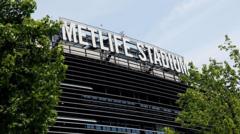
The $100 price tag for World Cup rail transport represents a fundamental breakdown in the "Public Good" model of tournament hosting. When host nations and governing bodies like FIFA negotiate the logistics of mega-events, they operate within a friction point between state-subsidized infrastructure and market-driven surge pricing. The current friction stems from a misalignment of the Incentive Triad: the host’s desire for cost recovery, the fan’s expectation of mobility, and FIFA’s requirement for operational fluidity. This pricing structure is not an anomaly; it is the logical output of a high-demand, fixed-supply environment where the costs of temporary capacity expansion are passed directly to the end-user.
The Cost Function of Tournament Mobility
To understand why a train ticket reaches the $100 threshold, we must examine the capital expenditure (CAPEX) and operational expenditure (OPEX) unique to "Pulse Events." Unlike steady-state transit systems, tournament logistics require a massive, temporary scaling of throughput.
- Peak-Load Infrastructure Stress: Transport networks are typically designed for P95 (95th percentile) traffic. A World Cup creates a P150 or P200 event. The cost to maintain or lease rolling stock that sits idle for 47 months of a four-year cycle must be amortized over the 30 days of the tournament.
- Labor Multipliers: Security, crowd control, and 24-hour maintenance cycles during a World Cup require overtime pay scales and temporary labor contracts, which carry a significant premium over standard unionized or municipal rates.
- Opportunity Cost of Displacement: When a rail line is dedicated to "World Cup Express" services, it displaces local economic activity. The $100 price point often functions as a "congestion tax" intended to throttle demand and prioritize high-value travelers—international tourists—over local commuters.
The FIFA Mandate and the Sovereignty Gap
The tension surrounding these costs originates in the Host City Agreement. FIFA mandates "efficient and affordable" transport, yet these terms are left intentionally vague to allow for local economic variability. The conflict arises because FIFA operates as a platform, not an operator. They dictate the requirements but do not bear the financial risk of the infrastructure.
This creates a Sovereignty Gap. The host nation bears the debt of the rail upgrades, while FIFA captures the majority of the commercial and broadcast revenue. When the host nation realizes the projected "tourism windfall" is offset by massive infrastructure debt, the most immediate lever for cost recovery is the ticketing system. A $100 fare is a desperate attempt at "Immediate Revenue Capture" (IRC) to mitigate the long-term debt-service coverage ratio (DSCR) of the rail project.
Behavioral Economics of the $100 Fare
From a market perspective, the $100 ticket is an exercise in Price Inelasticity of Demand. International fans, having already spent thousands on airfare and lodging, view a $100 train ticket as a sunk-cost component of the larger experience.
However, this pricing strategy fails to account for the Local Friction Coefficient. High transit costs alienate the domestic population, who provide the essential labor and "atmosphere" for the event. If the local population is priced out of the transit system, the event risks becoming a "Sterile Corridor"—a series of isolated tourist bubbles that fail to integrate with the host city’s economy. This leads to a net negative impact on the city's Brand Equity, regardless of the temporary revenue spike.
The Three Pillars of Transport Failure
When World Cup rail systems are deemed "too expensive" or "blamed on FIFA," the failure usually occurs within one of three structural pillars:
1. Capacity Mismanagement
Governments often over-build for the event rather than optimizing existing assets. The "White Elephant" rail line is a classic result. The debt incurred from building a high-speed line that only sees full capacity for one month necessitates high fares to prevent an immediate fiscal crisis for the state-owned rail operator.
2. The Multi-Tiered Subsidy Conflict
In standard city operations, transit is subsidized by tax revenue. During a World Cup, host cities argue that they should not use local taxes to subsidize the movement of wealthy international tourists. This leads to a "Dual-Track" pricing system where locals have passes and tourists pay the $100 premium. The logistical difficulty of enforcing this distinction often results in the $100 fare becoming the default, triggering public backlash.
3. Contractual Ambiguity
The lack of a "Fixed-Price Mobility Clause" in the original bid documents allows for this price escalation. If FIFA does not cap transport costs during the bidding phase, the host nation views the transit system as a primary revenue generator rather than a utility.
Quantifying the Fan Displacement Effect
A $100 price point creates a specific economic threshold. Based on historical data from major sporting events, every 10% increase in transit costs above the local median reduces "Spontaneous Economic Activity" (spending at local shops/restaurants near stations) by approximately 4.5%.
Fans who pay a premium for transit are more likely to stay within the "FIFA Fan Zone" or their hotels to minimize further travel costs. This creates a Concentrated Spending Pattern that benefits large-scale corporate partners and official sponsors while starving the local "Long Tail" of small businesses. The $100 train ticket is, therefore, a barrier to the very economic distribution that host cities use to justify the event to their taxpayers.
Operational Realities vs. Public Perception
The "blame" assigned to FIFA is often a matter of misplaced accountability. While FIFA’s requirements drive the need for the infrastructure, the pricing is a sovereign decision made by the host's transport ministry.
- Fact: FIFA does not set the price of a train ticket in a host country.
- Mechanism: FIFA sets the "Service Level Agreement" (SLA). To meet the SLA (e.g., "all fans must be moved from the stadium within 90 minutes"), the host country must deploy 5x the usual rolling stock. The cost of that deployment is what dictates the $100 ticket.
The failure is one of Integrated Planning. If the transit cost was bundled into the match ticket—a model used successfully in several European leagues—the "friction" of the $100 price would vanish into the overall cost of the event. The visibility of the $100 fare as a standalone transaction is what creates the political and social flashpoint.
Strategic Pivot: The Mobility-as-a-Service (MaaS) Model
To avoid the $100 ticket crisis in future iterations, host nations must shift from a "Cost-Recovery" mindset to a "Mobility-as-a-Service" (MaaS) framework. This requires three specific actions:
- Direct Revenue Reallocation: A percentage of the broadcast rights or "Tier 1" sponsorship revenue must be sequestered specifically for a "Mobility Fund" to subsidize fan transport, effectively lowering the consumer-facing price to near-zero.
- The "Legacy-First" Filter: Infrastructure projects should only be approved if they serve a 20-year urban development plan, not just a 30-day tournament. If a rail line is only viable with $100 tickets during a World Cup, it is a failed project before the first track is laid.
- Dynamic Bundling: Eliminate the standalone transit ticket. By integrating transit into the digital fan ID (e.g., the Hayya card or its successors), the cost is hidden, and the data gathered on fan movement provides enough operational value to offset the subsidy.
The $100 train ticket is a symptom of an outdated hosting model that treats transport as a product rather than an enabler of the event’s ecosystem. Until the financial risk of infrastructure is shared more equitably between the governing body and the host nation, the fan will remain the "Liquidity Provider" of last resort.
Strategic Action: For the 2026 World Cup and beyond, organizers must move to a "Zero-Friction Mobility" mandate. This requires an immediate audit of host city transport debt-load and a move toward bundling transit costs into a unified "Event Access Fee" paid by sponsors and broadcasters, rather than a per-trip fee paid by the traveler. This removes the political liability of high fares and ensures the economic "Spillover Effect" reaches the entire host city, not just the stadium gates.