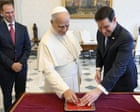
The air inside the Apostolic Palace does not move. It is heavy with the scent of floor wax, old incense, and the crushing weight of two millennia. When a diplomat walks these corridors, their footsteps don't just echo; they seem to be swallowed by the velvet and the marble. It is a place designed to make the powerful feel small.
Marco Rubio, a man used to the sharp, caffeinated friction of Capitol Hill, found himself in this silence recently. He wasn't there for a soundbite. He was there because the world is screaming, and the Vatican is one of the few places left that still speaks in whispers.
The meeting between the American Secretary of State and Pope Francis was never going to be a simple exchange of pleasantries. Relationships between the Holy See and the current U.S. administration have been, to put it mildly, brittle. They are like two tectonic plates grinding against one another—massive, slow-moving, and capable of causing tremors felt thousands of miles away.
The Geography of Friction
On one side, you have a Pope from the Global South who views the world through the lens of the marginalized. On the other, you have an American administration focused on hard power, strategic alliances, and the cold calculus of national interest.
The tension isn't just about policy. It’s about how we define "neighbor." For the Vatican, a neighbor is the migrant shivering at a border or the family caught in the crossfire of a forgotten war in Sudan. For Washington, a neighbor is often a strategic partner or a systemic rival. When these two worldviews sit across a wooden table in a private library, the air gets thin.
Consider the optics. Rubio arrives with the mandate of a superpower. Francis sits with the moral authority of a billion souls. One deals in quarters and election cycles; the other deals in centuries.
The Invisible Third Party
There was a ghost in the room during their conversation: Ukraine.
While the public statements focused on "the need for peace," that phrase is a hollow vessel until you pour the blood of reality into it. For months, the Vatican has been playing a dangerous, delicate game of back-channel diplomacy. They have been trying to bridge the gap between Moscow and Kyiv, often to the frustration of Western leaders who want a more muscular condemnation of Russian aggression.
The friction lies in the definition of "peace." To the State Department, peace often looks like a restoration of borders and a clear defeat of an aggressor. To the Pope, peace is the absence of killing, even if the compromise required to get there is bitter and ugly.
It is a classic collision of the Idealist and the Realist.
The Human Toll of Policy
Let’s step away from the marble halls for a moment. Imagine a small kitchen in a suburb of Des Moines, or a cramped apartment in Caracas. To the people living there, "bilateral relations" are abstract. But the consequences of these high-level disagreements are tangible.
When the U.S. and the Vatican disagree on migration, it changes the way aid is distributed. It shifts the rhetoric used by local priests and politicians. It trickles down into how a community looks at the stranger knocking on the door.
Rubio, a devout Catholic, embodies this internal tug-of-war. He represents a government that must project strength, yet he belongs to a faith that commands humility. He is the bridge. But bridges are meant to be walked on, and that creates a specific kind of wear and tear.
The Language of the Unspoken
In the Vatican, what isn't said is often more important than what is. The official communique mentioned "constructive dialogue." In the world of high-stakes diplomacy, "constructive" is often code for "we disagreed on almost everything but managed not to shout."
But there is value in the disagreement.
The world is currently obsessed with echo chambers. We seek out the voices that confirm our biases and shield us from the discomfort of being wrong. The meeting between Rubio and the Pope is the antidote to that. It is a forced encounter between two different versions of the truth.
One version says that the only way to protect the innocent is through strength and deterrence. The other says that strength is a trap, and true security only comes through radical empathy and the courage to disarm.
The Weight of the Ring
There is a specific moment in these meetings that never makes the evening news. It’s the moment the cameras leave. The door clicks shut. The advisors fade into the background.
In that silence, the Secretary of State and the Bishop of Rome are just two men. They are two men who are acutely aware that the decisions they make—or fail to make—will result in people living or dying.
The Vatican's insistence on peace isn't just a religious platitude. It’s a desperate plea for a different way of being in the world. They see a global architecture that is cracking. They see a "Third World War fought in pieces," as Francis often describes it.
Rubio’s task is different. He has to navigate a world of shifting red lines and nuclear posturing. He has to ensure that the American experiment survives in an increasingly hostile environment.
The tragedy is that they are both right.
The Long Walk Back
As Rubio left the palace, walking back through those long, silent corridors toward the heat and noise of Rome, the fundamental reality remained unchanged. The U.S. and the Holy See remain at odds on key issues of climate, migration, and the specific path to ending the war in Europe.
But the meeting happened.
In an age of digital warfare and severed ties, the act of sitting in a room with your ideological opposite is a revolutionary act. It doesn't solve the problem, but it acknowledges that the person across the table is a human being, not a data point or a political obstacle.
The "strained relations" reported by the wires aren't a sign of failure. They are a sign of engagement. They are the sound of two massive forces trying to find a way to coexist without breaking the world.
The sun sets over the dome of St. Peter’s, casting long shadows across the piazza. Somewhere in a folder, a transcript of the meeting will be filed away, destined to be picked apart by historians and analysts. But the true impact wasn't in the words recorded. It was in the shared silence between a man of the state and a man of the spirit, both trying to steer a course through a storm that shows no sign of breaking.
The doors are closed now, but the echo of the conversation remains, vibrating in the ancient stone.


