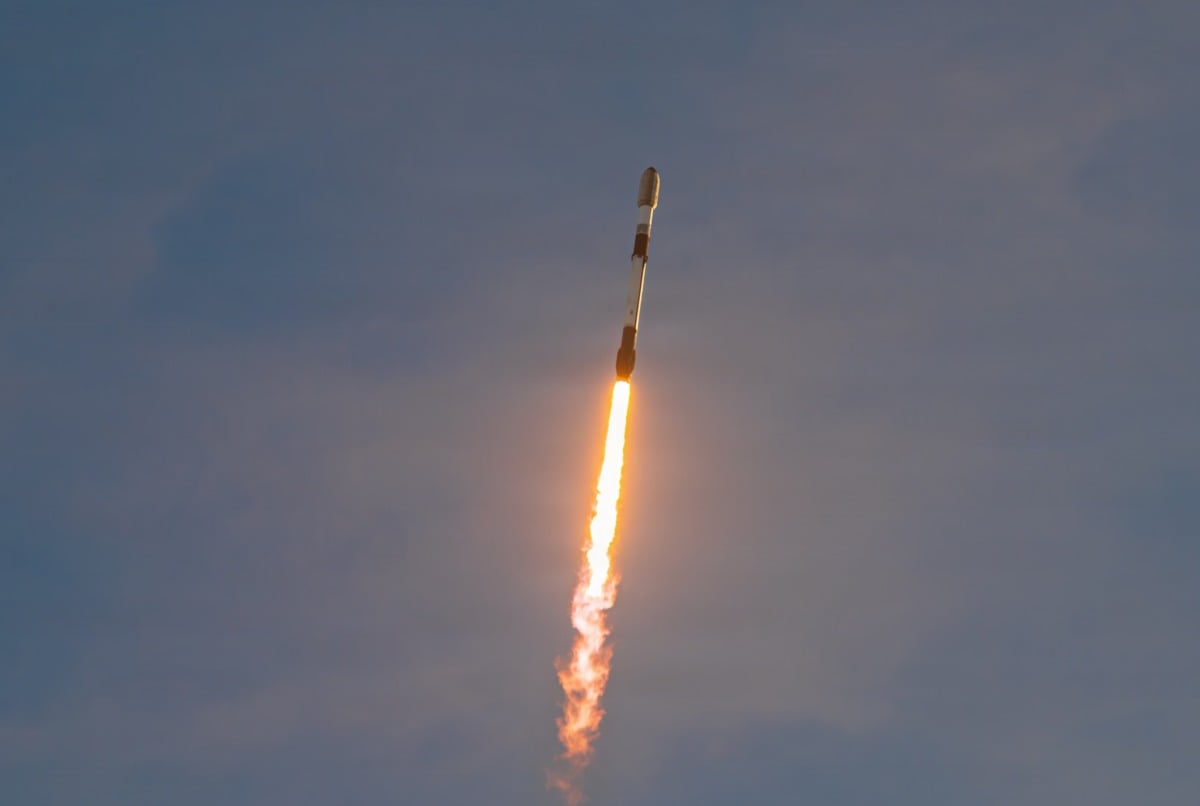
On a chilly September morning in 1977, a small team of engineers stood inside a concrete bunker at the Jet Propulsion Laboratory in Pasadena, California. They were listening to a hum. It was the sound of a 12-foot-wide aluminum dish snapping into place atop a lattice of instruments, bolted to a fuel tank, and hurled into the atmosphere on the back of a Titan IE rocket.
They called it Voyager 1.
The engineers in that room were young, sporting the thick sideburns and wide collars of the era. They drank stale coffee from Styrofoam cups and worried about leaking thruster valves. They hoped the machine would last long enough to reach Saturn. Maybe five years, if they were lucky. Then, the radiation of the gas giants would fry its primitive circuitry, or the cold would freeze its joints, and it would become just another piece of expensive space junk.
They were wrong.
Decades faded away. The engineers grew gray, retired, and were replaced by men and women who hadn't even been born when the rocket ignited. The Styrofoam cups became reusable thermoses. The room grew quieter. And still, against every law of probability and planned obsolescence, the machine kept talking.
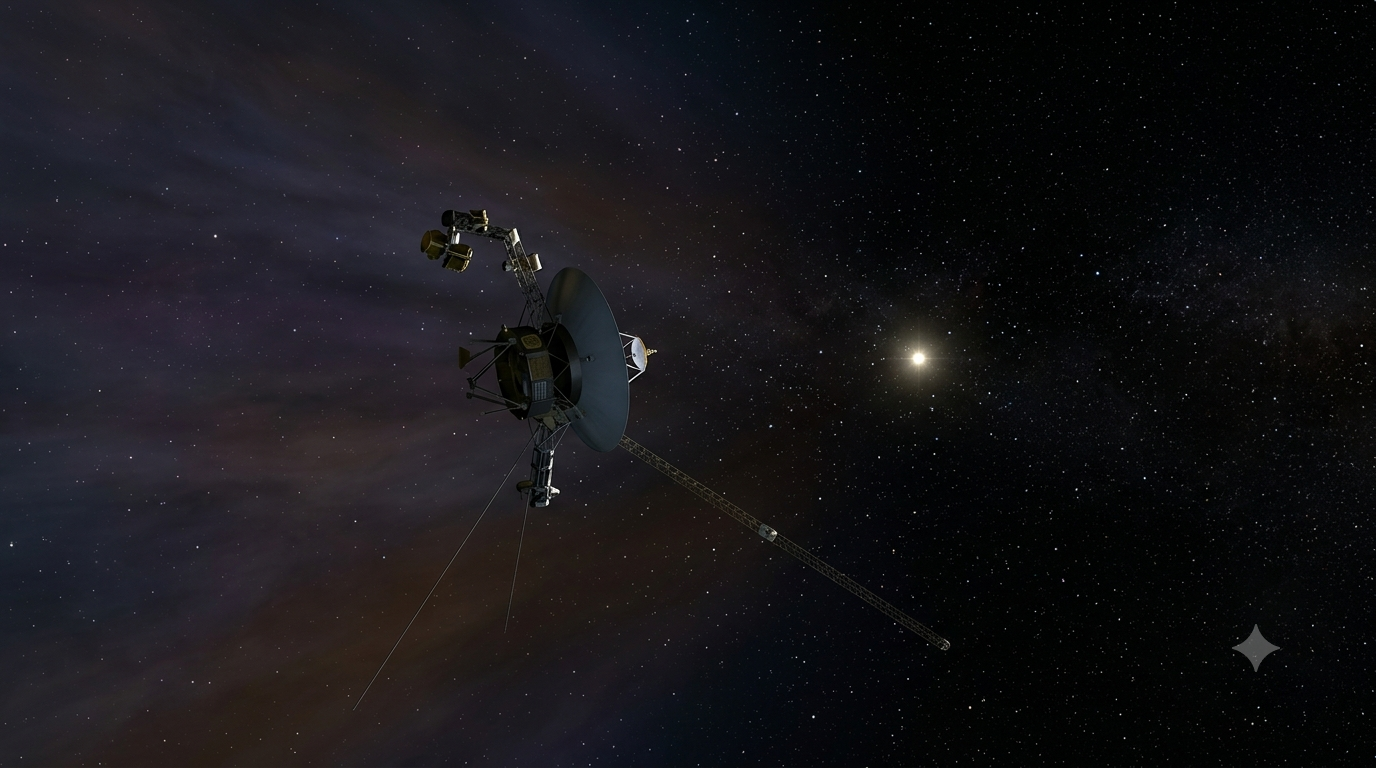
Right now, as you read these words, Voyager 1 is hurtling through the pitch-black void of interstellar space at 38,000 miles per hour. It is more than 15 billion miles away from Earth. If you want to understand that distance, stop thinking in miles and start thinking in the only currency that matters to the cosmos: the speed of light.
Light travels at 186,000 miles per second. It can circle the Earth seven times in a single heartbeat. Yet, if you were to send a radio command to Voyager 1 this morning, your signal would travel through the atmosphere, past the moon, past the frozen deserts of Mars, through the asteroid belt, and past the orbits of the outer giants. It would travel all day. It would travel through the night.
It takes over 22 and a half hours for our voice to reach Voyager 1. And it takes another 22 and a half hours for its reply to whisper back across the void.
Think about the sheer vulnerability of that connection. We live in an era of instant gratification. If a webpage takes four seconds to load, we lose our patience. If a text message stays on "read" for an hour, we feel abandoned. Now imagine waiting nearly two full days just to hear a machine say, I am still here.
The Ghost in the 8-Track Tape
To understand the miracle of this conversation, we have to look at what Voyager actually is. It is not a sleek, modern piece of technology. It is a time capsule built of copper wire, gold leaf, and ideas that belong in a museum.
Imagine your smartphone. It likely has about 8 gigabytes of RAM. Voyager 1 has 69 kilobytes of memory. Your phone can hold hundreds of thousands of times more data than the spacecraft that is currently charting the boundary between our sun and the rest of the galaxy. Voyager's main computer system relies on a digital tape recorder—essentially a ruggedized 8-track player—to store its scientific observations before beaming them home.
When the spacecraft needs to change its orientation or fix a glitch, the engineering team in California cannot just upload a quick software patch. They have to write code using a programming language that has been obsolete for forty years. They have to double-check every line. If they make a single error, if they send a command that accidentally drains the battery or misaligns the antenna by a fraction of a degree, the spacecraft will turn its back on us forever.
The silence would be absolute.
This almost happened recently. The spacecraft began sending back a nonsensical stream of alternating ones and zeros, a digital stutter that lasted for months. It was as if Voyager had developed dementia. The team didn't panic. Instead, they became detectives, combing through yellowed schematics and handwritten notes from engineers who had passed away decades ago. They deduced that a single chip in the flight data subsystem had failed.
They couldn't replace the chip. It was 15 billion miles away. So, they did something bolder: they rewrote the software, broke it into pieces, and tucked those pieces into different, surviving corners of the computer's tiny memory. They sent the command into the dark.
They waited.
Two days later, the Deep Space Network antenna in Madrid caught a faint spike in the noise. The binary gibberish had vanished. In its place was a clean, clear stream of telemetry. The old explorer was sane again.
A Whisper in a Hurricane
How do we even hear it?
The transmitter on Voyager 1 operates on roughly 23 watts of power. That is less than the bulb illuminating the inside of your refrigerator. By the time that 23-watt signal crosses the immense gulf of space and reaches Earth, it has spread out across millions of miles of empty void. It arrives at our planet as an incomprehensibly faint whisper.
To catch it, NASA relies on the Deep Space Network—massive, 70-meter radio dishes stationed in California, Spain, and Australia. These dishes are aimed at a precise point in the sky, listening with an intensity that strains human imagination. The signal they capture is twenty billion times weaker than the battery in a digital wristwatch.
It requires an extraordinary amount of human effort to keep this thread from snapping. It requires a quiet, multi-generational dedication that is rare in our loud, forward-looking world. The people who manage Voyager today are caretakers of a legacy. They are listening to an echo of our own past.
The Dying Campfire
But the clock is ticking.
Voyager 1 does not run on solar panels. At its immense distance, the sun is nothing more than an exceptionally bright star, incapable of warming a solar cell. Instead, the spacecraft is powered by three radioisotope thermoelectric generators—essentially, small nuclear furnaces that convert the heat from decaying plutonium-238 into electricity.
Every year, that plutonium decays a little bit more. Every year, Voyager's power output drops by about four watts.
The mission control team is locked in a slow, agonizing triage. Over the past decade, they have been forced to systematically turn off the spacecraft’s instruments to save power. First went the cameras that captured the iconic "Pale Blue Dot" photograph in 1990. Then went the heaters that kept the remaining sensors warm. The spacecraft is freezing, its hull dropping to temperatures that would shatter ordinary steel.
Yet, its cosmic ray instrument and magnetometer are still humming, tasting the interstellar medium, measuring the particles that fly between the stars, sending us data about a realm no human eye will ever see.
Eventually, the math will win. There will come a day—perhaps next year, perhaps at the turn of the decade—when the power drops below the absolute minimum required to keep the transmitter alive. The final heater will die. The transmitter will go cold.
Voyager 1 will not stop moving. Without the friction of an atmosphere, it will continue its journey through the Milky Way for millions of years. It carries a golden record, a message from humanity containing the sounds of surf, the laughter of children, and music from Bach to Blind Willie Johnson, designed to outlive our civilizations.
But it will be silent.
We will continue to point our massive dishes at the stars, but the 22-hour delay will stretch into infinity. We will listen to the static of the universe, the hiss of dying suns and distant galaxies, waiting for a 23-watt whisper that will never come again.
Until then, the old machine pushes forward through the dark, a tiny spark of human curiosity refusing to go out.