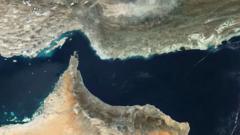
The Strait of Hormuz is not merely a shipping lane; it is the physical manifestation of a single-point-of-failure in the global energy supply chain. At its narrowest point, the shipping channels consist of two two-mile-wide lanes separated by a two-mile buffer zone. Approximately 20% of the world’s liquid petroleum and nearly 25% of its liquefied natural gas (LNG) pass through this 21-mile-wide chokepoint daily. Any disruption here transcends regional geopolitics, triggering an immediate transformation of global energy arbitrage into a crisis of physical scarcity.
The Triple Convergence of Obstruction
A total closure of the Strait relies on three distinct operational layers: physical blockage, kinetic deterrence, and the psychological collapse of the insurance market.
- Physical Obstruction: While the depth of the Strait (approximately 75 to 100 meters) makes it difficult to "block" with scuttled ships in the traditional sense, the deployment of bottom-moored and tethered mines creates a lethal environment for double-hulled Very Large Crude Carriers (VLCCs).
- Kinetic Deterrence: The use of shore-to-ship missile batteries, such as the Noor or Qader systems, combined with swarming tactics from fast attack craft, forces naval escorts into a defensive posture that prioritizes survival over the continuity of commerce.
- The Risk Premium Breach: The moment a "War Risk" designation is applied by Lloyd's Market Association to the entire Persian Gulf, shipping rates do not merely rise—they become mathematically prohibitive. If P&I clubs (Protection and Indemnity) withdraw coverage, the flow of oil stops because no rational sovereign entity or private corporation will risk a $200 million hull and $100 million in cargo without indemnity.
The Inventory Buffer Fallacy
Common analysis suggests that Global Strategic Petroleum Reserves (SPR) provide a sufficient cushion against a Hormuz closure. This view ignores the "Refinery Configuration Constraint." Crude oil is not a homogenous commodity; it is categorized by API gravity and sulfur content.
The Gulf exports primarily "Medium Sour" crude. Most high-complexity refineries in Asia—specifically in China, India, and South Korea—are calibrated to process this specific chemical profile. While the U.S. or other IEA members may release light, sweet crude from their reserves, this does not solve the fundamental mismatch in refinery feedstock. A sudden shift in crude quality results in:
- Lowered Throughput: Refineries must slow down to handle different sulfur levels, reducing the total output of gasoline and diesel.
- Secondary Shortages: The lack of specific byproducts impacts the petrochemical industry, affecting everything from plastics to fertilizers.
The global economy operates on "just-in-time" energy. Commercial inventories typically hold 60 to 90 days of supply, but the logistical lag of rerouting tankers and recalibrating refineries means the price shock hits the pumps within 72 hours of the first kinetic event.
Alternative Route Elasticity and Failures
The belief that pipelines offer a viable workaround is geographically and technically flawed. Currently, only two major bypass routes exist, and neither possesses the capacity to offset a total closure.
- The East-West Pipeline (Saudi Arabia): Spanning from the Abqaiq processing facility to the Red Sea port of Yanbu, this line has a nameplate capacity of roughly 5 million barrels per day (mb/d). However, sustained operations at peak capacity often meet technical bottlenecks at pumping stations.
- The Abu Dhabi Crude Oil Pipeline (ADCOP): Connecting the Habshan fields to Fujairah, this route bypasses the Strait but caps out at 1.5 mb/d.
Even if these pipelines operate at 100% efficiency, they account for less than 40% of the usual volume flowing through the Strait. The remaining 12 to 15 million barrels per day would be effectively trapped. Furthermore, these pipelines terminate in the Red Sea and the Gulf of Oman, both of which remain within the operational reach of the same regional tensions that would close the Strait in the first place.
The Liquefied Natural Gas (LNG) Deadlock
Oil can be diverted or stored with relative ease compared to Natural Gas. Qatar is the world's leading exporter of LNG, and 100% of its maritime exports must pass through the Strait of Hormuz.
Unlike the oil market, where a "shadow fleet" of older tankers often operates outside traditional oversight, the LNG fleet is highly specialized and technologically sensitive. There is no alternative pipeline for Qatari gas that reaches major markets in Europe or Asia. A closure of the Strait creates an immediate, absolute vacuum in the global gas market. For nations like Japan and South Korea, which rely on LNG for a significant portion of their base-load power generation, a Hormuz closure isn't just an economic hit—it is a threat to the integrity of their national power grids.
The Cost Function of Re-Opening
The military effort required to clear the Strait—referred to as "Mine Countermeasures" (MCM)—is a slow, methodical process that cannot be rushed by political urgency.
- The Snail's Pace of Detection: Mine hunting involves sonar scanning and underwater drone deployment. A single mine-like object can take hours to identify and neutralize.
- The Vulnerability of the Sweepers: MCM vessels are typically slow and lightly armed. They cannot operate in a contested environment. Therefore, before the Strait can be cleared, the "Bubble of Denial" (shore-based missiles and air defenses) must be dismantled.
- The Insurance Lag: Even after the military declares the waters "clear," the shipping industry requires a period of "zero-incident" proof before insurers recalibrate premiums. This creates a "shadow closure" that persists for weeks after the physical threat is neutralized.
Strategic Realignment of Global Trade
A disruption of this magnitude triggers a permanent shift in how sovereign states view energy security. We can identify the following structural transitions that would occur in the aftermath:
- The Death of Just-In-Time Energy: Corporations and states will move toward a "Just-In-Case" model, permanently increasing the baseline cost of energy due to higher storage and carry costs.
- Accelerated Bipolarization: Resource-poor nations will be forced to choose between competing security umbrellas (e.g., U.S.-led maritime security vs. regional Chinese-backed diplomacy) to guarantee their specific supply lines.
- Internal Combustion Obsolescence: The volatility risk associated with the Strait of Hormuz acts as a massive, unplanned subsidy for electric vehicle (EV) infrastructure and nuclear power. Governments will prioritize "de-bottlenecking" their energy needs from maritime chokepoints.
The immediate strategic priority for any entity exposed to this risk is the diversification of the "Crude Slate." Refineries must be retrofitted to handle a wider variance of API gravities, and strategic reserves must be shifted from raw crude to refined product, which can be deployed into the economy with zero processing lag. Relying on the reopening of the Strait as a primary strategy is a failure of risk management; the only viable defense is a logistical architecture that assumes the Strait is already closed.


