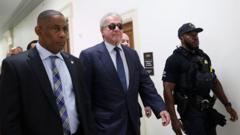
You don't usually see a Wall Street billionaire get hit with two congressional subpoenas while sitting inside a closed-door hearing room. But that's exactly what went down on Capitol Hill when Apollo Global Management co-founder Leon Black showed up for what was supposed to be a voluntary interview.
Instead of putting a lingering scandal to bed, the private equity titan managed to turn a quiet Friday morning session into an absolute train wreck.
The House Oversight Committee has been digging into the money trail surrounding Jeffrey Epstein for over a year. They want to know how a convicted sex offender managed to stay embedded with the global elite for so long. Black was supposed to be a star witness. Instead, he stonewalled lawmakers so aggressively on the subject of nondisclosure agreements (NDAs) that Chairman James Comer issued the subpoenas right then and there. Black basically checked out, the interview ended abruptly, and now he is facing a high-stakes, videotaped deposition under oath on July 16.
Here is what really happened behind closed doors, why the government is obsessed with Black's NDAs, and what this tells us about the crumbling wall of secrecy surrounding the Epstein network.
The Secret NDAs Taking Center Stage
When Black walked into that room, he came armed with a prepared statement trying to frame his relationship with Epstein as purely professional. He tried the classic defense: "I knew Jekyll. I didn't know Hyde." He claimed he was totally blind to Epstein's criminal behavior until the federal indictment dropped in 2019.
But things went sideways the second lawmakers started pressing him on personal nondisclosure agreements he signed with several women.
According to committee members from both sides of the aisle, Black outright refused to talk about them. That was a massive tactical error. If you refuse to answer questions during a "voluntary" congressional inquiry, you lose all leverage.
Oregon Senator Ron Wyden recently pointed out that newly released Department of Justice records suggest Epstein may have acted as a "fixer" for Black. The theory being investigated is whether Epstein helped coordinate or fund silence from women on Black's behalf.
Lawmakers want answers to specific, ugly questions:
- Was Epstein directly involved in drafting these NDAs?
- Did Epstein help route the money used to pay off these women?
- Why did a private equity genius need a sex offender to handle his personal damage control?
Black's legal team, led by Susan Estrich, quickly shot back, calling the subpoenas a "planned political stunt" and insisting Epstein had zero involvement with any NDAs. But the committee isn't backing down. They ordered Black to hand over the actual documents.
The Ridiculous $158 Million Math Problem
Even if you look past the NDAs, the sheer volume of money Black paid Epstein makes absolutely no sense.
During his opening remarks, Black confirmed he paid Epstein a staggering $158 million between 2012 and 2017. Let's put that in perspective. This massive wealth transfer happened after Epstein's 2008 conviction in Florida for soliciting prostitution from a minor. Black admitted he knew about the plea deal but shrugged it off at the time as an "isolated incident" because the sentence was lenient.
Black claims the $158 million was strictly for "bona fide tax, estate planning and other related services." He told the committee that Epstein solved a massive estate problem that no other lawyer or accountant could crack.
But there's a huge catch. Black now claims he was totally scammed on the price tag. In his testimony, he stated he actually believed he was paying around $95 million over five years, but it turned out to be $158 million because Epstein "exaggerated, embellished, manipulated, and outright lied" about the fees.
Think about that for a second. You are a legendary private equity manager, a guy who built a $600 billion empire by scrutinizing every single decimal point on a balance sheet. Yet you accidentally overpaid your tax guy by $63 million?
It doesn't pass the smell test. Senator Wyden noted that Black has yet to provide any credible explanation for why his fees to Epstein vastly exceeded what any normal, highly sophisticated professional firm would charge for the exact same estate planning.
The Collateral Damage of Staying Loyal
This isn't just about bad optics anymore. The fallout has already cost Black his crown at Apollo, forcing him to step down as CEO in 2021. It also cost him cold, hard cash. In 2023, he quietly paid a $62.5 million settlement to the U.S. Virgin Islands to resolve a civil investigation into his ties to Epstein.
In that settlement, Black had to acknowledge a brutal fact: Epstein used some of Black's money to partially fund his operations in the Virgin Islands—the exact location where young women and girls were trafficked and abused.
During the hearing, Black tried to spread the blame around, dropping names like Elon Musk, Sergey Brin, and Peter Thiel as people who were also part of Epstein's elite rolodex. He expressed deep regret, lamenting the "toxic environment" the scandal has created for his family.
But sympathy is in short supply on Capitol Hill right now. Lawmakers are treating Black as the ultimate gatekeeper to understanding how Epstein's financial engine operated.
What Happens Next
If you are tracking this case, forget the press releases. The real action happens over the next three weeks. Black's team can call this a political circus all they want, but a federal subpoena isn't optional. He has two immediate legal obligations that will reshape this entire investigation.
First, Black has to turn over the text and terms of those nondisclosure agreements. If those documents show any digital or financial fingerprints belonging to Epstein, Black's "Jekyll and Hyde" defense completely falls apart.
Second, he has to sit for that recorded deposition on July 16. There won't be any walking out this time. He will be under oath, meaning any evasion, half-truths, or refusal to answer can be treated as perjury or contempt of Congress. Watch the timeline closely—this investigation just shifted into high gear.